QUESTION IMAGE
Question
Question was provided via image upload.
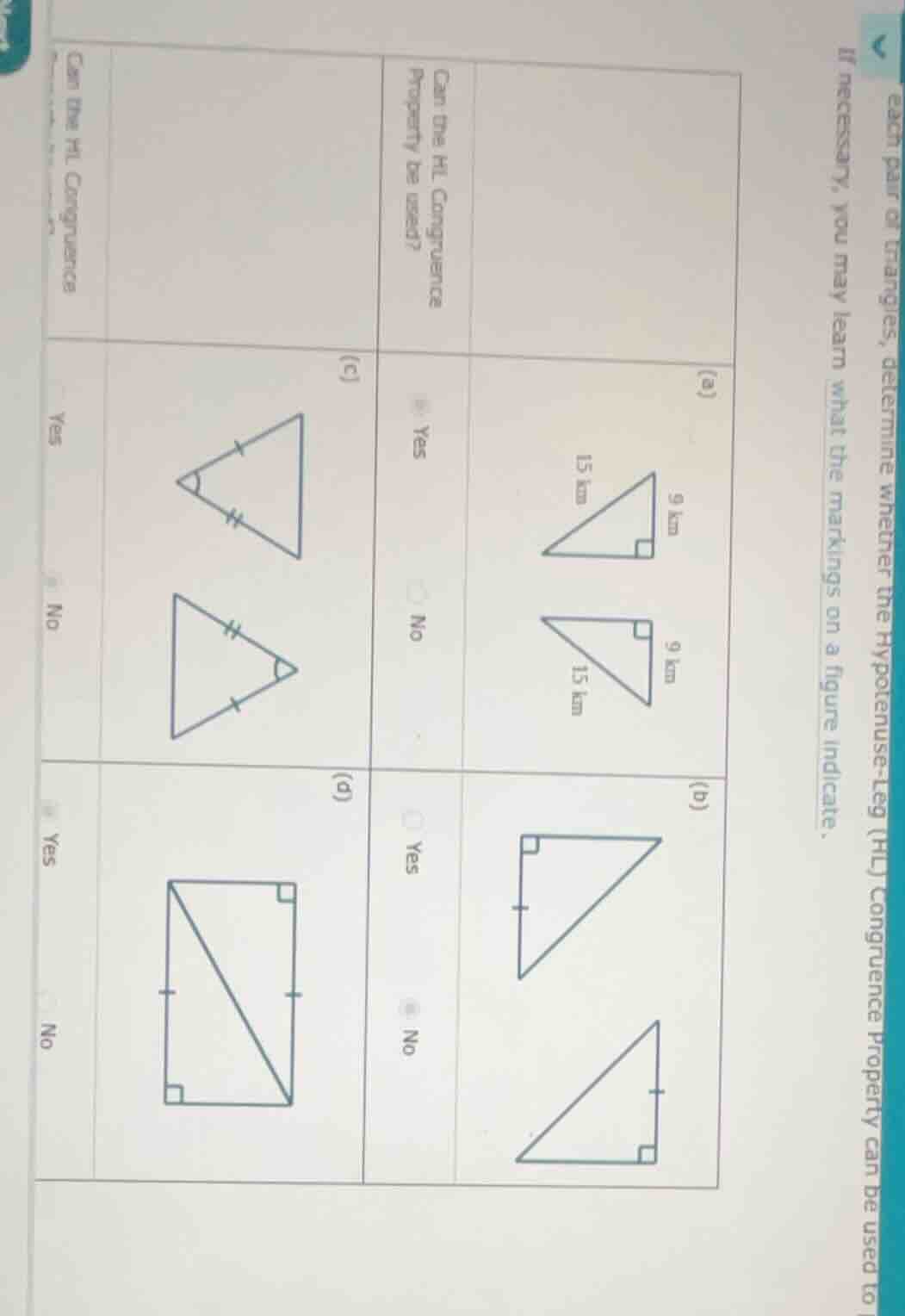
To determine if the HL (Hypotenuse - Leg) Congruence Property can be used, we recall that the HL Congruence Theorem states that if the hypotenuse and one leg of a right triangle are congruent to the hypotenuse and one leg of another right triangle, then the two right triangles are congruent. Let's analyze each part:
Part (a)
- We have two right - angled triangles. One leg of each triangle is \(9\) km, and the hypotenuse of each triangle is \(15\) km.
- For right - angled triangles, we can apply the HL Congruence Theorem here because we have a right angle (given by the right - angle symbol), a pair of congruent legs (\(9\) km) and a pair of congruent hypotenuses (\(15\) km). So the answer for part (a) is Yes.
Part (b)
- We have two right - angled triangles. But the marked legs are not the corresponding legs (the markings are on different sides of the right angle in a way that we don't have a pair of congruent legs and a pair of congruent hypotenuses in the HL sense).
- The HL Theorem requires a specific leg (one of the non - hypotenuse sides) and the hypotenuse to be congruent between the two triangles. Here, the marked sides do not represent a leg - hypotenuse correspondence. So the answer for part (b) is No.
Part (c)
- The triangles in part (c) are not right - angled triangles (there is no right - angle symbol). The HL Congruence Theorem applies only to right - angled triangles.
- Since these are not right - angled triangles, we cannot use the HL Congruence Property. So the answer for part (c) is No.
Part (d)
- We have a rectangle, and the two triangles formed by the diagonal of the rectangle are right - angled triangles (because all angles in a rectangle are right angles). The diagonal is the hypotenuse for both triangles, and the opposite sides of the rectangle are equal, so the legs of the right - angled triangles (the sides of the rectangle) are congruent.
- For the two right - angled triangles (formed by the diagonal of the rectangle), the hypotenuse (the diagonal) is common (congruent) and one leg (a side of the rectangle) is congruent. By the HL Congruence Theorem, we can say that the two right - angled triangles are congruent using HL. So the answer for part (d) is Yes.
Final Answers
- (a): Yes
- (b): No
- (c): No
- (d): Yes

Snap & solve any problem in the app
Get step-by-step solutions on Sovi AI
Photo-based solutions with guided steps
Explore more problems and detailed explanations
To determine if the HL (Hypotenuse - Leg) Congruence Property can be used, we recall that the HL Congruence Theorem states that if the hypotenuse and one leg of a right triangle are congruent to the hypotenuse and one leg of another right triangle, then the two right triangles are congruent. Let's analyze each part:
Part (a)
- We have two right - angled triangles. One leg of each triangle is \(9\) km, and the hypotenuse of each triangle is \(15\) km.
- For right - angled triangles, we can apply the HL Congruence Theorem here because we have a right angle (given by the right - angle symbol), a pair of congruent legs (\(9\) km) and a pair of congruent hypotenuses (\(15\) km). So the answer for part (a) is Yes.
Part (b)
- We have two right - angled triangles. But the marked legs are not the corresponding legs (the markings are on different sides of the right angle in a way that we don't have a pair of congruent legs and a pair of congruent hypotenuses in the HL sense).
- The HL Theorem requires a specific leg (one of the non - hypotenuse sides) and the hypotenuse to be congruent between the two triangles. Here, the marked sides do not represent a leg - hypotenuse correspondence. So the answer for part (b) is No.
Part (c)
- The triangles in part (c) are not right - angled triangles (there is no right - angle symbol). The HL Congruence Theorem applies only to right - angled triangles.
- Since these are not right - angled triangles, we cannot use the HL Congruence Property. So the answer for part (c) is No.
Part (d)
- We have a rectangle, and the two triangles formed by the diagonal of the rectangle are right - angled triangles (because all angles in a rectangle are right angles). The diagonal is the hypotenuse for both triangles, and the opposite sides of the rectangle are equal, so the legs of the right - angled triangles (the sides of the rectangle) are congruent.
- For the two right - angled triangles (formed by the diagonal of the rectangle), the hypotenuse (the diagonal) is common (congruent) and one leg (a side of the rectangle) is congruent. By the HL Congruence Theorem, we can say that the two right - angled triangles are congruent using HL. So the answer for part (d) is Yes.
Final Answers
- (a): Yes
- (b): No
- (c): No
- (d): Yes