QUESTION IMAGE
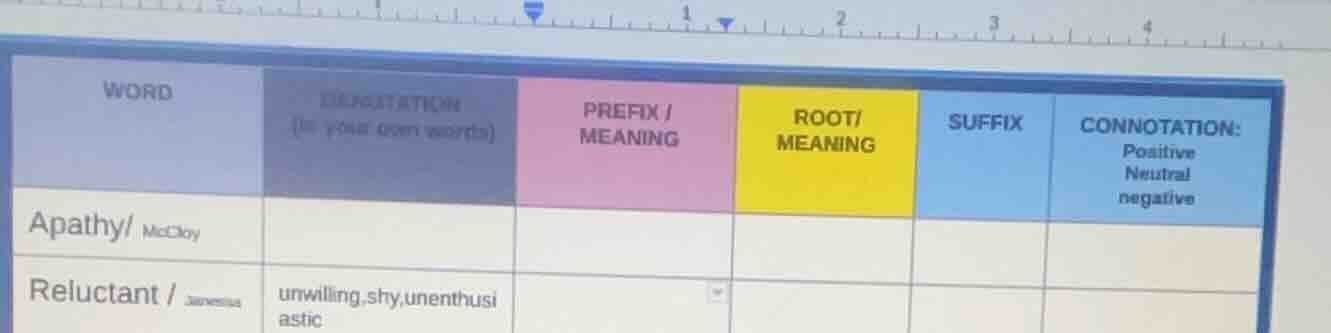
Question
Question was provided via image upload.
To solve the analysis of the word "Apathy" (and "Reluctant" as a reference), we use etymology (subfield of Arts) to break down the word and analyze its connotation:
For "Apathy":
Step 1: Denotation (Definition)
Apathy means a lack of interest, enthusiasm, or concern. In one's own words: "No interest or concern about something."
Step 2: Prefix / Meaning
The prefix "a - " (from Greek "a - " or "an - ") means "without" or "not".
Step 3: Root / Meaning
The root "path - " (from Greek "pathos") means "feeling" or "emotion". So combining the prefix and root: "without feeling/emotion".
Step 4: Suffix
The suffix is " - y", which in this case forms a noun from the root, indicating a state or condition (e.g., "apathy" is the state of being without feeling).
Step 5: Connotation
Apathy generally has a negative connotation because it implies indifference or a lack of caring, which is often seen as a negative trait (e.g., "public apathy towards social issues" is a negative situation as it hinders progress or change).
For "Reluctant" (as a reference for the table structure):
Step 1: Denotation (Given: "unwilling, shy, unenthusiastic")
Step 2: Prefix / Meaning
The prefix "re - " (from Latin) can mean "back" or "against" (in the sense of holding back from an action).
Step 3: Root / Meaning
The root "luct - " (from Latin "luctari") means "to struggle" or "to fight". So "reluctant" relates to struggling against doing something (hence unwilling).
Step 4: Suffix
The suffix " - ant" (from Latin) forms an adjective, meaning "characterized by" (so "reluctant" is characterized by reluctance/struggling against an action).
Step 5: Connotation
"Reluctant" can have a neutral to slightly negative connotation. It is neutral when describing a mild unwillingness (e.g., "I'm reluctant to go, but I will"), but can be negative if it implies stubbornness (e.g., "He was reluctant to help, showing selfishness").
Filling the Table for "Apathy":
| WORD | DENOTATION (in your own words) | PREFIX / MEANING | ROOT / MEANING | SUFFIX | CONNOTATION: Positive/Neutral/Negative |
|---|---|---|---|---|---|
| Reluctant | unwilling, shy, unenthusiastic | re - : against/back | luct - : struggle/fight | -ant | Neutral (or slightly Negative) |
Final Answer (Table for "Apathy" filled):
For "Apathy":
- Denotation: No interest or concern about something.
- Prefix / Meaning: a - : without
- Root / Meaning: path - : feeling/emotion
- Suffix: -y (state of being)
- Connotation: Negative
For "Reluctant" (as a guide for the table):
- Denotation: unwilling, shy, unenthusiastic (given)
- Prefix / Meaning: re - : against/back
- Root / Meaning: luct - : struggle/fight
- Suffix: -ant (adjective form)
- Connotation: Neutral (or slightly Negative)

Snap & solve any problem in the app
Get step-by-step solutions on Sovi AI
Photo-based solutions with guided steps
Explore more problems and detailed explanations
To solve the analysis of the word "Apathy" (and "Reluctant" as a reference), we use etymology (subfield of Arts) to break down the word and analyze its connotation:
For "Apathy":
Step 1: Denotation (Definition)
Apathy means a lack of interest, enthusiasm, or concern. In one's own words: "No interest or concern about something."
Step 2: Prefix / Meaning
The prefix "a - " (from Greek "a - " or "an - ") means "without" or "not".
Step 3: Root / Meaning
The root "path - " (from Greek "pathos") means "feeling" or "emotion". So combining the prefix and root: "without feeling/emotion".
Step 4: Suffix
The suffix is " - y", which in this case forms a noun from the root, indicating a state or condition (e.g., "apathy" is the state of being without feeling).
Step 5: Connotation
Apathy generally has a negative connotation because it implies indifference or a lack of caring, which is often seen as a negative trait (e.g., "public apathy towards social issues" is a negative situation as it hinders progress or change).
For "Reluctant" (as a reference for the table structure):
Step 1: Denotation (Given: "unwilling, shy, unenthusiastic")
Step 2: Prefix / Meaning
The prefix "re - " (from Latin) can mean "back" or "against" (in the sense of holding back from an action).
Step 3: Root / Meaning
The root "luct - " (from Latin "luctari") means "to struggle" or "to fight". So "reluctant" relates to struggling against doing something (hence unwilling).
Step 4: Suffix
The suffix " - ant" (from Latin) forms an adjective, meaning "characterized by" (so "reluctant" is characterized by reluctance/struggling against an action).
Step 5: Connotation
"Reluctant" can have a neutral to slightly negative connotation. It is neutral when describing a mild unwillingness (e.g., "I'm reluctant to go, but I will"), but can be negative if it implies stubbornness (e.g., "He was reluctant to help, showing selfishness").
Filling the Table for "Apathy":
| WORD | DENOTATION (in your own words) | PREFIX / MEANING | ROOT / MEANING | SUFFIX | CONNOTATION: Positive/Neutral/Negative |
|---|---|---|---|---|---|
| Reluctant | unwilling, shy, unenthusiastic | re - : against/back | luct - : struggle/fight | -ant | Neutral (or slightly Negative) |
Final Answer (Table for "Apathy" filled):
For "Apathy":
- Denotation: No interest or concern about something.
- Prefix / Meaning: a - : without
- Root / Meaning: path - : feeling/emotion
- Suffix: -y (state of being)
- Connotation: Negative
For "Reluctant" (as a guide for the table):
- Denotation: unwilling, shy, unenthusiastic (given)
- Prefix / Meaning: re - : against/back
- Root / Meaning: luct - : struggle/fight
- Suffix: -ant (adjective form)
- Connotation: Neutral (or slightly Negative)