QUESTION IMAGE
Question
Question was provided via image upload.
Response
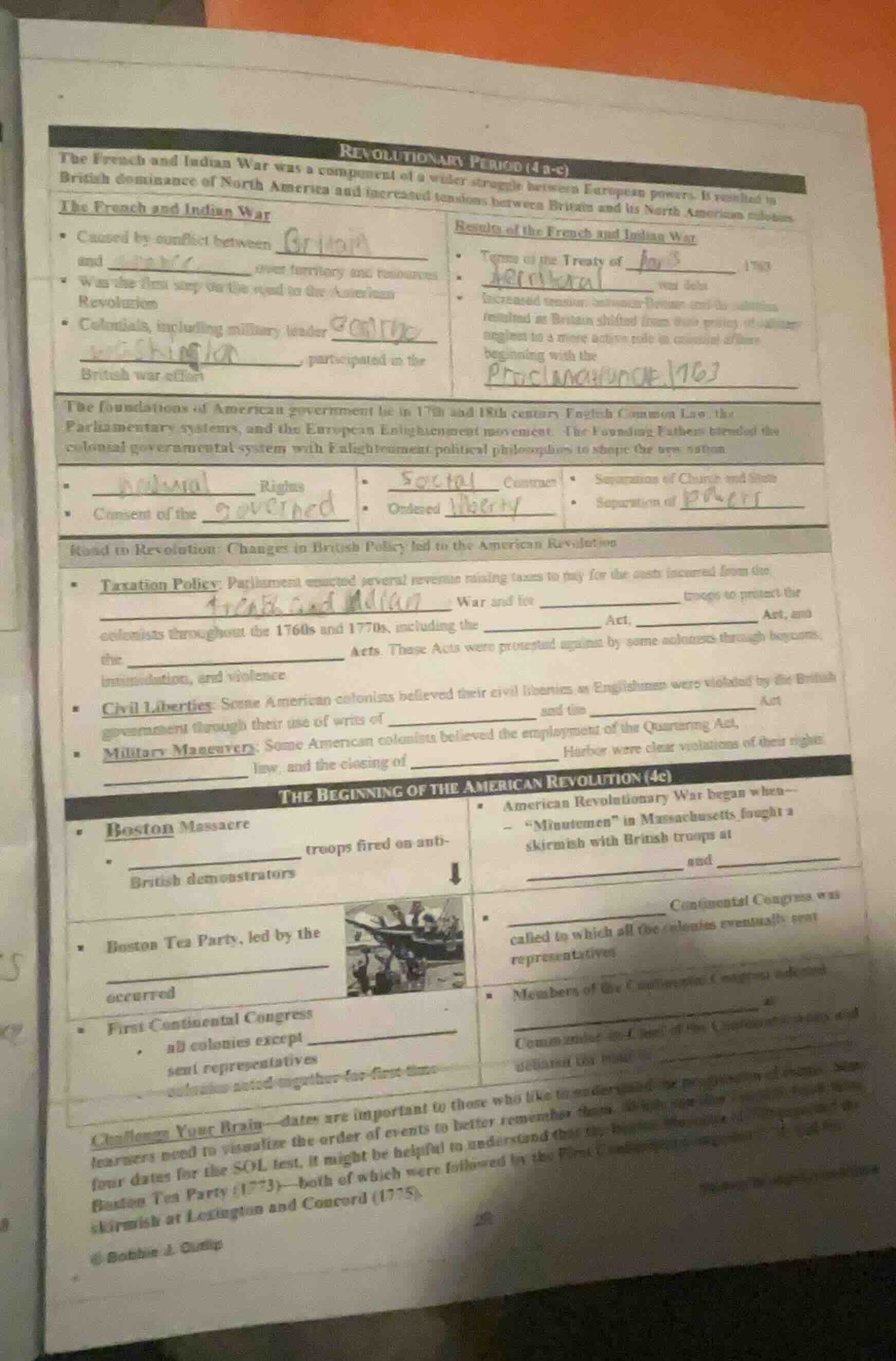
To answer the fill - in - the - blanks related to the American Revolutionary Period, we use historical knowledge:
The French and Indian War section
- Caused by conflict between: The French and Indian War was a conflict between Britain and France over territory and resources in North America. So we fill in "Britain" and "France".
- Colonials, including military leader: George Washington was a colonial military leader who participated in the British war effort during the French and Indian War. So we fill in "George Washington".
Results of the French and Indian War section
- Treaty of: The war ended with the Treaty of Paris in 1763. So we fill in "Paris".
- and debt: The war left Britain with a large amount of debt. So we fill in "Britain".
- beginning with the: After the war, the Proclamation of 1763 was one of the first British policies that increased tensions with the colonies. So we fill in "Proclamation of 1763".
Foundations of American government section
- Rights: We have "Natural" Rights (based on Enlightenment ideas about natural rights).
- Consent of the: It is the "governed" (from the idea of social contract, where government exists with the consent of the governed).
- Common: "English" Common Law was a foundation of American government.
- Ordered: "Liberty" (the idea of ordered liberty, balancing liberty and order).
- Separation of: "Powers" (the separation of powers in government, a key Enlightenment - inspired idea).
Road to Revolution - Taxation Policy section
- War and for: The taxes were to pay for the French and Indian War and for British troops to protect the colonists. So we fill in "French and Indian" and "British".
- including the...Acts: Some of the notable tax acts were the Stamp Act, the Townshend Act, and the Intolerable (Coercive) Acts. So we fill in "Stamp", "Townshend", and "Intolerable (Coercive)".
Civil Liberties section
- writs of and Act: The British used writs of assistance and the Quartering Act (among others) which colonists saw as violations of their civil liberties. So we fill in "assistance" and "Quartering".
Military Maneuvers section
- law, and the closing of...Harbor: The Quartering Act, martial law, and the closing of Boston Harbor (after the Boston Tea Party) were seen as violations. So we fill in "martial" and "Boston".
Boston Massacre section
- troops fired on anti - British demonstrators: British troops fired on anti - British demonstrators during the Boston Massacre. So we fill in "British".
The Beginning of the American Revolution section
- skirmish with British troops at: The American Revolutionary War began with the skirmish at Lexington and Concord. So we fill in "Lexington" and "Concord".
- Boston Tea Party, led by the: The Boston Tea Party was led by the Sons of Liberty. So we fill in "Sons of Liberty".
- First Continental Congress - all colonies except: All colonies except Georgia sent representatives to the First Continental Congress. So we fill in "Georgia".
- Continental Congress was called: The First Continental Congress was called, and later the Second Continental Congress was also important, but for the first, we fill in "First".
Final Answers (selected key blanks as examples)
- Caused by conflict between: $\boldsymbol{\text{Britain}}$ and $\boldsymbol{\text{France}}$
- Colonial military leader: $\boldsymbol{\text{George Washington}}$
- Treaty of: $\boldsymbol{\text{Paris}}$
- beginning with the: $\boldsymbol{\text{Proclamation of 1763}}$
- Rights: $\bold…

Snap & solve any problem in the app
Get step-by-step solutions on Sovi AI
Photo-based solutions with guided steps
Explore more problems and detailed explanations
To answer the fill - in - the - blanks related to the American Revolutionary Period, we use historical knowledge:
The French and Indian War section
- Caused by conflict between: The French and Indian War was a conflict between Britain and France over territory and resources in North America. So we fill in "Britain" and "France".
- Colonials, including military leader: George Washington was a colonial military leader who participated in the British war effort during the French and Indian War. So we fill in "George Washington".
Results of the French and Indian War section
- Treaty of: The war ended with the Treaty of Paris in 1763. So we fill in "Paris".
- and debt: The war left Britain with a large amount of debt. So we fill in "Britain".
- beginning with the: After the war, the Proclamation of 1763 was one of the first British policies that increased tensions with the colonies. So we fill in "Proclamation of 1763".
Foundations of American government section
- Rights: We have "Natural" Rights (based on Enlightenment ideas about natural rights).
- Consent of the: It is the "governed" (from the idea of social contract, where government exists with the consent of the governed).
- Common: "English" Common Law was a foundation of American government.
- Ordered: "Liberty" (the idea of ordered liberty, balancing liberty and order).
- Separation of: "Powers" (the separation of powers in government, a key Enlightenment - inspired idea).
Road to Revolution - Taxation Policy section
- War and for: The taxes were to pay for the French and Indian War and for British troops to protect the colonists. So we fill in "French and Indian" and "British".
- including the...Acts: Some of the notable tax acts were the Stamp Act, the Townshend Act, and the Intolerable (Coercive) Acts. So we fill in "Stamp", "Townshend", and "Intolerable (Coercive)".
Civil Liberties section
- writs of and Act: The British used writs of assistance and the Quartering Act (among others) which colonists saw as violations of their civil liberties. So we fill in "assistance" and "Quartering".
Military Maneuvers section
- law, and the closing of...Harbor: The Quartering Act, martial law, and the closing of Boston Harbor (after the Boston Tea Party) were seen as violations. So we fill in "martial" and "Boston".
Boston Massacre section
- troops fired on anti - British demonstrators: British troops fired on anti - British demonstrators during the Boston Massacre. So we fill in "British".
The Beginning of the American Revolution section
- skirmish with British troops at: The American Revolutionary War began with the skirmish at Lexington and Concord. So we fill in "Lexington" and "Concord".
- Boston Tea Party, led by the: The Boston Tea Party was led by the Sons of Liberty. So we fill in "Sons of Liberty".
- First Continental Congress - all colonies except: All colonies except Georgia sent representatives to the First Continental Congress. So we fill in "Georgia".
- Continental Congress was called: The First Continental Congress was called, and later the Second Continental Congress was also important, but for the first, we fill in "First".
Final Answers (selected key blanks as examples)
- Caused by conflict between: $\boldsymbol{\text{Britain}}$ and $\boldsymbol{\text{France}}$
- Colonial military leader: $\boldsymbol{\text{George Washington}}$
- Treaty of: $\boldsymbol{\text{Paris}}$
- beginning with the: $\boldsymbol{\text{Proclamation of 1763}}$
- Rights: $\boldsymbol{\text{Natural}}$
- Consent of the: $\boldsymbol{\text{governed}}$
- Common: $\boldsymbol{\text{English}}$
- Ordered: $\boldsymbol{\text{Liberty}}$
- Separation of: $\boldsymbol{\text{Powers}}$
- War (in Taxation Policy): $\boldsymbol{\text{French and Indian}}$
- troops (in Taxation Policy): $\boldsymbol{\text{British}}$
- Tax acts: $\boldsymbol{\text{Stamp}}$, $\boldsymbol{\text{Townshend}}$, $\boldsymbol{\text{Intolerable (Coercive)}}$
- writs of: $\boldsymbol{\text{assistance}}$
- Act (Civil Liberties): $\boldsymbol{\text{Quartering}}$
- law (Military Maneuvers): $\boldsymbol{\text{martial}}$
- Harbor (Military Maneuvers): $\boldsymbol{\text{Boston}}$
- troops (Boston Massacre): $\boldsymbol{\text{British}}$
- skirmish at: $\boldsymbol{\text{Lexington}}$ and $\boldsymbol{\text{Concord}}$
- Boston Tea Party led by: $\boldsymbol{\text{Sons of Liberty}}$
- First Continental Congress - all colonies except: $\boldsymbol{\text{Georgia}}$
- Continental Congress called: $\boldsymbol{\text{First}}$