QUESTION IMAGE
Question
Question was provided via image upload.
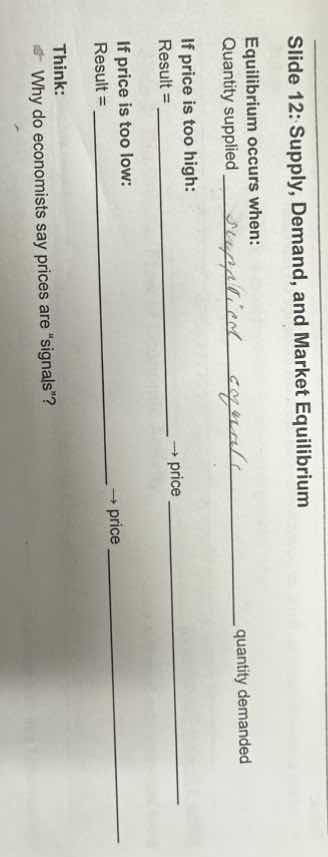
- Market equilibrium is defined as the point where the quantity of a good that producers want to sell equals the quantity consumers want to buy.
- When the market price is above the equilibrium level, the quantity supplied will exceed quantity demanded, creating a surplus. This surplus puts downward pressure on the price as sellers compete to sell excess goods.
- When the market price is below the equilibrium level, the quantity demanded will exceed quantity supplied, creating a shortage. This shortage puts upward pressure on the price as buyers compete for limited goods.
- Prices act as signals because they communicate information about scarcity and consumer/producer preferences, automatically adjusting to balance supply and demand.

Snap & solve any problem in the app
Get step-by-step solutions on Sovi AI
Photo-based solutions with guided steps
Explore more problems and detailed explanations
Equilibrium occurs when:
Quantity supplied $\boldsymbol{equals}$ quantity demanded
If price is too high:
Result = $\boldsymbol{Surplus\ (quantity\ supplied > quantity\ demanded)}$ $
ightarrow$ price $\boldsymbol{decreases}$
If price is too low:
Result = $\boldsymbol{Shortage\ (quantity\ demanded > quantity\ supplied)}$ $
ightarrow$ price $\boldsymbol{increases}$
Think:
Why do economists say prices are "signals"?
Prices signal information about the relative scarcity of a good. A rising price signals a shortage (high demand/low supply), encouraging more production and less consumption. A falling price signals a surplus (low demand/high supply), encouraging less production and more consumption, helping the market automatically adjust toward equilibrium.