QUESTION IMAGE
Question
Question was provided via image upload.
Part 1: Identifying Variables
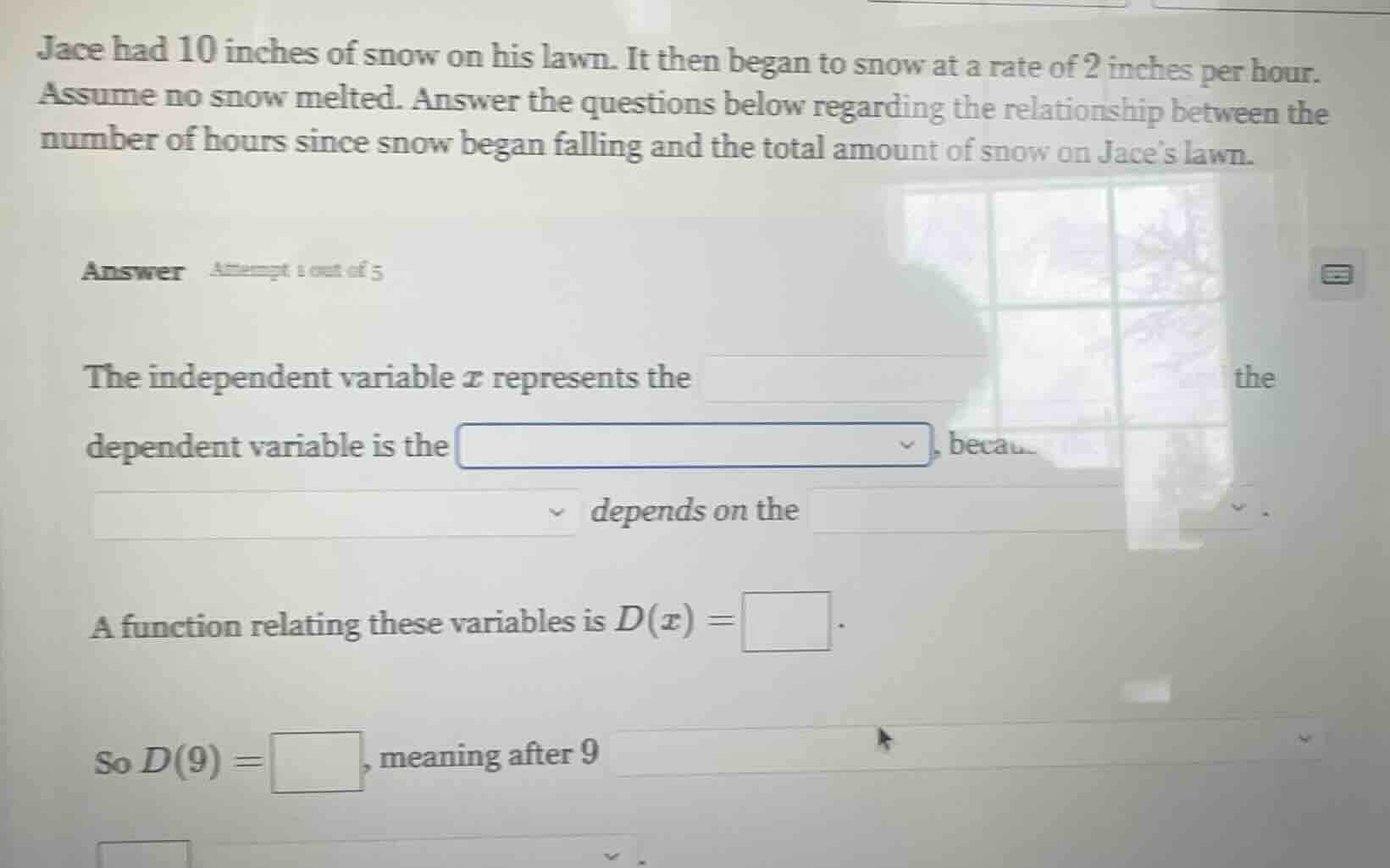
- The independent variable \( x \) represents the number of hours since snow began falling (because it's the variable we can control or that changes independently).
- The dependent variable is the total amount of snow on the lawn (because the amount of snow depends on how many hours it has been snowing).
Part 2: Function Definition
Step 1: Determine the initial amount and rate
The initial amount of snow is 10 inches, and the rate of snowfall is 2 inches per hour. The total amount of snow \( D(x) \) (in inches) after \( x \) hours is the initial amount plus the amount of snow that falls in \( x \) hours. The amount of snow that falls in \( x \) hours is \( 2x \) (since it's 2 inches per hour for \( x \) hours).
So the function is \( D(x)=10 + 2x \).
Step 3: Calculate \( D(9) \)
To find \( D(9) \), we substitute \( x = 9 \) into the function \( D(x)=10+2x \).
\( D(9)=10 + 2\times9 \)
First, calculate \( 2\times9 = 18 \).
Then, \( 10+18 = 28 \).
Final Answers:
- Independent variable \( x \): number of hours since snow began falling
- Dependent variable: total amount of snow on the lawn (because the total amount of snow depends on the number of hours since snow began falling)
- Function: \( D(x)=\boldsymbol{10 + 2x} \)
- \( D(9)=\boldsymbol{28} \) (meaning after 9 hours, the total amount of snow on the lawn is 28 inches)

Snap & solve any problem in the app
Get step-by-step solutions on Sovi AI
Photo-based solutions with guided steps
Explore more problems and detailed explanations
Part 1: Identifying Variables
- The independent variable \( x \) represents the number of hours since snow began falling (because it's the variable we can control or that changes independently).
- The dependent variable is the total amount of snow on the lawn (because the amount of snow depends on how many hours it has been snowing).
Part 2: Function Definition
Step 1: Determine the initial amount and rate
The initial amount of snow is 10 inches, and the rate of snowfall is 2 inches per hour. The total amount of snow \( D(x) \) (in inches) after \( x \) hours is the initial amount plus the amount of snow that falls in \( x \) hours. The amount of snow that falls in \( x \) hours is \( 2x \) (since it's 2 inches per hour for \( x \) hours).
So the function is \( D(x)=10 + 2x \).
Step 3: Calculate \( D(9) \)
To find \( D(9) \), we substitute \( x = 9 \) into the function \( D(x)=10+2x \).
\( D(9)=10 + 2\times9 \)
First, calculate \( 2\times9 = 18 \).
Then, \( 10+18 = 28 \).
Final Answers:
- Independent variable \( x \): number of hours since snow began falling
- Dependent variable: total amount of snow on the lawn (because the total amount of snow depends on the number of hours since snow began falling)
- Function: \( D(x)=\boldsymbol{10 + 2x} \)
- \( D(9)=\boldsymbol{28} \) (meaning after 9 hours, the total amount of snow on the lawn is 28 inches)