QUESTION IMAGE
Question
Question was provided via image upload.
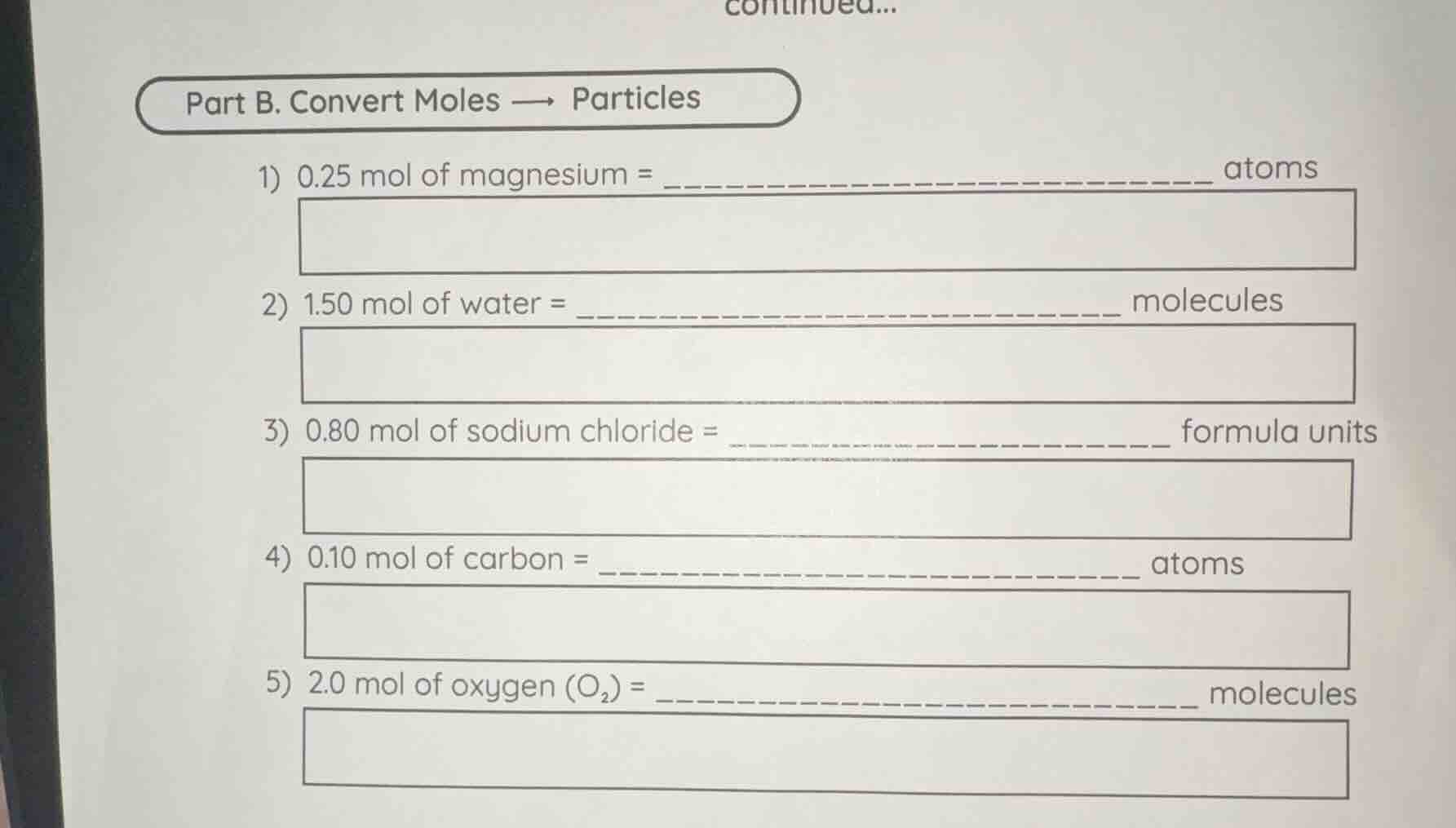
1)
Step1: Recall Avogadro's number
Avogadro's number is \( 6.022 \times 10^{23} \) particles per mole. To convert moles to atoms, multiply moles by Avogadro's number.
Step2: Calculate number of atoms
For 0.25 mol of magnesium, the number of atoms is \( 0.25 \, \text{mol} \times 6.022 \times 10^{23} \, \text{atoms/mol} \).
\( 0.25 \times 6.022 \times 10^{23} = 1.5055 \times 10^{23} \approx 1.5 \times 10^{23} \) (or more precisely \( 1.5055 \times 10^{23} \))
Step1: Recall Avogadro's number
Avogadro's number is \( 6.022 \times 10^{23} \) particles per mole. To convert moles of a compound (water) to molecules, multiply moles by Avogadro's number.
Step2: Calculate number of molecules
For 1.50 mol of water, the number of molecules is \( 1.50 \, \text{mol} \times 6.022 \times 10^{23} \, \text{molecules/mol} \).
\( 1.50 \times 6.022 \times 10^{23} = 9.033 \times 10^{23} \)
Step1: Recall Avogadro's number
Avogadro's number is \( 6.022 \times 10^{23} \) formula units per mole for ionic compounds (like sodium chloride). To convert moles to formula units, multiply moles by Avogadro's number.
Step2: Calculate number of formula units
For 0.80 mol of sodium chloride, the number of formula units is \( 0.80 \, \text{mol} \times 6.022 \times 10^{23} \, \text{formula units/mol} \).
\( 0.80 \times 6.022 \times 10^{23} = 4.8176 \times 10^{23} \approx 4.8 \times 10^{23} \) (or more precisely \( 4.8176 \times 10^{23} \))

Snap & solve any problem in the app
Get step-by-step solutions on Sovi AI
Photo-based solutions with guided steps
Explore more problems and detailed explanations
\( 1.5055 \times 10^{23} \) (or \( 1.5 \times 10^{23} \)) atoms