QUESTION IMAGE
Question
Question was provided via image upload.
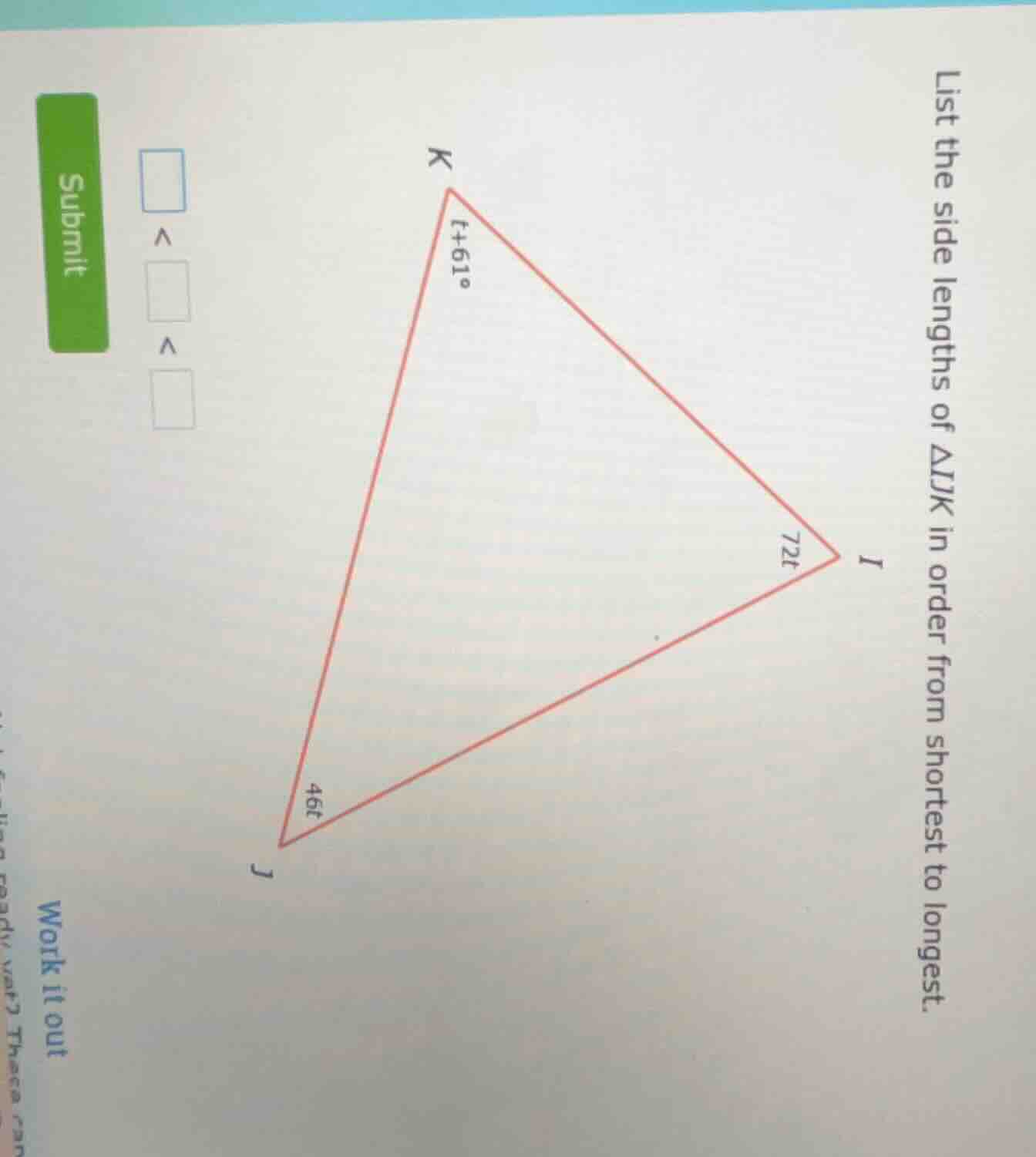
Step1: Find the value of \( t \)
The sum of the interior angles of a triangle is \( 180^\circ \). So we set up the equation:
\[
(t + 61) + 72t + 46t = 180
\]
Combine like terms:
\[
(1 + 72 + 46)t + 61 = 180
\]
\[
119t + 61 = 180
\]
Subtract 61 from both sides:
\[
119t = 180 - 61
\]
\[
119t = 119
\]
Divide both sides by 119:
\[
t = 1
\]
Step2: Calculate each angle
- Angle \( K \): \( t + 61 = 1 + 61 = 62^\circ \)
- Angle \( I \): \( 72t = 72\times1 = 72^\circ \)
- Angle \( J \): \( 46t = 46\times1 = 46^\circ \)
Step3: Relate angles to side lengths
In a triangle, the larger the angle, the longer the side opposite it.
- Opposite angle \( J \) (\( 46^\circ \)): side \( IK \)
- Opposite angle \( K \) (\( 62^\circ \)): side \( IJ \)
- Opposite angle \( I \) (\( 72^\circ \)): side \( JK \)
So the order from shortest to longest side is based on the order of the angles from smallest to largest (\( 46^\circ < 62^\circ < 72^\circ \)), so the sides are \( IK \), \( IJ \), \( JK \) (or in terms of the triangle's vertices, the sides opposite the angles: side opposite \( J \) is \( IK \), opposite \( K \) is \( IJ \), opposite \( I \) is \( JK \)). Wait, actually, let's label the triangle: vertices \( I \), \( J \), \( K \). So side \( IJ \) is between \( I \) and \( J \), side \( JK \) is between \( J \) and \( K \), side \( IK \) is between \( I \) and \( K \).
Angle at \( J \) is \( 46^\circ \), so side opposite ( \( IK \) ) is opposite \( 46^\circ \).
Angle at \( K \) is \( 62^\circ \), so side opposite ( \( IJ \) ) is opposite \( 62^\circ \).
Angle at \( I \) is \( 72^\circ \), so side opposite ( \( JK \) ) is opposite \( 72^\circ \).
Since \( 46^\circ < 62^\circ < 72^\circ \), the sides opposite are \( IK < IJ < JK \).

Snap & solve any problem in the app
Get step-by-step solutions on Sovi AI
Photo-based solutions with guided steps
Explore more problems and detailed explanations
The side lengths of \( \triangle IJK \) in order from shortest to longest are \( IK \), \( IJ \), \( JK \) (or using the angle - side relationship, the sides opposite the angles \( 46^\circ \), \( 62^\circ \), \( 72^\circ \) respectively, so the order is \( IK < IJ < JK \)).