QUESTION IMAGE
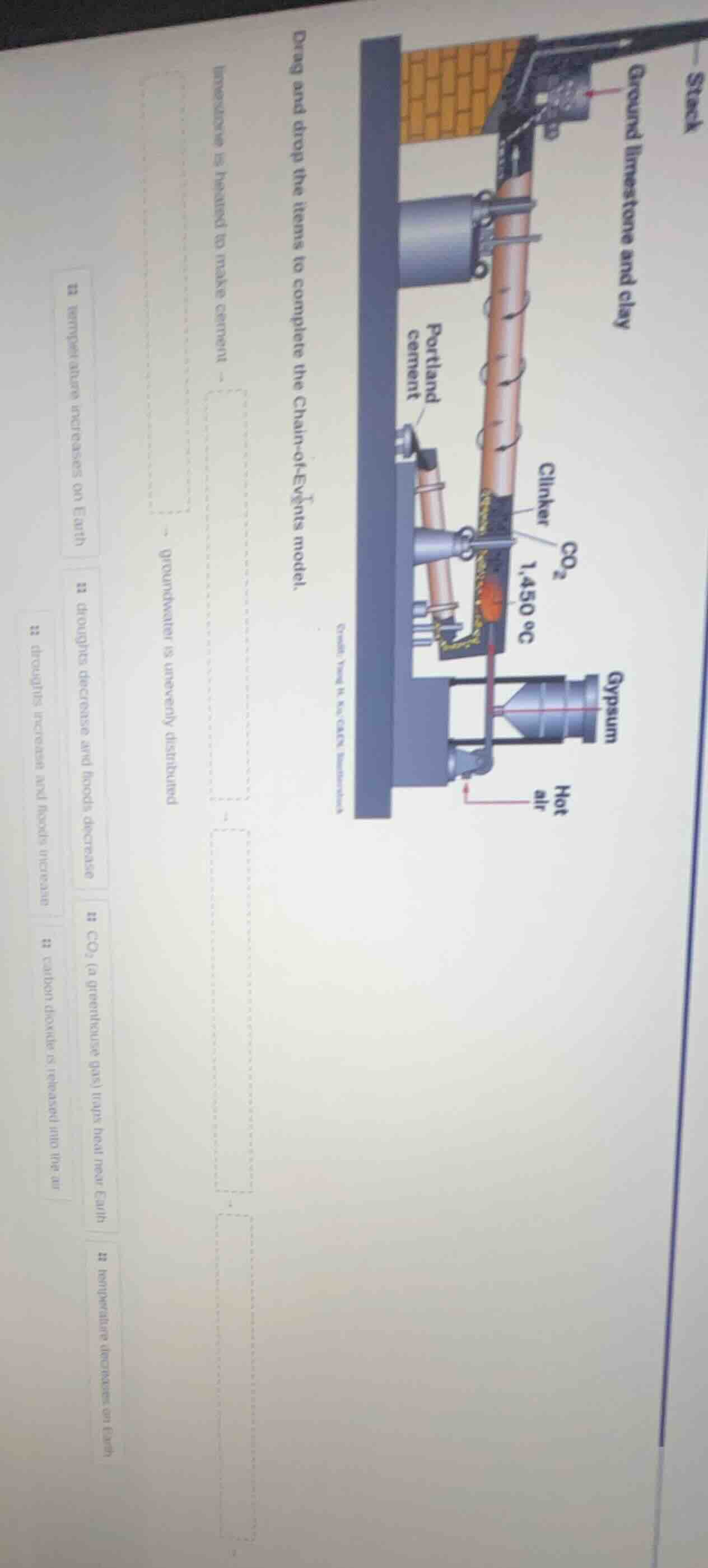
Question
Question was provided via image upload.
To solve the chain - of - events model for cement production and its environmental impacts, we analyze the cause - effect relationships:
Step 1: Start with Cement Production
The process begins with heating limestone and clay (along with gypsum and hot air) to make cement. During this heating process at \(1450^{\circ}C\), \(CO_2\) (a greenhouse gas) is released into the air. So the first event is "limestone is heated to make cement" leading to "carbon dioxide (a greenhouse gas) is released into the air".
Step 2: Greenhouse Gas Effect
When \(CO_2\) (a greenhouse gas) is released into the air, it traps heat near the Earth. This causes the "temperature increases on Earth" as the greenhouse effect intensifies.
Step 3: Impact on Precipitation and Groundwater
With the increase in temperature on Earth, the water cycle is affected. Evaporation increases, which leads to more moisture in the atmosphere. This results in "droughts decrease and floods increase" (since more moisture can lead to more intense rainfall events and changes in the distribution of water). Also, the change in the water cycle and temperature can lead to "groundwater is unevenly distributed" as the patterns of infiltration and runoff change. And as the climate changes, we see "droughts increase and floods increase" (the overall instability in the water cycle can cause both more droughts in some areas and more floods in others due to the uneven distribution of precipitation) and "droughts decrease and floods decrease" is incorrect, while the correct subsequent effect of temperature increase and changed water cycle is the increase in the variability of water - related events like droughts and floods.
The correct chain of events is:
- limestone is heated to make cement \(\to\) carbon dioxide (a greenhouse gas) is released into the air
- carbon dioxide (a greenhouse gas) is released into the air \(\to\) temperature increases on Earth
- temperature increases on Earth \(\to\) droughts increase and floods increase (and groundwater is unevenly distributed)
- (As a result of the above) droughts decrease and floods decrease is incorrect, and the correct impacts are related to the increase in the variability of droughts and floods and uneven groundwater distribution.
If we are to list the events in order:
- limestone is heated to make cement
- carbon dioxide (a greenhouse gas) is released into the air
- temperature increases on Earth
- droughts increase and floods increase (and groundwater is unevenly distributed)
If we consider the options given for the drag - and - drop (even though the options are a bit mixed in terms of wording), the correct sequence of cause and effect is centered around the release of \(CO_2\) from cement production, leading to temperature increase, and then to changes in water - related events and groundwater distribution.
For example, if we have to match the events:
- Cause: limestone is heated to make cement
- Effect: carbon dioxide (a greenhouse gas) is released into the air
- Cause: carbon dioxide (a greenhouse gas) is released into the air
- Effect: temperature increases on Earth
- Cause: temperature increases on Earth
- Effect: droughts increase and floods increase (and groundwater is unevenly distributed)
If the question is about the correct pairing of the first event (cement production) with its environmental impact, the first link is "limestone is heated to make cement" paired with "carbon dioxide (a greenhouse gas) is released into the air".
If we are to answer in terms of the final answer for the chain (assuming a seq…

Snap & solve any problem in the app
Get step-by-step solutions on Sovi AI
Photo-based solutions with guided steps
Explore more problems and detailed explanations
To solve the chain - of - events model for cement production and its environmental impacts, we analyze the cause - effect relationships:
Step 1: Start with Cement Production
The process begins with heating limestone and clay (along with gypsum and hot air) to make cement. During this heating process at \(1450^{\circ}C\), \(CO_2\) (a greenhouse gas) is released into the air. So the first event is "limestone is heated to make cement" leading to "carbon dioxide (a greenhouse gas) is released into the air".
Step 2: Greenhouse Gas Effect
When \(CO_2\) (a greenhouse gas) is released into the air, it traps heat near the Earth. This causes the "temperature increases on Earth" as the greenhouse effect intensifies.
Step 3: Impact on Precipitation and Groundwater
With the increase in temperature on Earth, the water cycle is affected. Evaporation increases, which leads to more moisture in the atmosphere. This results in "droughts decrease and floods increase" (since more moisture can lead to more intense rainfall events and changes in the distribution of water). Also, the change in the water cycle and temperature can lead to "groundwater is unevenly distributed" as the patterns of infiltration and runoff change. And as the climate changes, we see "droughts increase and floods increase" (the overall instability in the water cycle can cause both more droughts in some areas and more floods in others due to the uneven distribution of precipitation) and "droughts decrease and floods decrease" is incorrect, while the correct subsequent effect of temperature increase and changed water cycle is the increase in the variability of water - related events like droughts and floods.
The correct chain of events is:
- limestone is heated to make cement \(\to\) carbon dioxide (a greenhouse gas) is released into the air
- carbon dioxide (a greenhouse gas) is released into the air \(\to\) temperature increases on Earth
- temperature increases on Earth \(\to\) droughts increase and floods increase (and groundwater is unevenly distributed)
- (As a result of the above) droughts decrease and floods decrease is incorrect, and the correct impacts are related to the increase in the variability of droughts and floods and uneven groundwater distribution.
If we are to list the events in order:
- limestone is heated to make cement
- carbon dioxide (a greenhouse gas) is released into the air
- temperature increases on Earth
- droughts increase and floods increase (and groundwater is unevenly distributed)
If we consider the options given for the drag - and - drop (even though the options are a bit mixed in terms of wording), the correct sequence of cause and effect is centered around the release of \(CO_2\) from cement production, leading to temperature increase, and then to changes in water - related events and groundwater distribution.
For example, if we have to match the events:
- Cause: limestone is heated to make cement
- Effect: carbon dioxide (a greenhouse gas) is released into the air
- Cause: carbon dioxide (a greenhouse gas) is released into the air
- Effect: temperature increases on Earth
- Cause: temperature increases on Earth
- Effect: droughts increase and floods increase (and groundwater is unevenly distributed)
If the question is about the correct pairing of the first event (cement production) with its environmental impact, the first link is "limestone is heated to make cement" paired with "carbon dioxide (a greenhouse gas) is released into the air".
If we are to answer in terms of the final answer for the chain (assuming a sequence - based answer), the key events in order are:
- limestone is heated to make cement
- carbon dioxide (a greenhouse gas) is released into the air
- temperature increases on Earth
- droughts increase and floods increase (and groundwater is unevenly distributed)
If we take the most direct cause - effect from cement production to the first environmental impact, the answer related to the first effect of cement production is that "carbon dioxide (a greenhouse gas) is released into the air" is the immediate effect of heating limestone to make cement.