QUESTION IMAGE
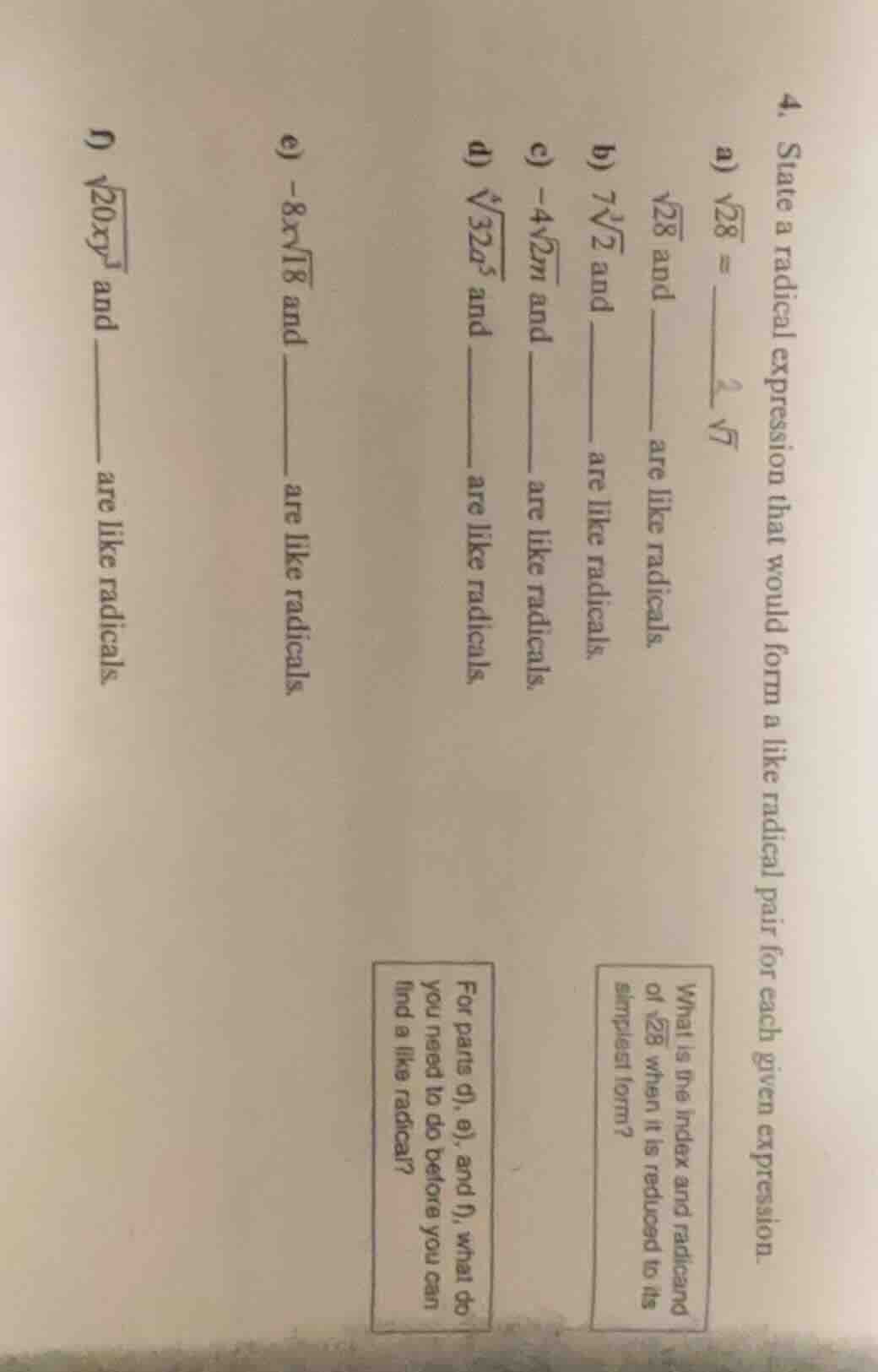
Question
Question was provided via image upload.
Part a)
Step 1: Simplify \(\sqrt{28}\)
We know that \(28 = 4\times7\), so we can use the property \(\sqrt{ab}=\sqrt{a}\times\sqrt{b}\) (where \(a = 4\) and \(b=7\)) and \(\sqrt{4}=2\).
\(\sqrt{28}=\sqrt{4\times7}=\sqrt{4}\times\sqrt{7}=2\sqrt{7}\)
Like radicals have the same radical (the part under the square root). The given radical is \(7\sqrt{2}\), so a radical with \(\sqrt{2}\) as the radical part is a like radical. We choose \(3\sqrt{2}\) (any coefficient with \(\sqrt{2}\) works).
Like radicals have the same radical (the part under the square root). The given radical is \(-4\sqrt{2m}\), so a radical with \(\sqrt{2m}\) as the radical part is a like radical. We choose \(5\sqrt{2m}\) (any coefficient with \(\sqrt{2m}\) works).

Snap & solve any problem in the app
Get step-by-step solutions on Sovi AI
Photo-based solutions with guided steps
Explore more problems and detailed explanations
\(2\)
Part b)
Like radicals have the same radical part. The radical part of \(7\sqrt{2}\) is \(\sqrt{2}\), so any expression with \(\sqrt{2}\) as the radical part will be a like radical. For example, \(3\sqrt{2}\) (we can choose any coefficient, here we choose \(3\) for simplicity).