QUESTION IMAGE
Question
Question was provided via image upload.
Brief Explanations
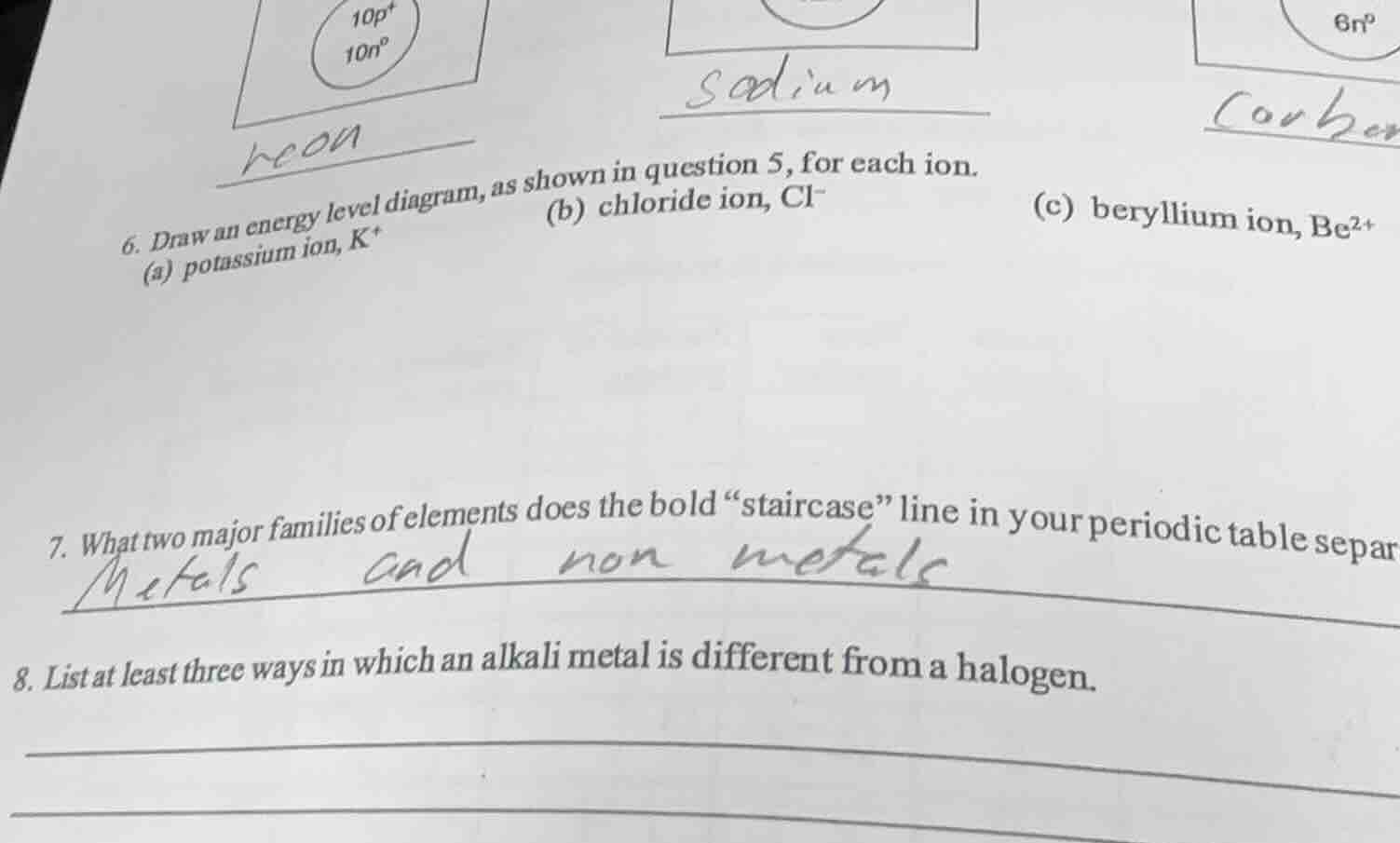
- Valence Electrons: Alkali metals have 1 valence electron, while halogens have 7 valence electrons.
- Ion Formation: Alkali metals lose 1 electron to form +1 cations; halogens gain 1 electron to form -1 anions.
- Physical State (STP): Alkali metals are soft, shiny solids; halogens are typically diatomic gases (F₂, Cl₂), liquid (Br₂), or solid (I₂) with dull, non-metallic appearances.
- Chemical Reactivity: Alkali metals react vigorously with water to produce alkaline metal hydroxide and hydrogen gas; halogens react with metals to form salts, and with water to form acidic solutions.

Snap & solve any problem in the app
Get step-by-step solutions on Sovi AI
Photo-based solutions with guided steps
Explore more problems and detailed explanations
- Alkali metals have 1 valence electron, halogens have 7 valence electrons.
- Alkali metals form +1 cations; halogens form -1 anions.
- Alkali metals are soft, metallic solids at standard conditions; most halogens are non-metallic gases/liquids at standard conditions.
- Alkali metals react with water to make alkaline solutions; halogens react with water to make acidic solutions.