QUESTION IMAGE
Question
Question was provided via image upload.
Part a
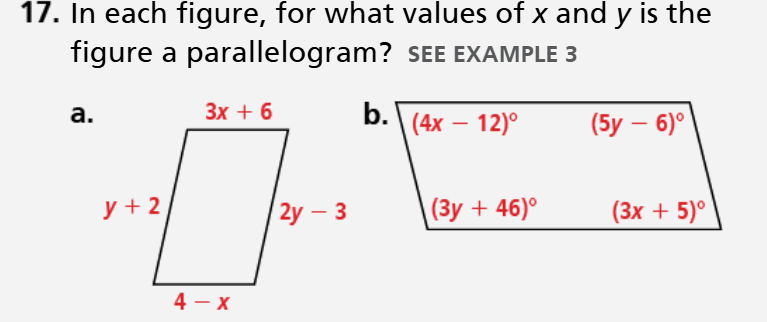
Step1: Opposite sides of a parallelogram are equal. So, set the expressions for the opposite sides equal.
For the vertical sides: \( y + 2 = 2y - 3 \)
For the horizontal sides: \( 3x + 6 = 4 - x \)
Step2: Solve for \( y \) from \( y + 2 = 2y - 3 \)
Subtract \( y \) from both sides: \( 2 = y - 3 \)
Add 3 to both sides: \( y = 5 \)
Step3: Solve for \( x \) from \( 3x + 6 = 4 - x \)
Add \( x \) to both sides: \( 4x + 6 = 4 \)
Subtract 6 from both sides: \( 4x = -2 \)
Divide by 4: \( x = -\frac{1}{2} \)
Step1: In a parallelogram, opposite angles are equal and consecutive angles are supplementary. So, set opposite angles equal.
For the angles involving \( x \): \( 4x - 12 = 3x + 5 \)
For the angles involving \( y \): \( 5y - 6 = 3y + 46 \)
Step2: Solve for \( x \) from \( 4x - 12 = 3x + 5 \)
Subtract \( 3x \) from both sides: \( x - 12 = 5 \)
Add 12 to both sides: \( x = 17 \)
Step3: Solve for \( y \) from \( 5y - 6 = 3y + 46 \)
Subtract \( 3y \) from both sides: \( 2y - 6 = 46 \)
Add 6 to both sides: \( 2y = 52 \)
Divide by 2: \( y = 26 \)

Snap & solve any problem in the app
Get step-by-step solutions on Sovi AI
Photo-based solutions with guided steps
Explore more problems and detailed explanations
\( x = -\frac{1}{2} \), \( y = 5 \)