QUESTION IMAGE
Question
Question was provided via image upload.
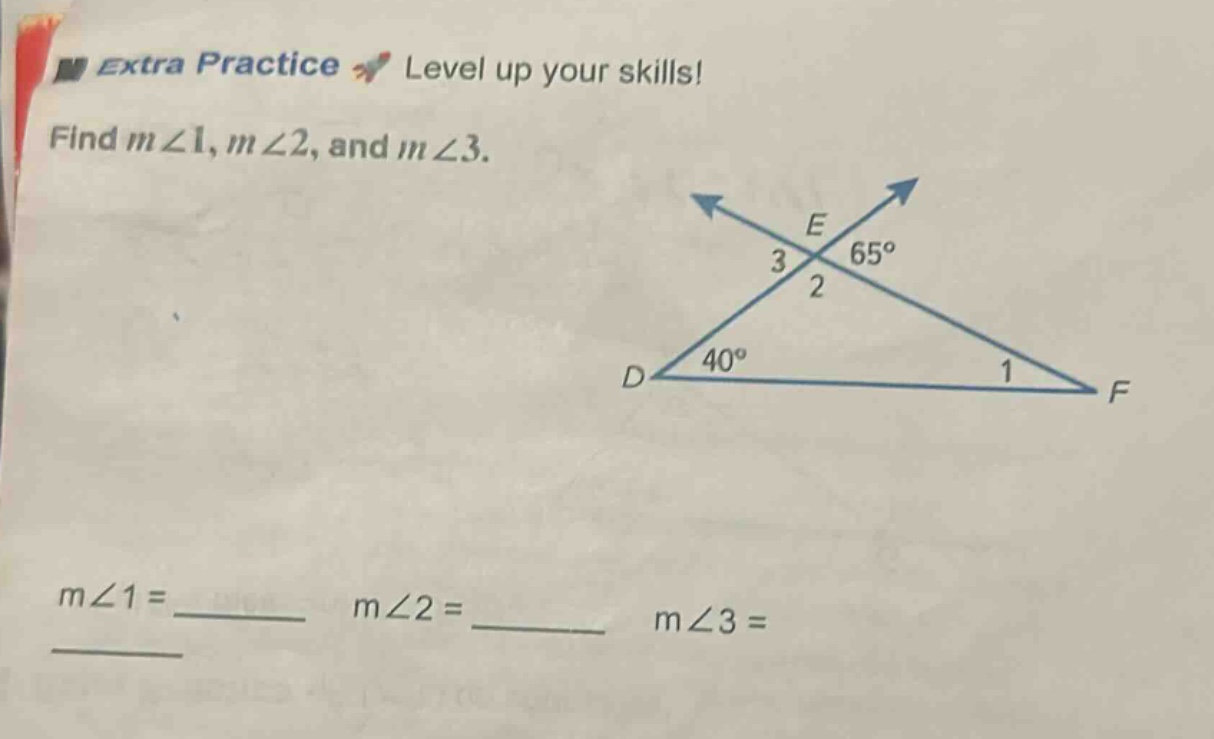
Step1: Find \( m\angle 1 \)
We know that vertical angles are equal, so the angle at \( E \) adjacent to \( 65^\circ \) (vertical to \( \angle 1 \)'s corresponding exterior angle? Wait, no, actually, using the triangle's exterior angle or triangle angle sum. Wait, the angle at \( E \) with \( 65^\circ \): the angle \( \angle DEF \) (wait, no, the angle at \( E \) for triangle \( DEF \): the exterior angle at \( E \) is \( 65^\circ \)? Wait, no, the angle given is \( 65^\circ \), and \( \angle D = 40^\circ \). Wait, actually, the angle at \( E \) for triangle \( DEF \): the angle \( \angle DEF \) is equal to \( 65^\circ \)? Wait, no, vertical angles: the angle labeled \( 65^\circ \) and \( \angle 3 \)? Wait, no, let's look at the diagram. The two lines intersect at \( E \), so the angle of \( 65^\circ \) and \( \angle 3 \) are vertical? No, wait, the triangle has vertices \( D \), \( F \), and \( E \)? Wait, \( D \) and \( F \) are on the base, \( E \) is the top vertex. So angle at \( E \) for triangle \( DEF \): the angle \( \angle DEF \) is equal to \( 65^\circ \)? Wait, no, the angle given is \( 65^\circ \) at \( E \), and \( \angle D = 40^\circ \). Then, in triangle \( DEF \), the sum of angles is \( 180^\circ \). Wait, angle at \( E \): is it \( 65^\circ \)? Wait, no, the angle labeled \( 65^\circ \) is adjacent to \( \angle 2 \). Wait, maybe \( \angle 1 \) can be found using the exterior angle theorem. The exterior angle at \( E \) (the \( 65^\circ \) angle) is equal to the sum of the two non-adjacent interior angles of the triangle. So \( 65^\circ = \angle D + \angle 1 \). Since \( \angle D = 40^\circ \), then \( \angle 1 = 65^\circ - 40^\circ = 25^\circ \).
\[
m\angle 1 = 65^\circ - 40^\circ = 25^\circ
\]
Step2: Find \( m\angle 2 \)
In triangle \( DEF \), the sum of angles is \( 180^\circ \). So \( \angle D + \angle 1 + \angle 2 = 180^\circ \)? Wait, no, wait, \( \angle 2 \) is a straight angle? Wait, no, the two lines intersect at \( E \), so \( \angle 2 \) and the \( 65^\circ \) angle are supplementary? Wait, no, let's check again. Wait, \( \angle 2 \) is adjacent to the \( 65^\circ \) angle, so they form a linear pair? Wait, no, \( \angle 2 \) is inside the triangle? Wait, maybe I made a mistake. Wait, the triangle has angles \( \angle D = 40^\circ \), \( \angle 1 = 25^\circ \), so \( \angle 2 = 180^\circ - 40^\circ - 25^\circ = 115^\circ \)? Wait, no, that can't be. Wait, no, the angle at \( E \) for the triangle: the angle \( \angle DEF \) is equal to \( 180^\circ - 65^\circ = 115^\circ \)? Wait, no, the two lines intersect at \( E \), so the angle of \( 65^\circ \) and \( \angle 2 \) are supplementary? Wait, if \( \angle 2 \) and the \( 65^\circ \) angle are adjacent and form a linear pair, then \( \angle 2 + 65^\circ = 180^\circ \), so \( \angle 2 = 180^\circ - 65^\circ = 115^\circ \). Alternatively, using the triangle angle sum: \( \angle D + \angle 1 + \angle (angle at E) = 180^\circ \). Wait, the angle at \( E \) for the triangle is \( \angle 2 \)? No, maybe \( \angle 2 \) is a straight angle? Wait, no, let's re-examine. The two lines intersect at \( E \), so \( \angle 2 \) and the angle opposite to it? Wait, no, let's use the linear pair. \( \angle 2 \) and the \( 65^\circ \) angle are supplementary, so \( m\angle 2 = 180^\circ - 65^\circ = 115^\circ \). Wait, but also, in the triangle, \( \angle D + \angle 1 + \angle (angle at E) = 180^\circ \). The angle at \( E \) for the triangle is equal to \( \angle 2 \)? Wait, no, the angle at \( E \) for the triangle is adjacent to \( \angle 2 \). Wait, maybe I confuse…

Snap & solve any problem in the app
Get step-by-step solutions on Sovi AI
Photo-based solutions with guided steps
Explore more problems and detailed explanations
\( m\angle 1 = 25^\circ \), \( m\angle 2 = 115^\circ \), \( m\angle 3 = 65^\circ \)