QUESTION IMAGE
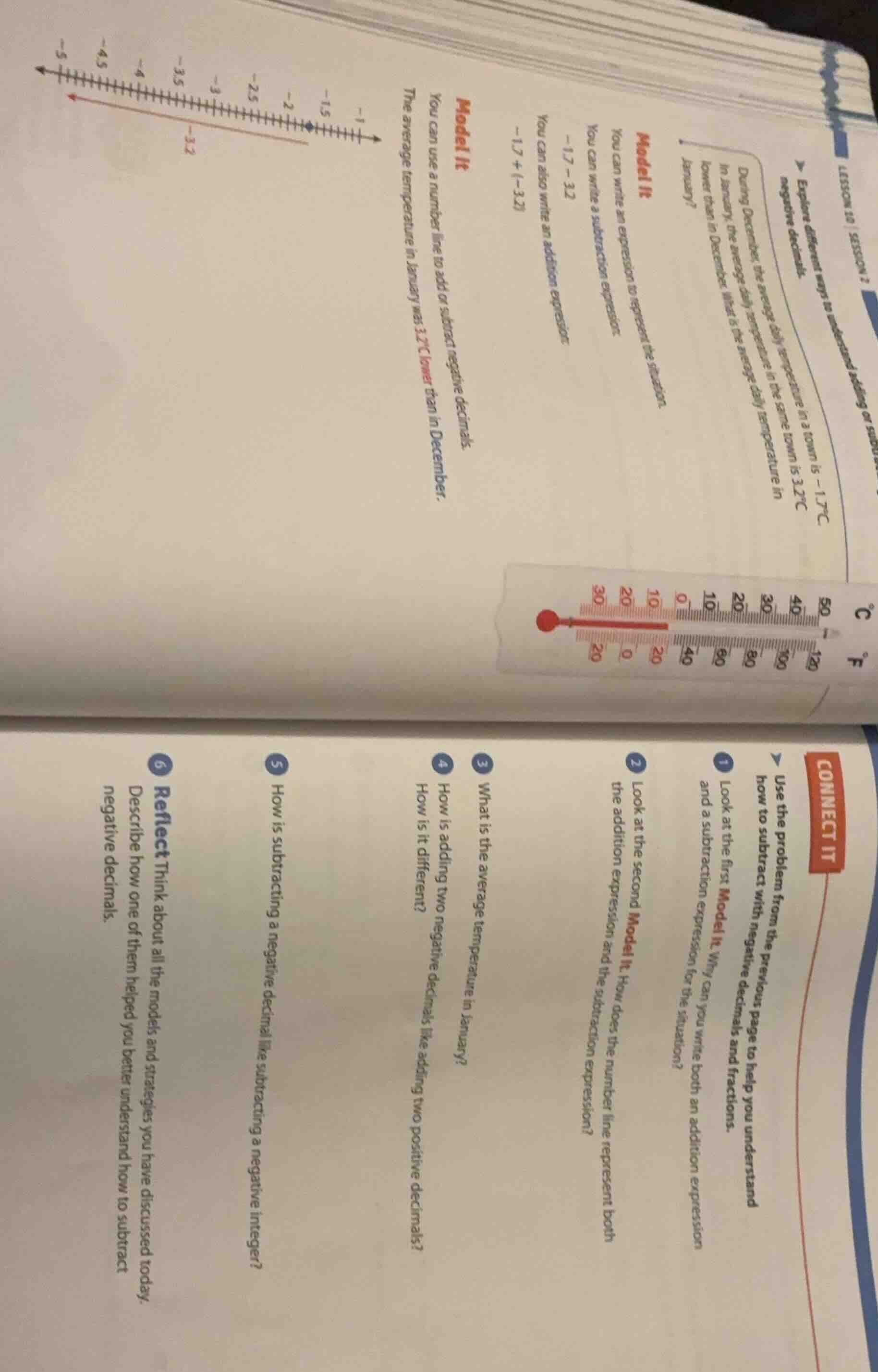
Question
Question was provided via image upload.
Step1: Identify given values
December temp: $-1.7^\circ\text{C}$, temp difference: $3.2^\circ\text{C}$
Step2: Use subtraction expression
January temp = $-1.7 - 3.2$
Step3: Calculate the result
$-1.7 - 3.2 = -4.9$
---
For Question 1:
We can rewrite subtraction as adding the opposite: subtracting a positive is the same as adding its negative, so $-1.7 - 3.2$ (subtraction) becomes $-1.7 + (-3.2)$ (addition).
For Question 2:
On the number line, starting at $-1.7$, the subtraction $-1.7 - 3.2$ means moving 3.2 units left from $-1.7$. The addition $-1.7 + (-3.2)$ also means starting at $-1.7$ and moving 3.2 units left (since adding a negative moves left on the number line).
For Question 4:
Adding two positive decimals gives a larger positive number; adding two negative decimals gives a more negative (smaller) number.
For Question 5:
Subtracting a negative decimal is the same as adding its positive counterpart, just like subtracting a negative integer is adding its positive counterpart. The sign rule is identical: $a - (-b) = a + b$ for both integers and decimals.
For Question 6:
The number line model helps visualize direction: subtracting a positive (or adding a negative) moves left on the number line, which makes it clear that the result becomes more negative. This concrete visual makes the abstract rule of negative decimal subtraction easier to grasp.

Snap & solve any problem in the app
Get step-by-step solutions on Sovi AI
Photo-based solutions with guided steps
Explore more problems and detailed explanations
- The subtraction expression is $-1.7 - 3.2$, and the addition expression is $-1.7 + (-3.2)$. We can write both because subtracting a positive value is equivalent to adding its negative opposite.
- The number line represents both expressions by starting at $-1.7$ and moving 3.2 units to the left: this movement corresponds to both subtracting 3.2 and adding $-3.2$.
- $-4.9^\circ\text{C}$
- Adding two positive decimals results in a positive value that is larger than either addend, while adding two negative decimals results in a negative value that is smaller (more negative) than either addend.
- Subtracting a negative decimal follows the same rule as subtracting a negative integer: it is equivalent to adding the positive version of that number (e.g., $a - (-b) = a + b$ for both decimals and integers).
- The number line model helped by providing a visual representation of how subtracting a positive (or adding a negative) decimal shifts the starting value left on the number line, making it clear that the result becomes a more negative number, which clarifies the abstract sign rules for negative decimal subtraction.