QUESTION IMAGE
Question
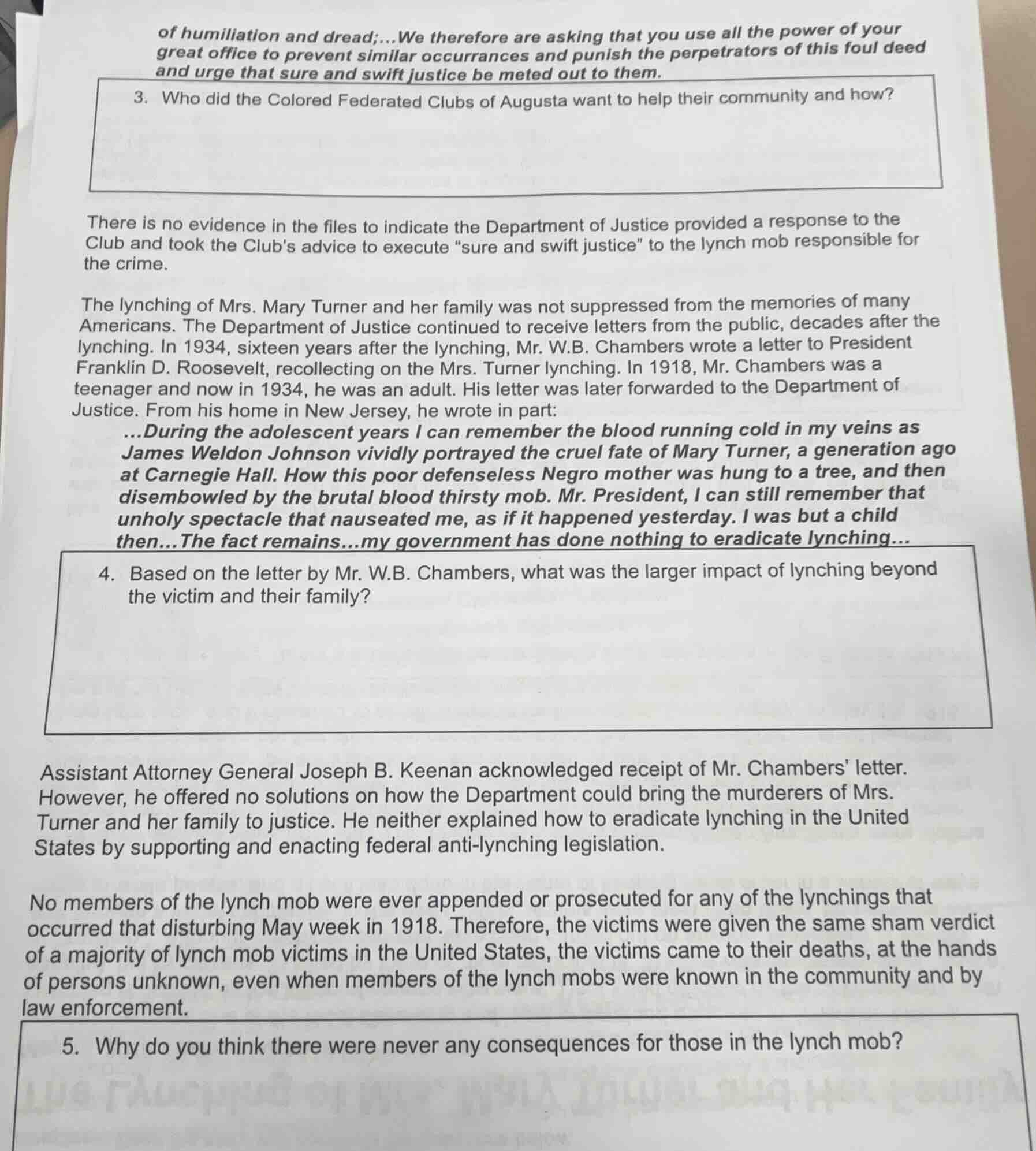
of humiliation and dread;…we therefore are asking that you use all the power of your great office to prevent similar occurrances and punish the perpetrators of this foul deed and urge that sure and swift justice be meted out to them. 3. who did the colored federated clubs of augusta want to help their community and how? there is no evidence in the files to indicate the department of justice provided a response to the club and took the club’s advice to execute \sure and swift justice\ to the lynch mob responsible for the crime. the lynching of mrs. mary turner and her family was not suppressed from the memories of many americans. the department of justice continued to receive letters from the public, decades after the lynching. in 1934, sixteen years after the lynching, mr. w.b. chambers wrote a letter to president franklin d. roosevelt, recollecting on the mrs. turner lynching. in 1918, mr. chambers was a teenager and now in 1934, he was an adult. his letter was later forwarded to the department of justice. from his home in new jersey, he wrote in part: …during the adolescent years i can remember the blood running cold in my veins as james weldon johnson vividly portrayed the cruel fate of mary turner, a generation ago at carnegie hall. how this poor defenseless negro mother was hung to a tree, and then disembowled by the brutal blood thirsty mob. mr. president, i can still remember that unholy spectacle that nauseated me, as if it happened yesterday. i was but a child then…the fact remains…my government has done nothing to eradicate lynching… 4. based on the letter by mr. w.b. chambers, what was the larger impact of lynching beyond the victim and their family? assistant attorney general joseph b. keenan acknowledged receipt of mr. chambers’ letter. however, he offered no solutions on how the department could bring the murderers of mrs. turner and her family to justice. he neither explained how to eradicate lynching in the united states by supporting and enacting federal anti - lynching legislation. no members of the lynch mob were ever appended or prosecuted for any of the lynchings that occurred that disturbing may week in 1918. therefore, the victims were given the same sham verdict of a majority of lynch mob victims in the united states, the victims came to their deaths, at the hands of persons unknown, even when members of the lynch mobs were known in the community and by law enforcement. 5. why do you think there were never any consequences for those in the lynch mob?
Question 3
The Colored Federated Clubs of Augusta wanted to get help from the person in the “great office” (likely a high - ranking official, such as someone in the Department of Justice or a similar authority). They wanted this person to use their power to prevent similar lynching - like occurrences, punish the perpetrators of the foul deed (the lynching), and ensure that swift and sure justice was meted out to those who committed the crime.
From Mr. W.B. Chambers' letter, we can see that lynching had a long - lasting and traumatic impact on the public. Chambers, as a teenager, was deeply affected by the lynching of Mary Turner, and this memory stayed with him into adulthood (sixteen years later). Also, the fact that the Department of Justice continued to receive letters from the public decades after the lynching shows that lynching affected the collective memory and sense of justice of the American public. It also eroded trust in the government's ability to protect citizens and eradicate such violent and unjust acts, as seen from Chambers' statement that “my government has done nothing to eradicate lynching”.
There could be several reasons. One reason is the prevalence of racial prejudice and discrimination at the time. The justice system and law enforcement may have been biased in favor of the lynch mob members (who were likely white) and against the Black victims. Also, there may have been a lack of political will to prosecute lynch mobs, as seen from the Department of Justice not taking action despite receiving letters. Additionally, the legal system may have had loopholes or a lack of strong anti - lynching legislation, which made it difficult to hold the mob members accountable. Social norms at the time may have also tolerated or even supported lynching in some communities, so there was little pressure to prosecute the perpetrators.

Snap & solve any problem in the app
Get step-by-step solutions on Sovi AI
Photo-based solutions with guided steps
Explore more problems and detailed explanations
The Colored Federated Clubs of Augusta wanted to get help from the person in the “great office” (a high - ranking official, likely related to the Department of Justice or similar authority). They hoped this person would use their power to prevent similar incidents, punish the perpetrators of the lynching, and ensure swift and sure justice was given to the criminals.