QUESTION IMAGE
Question
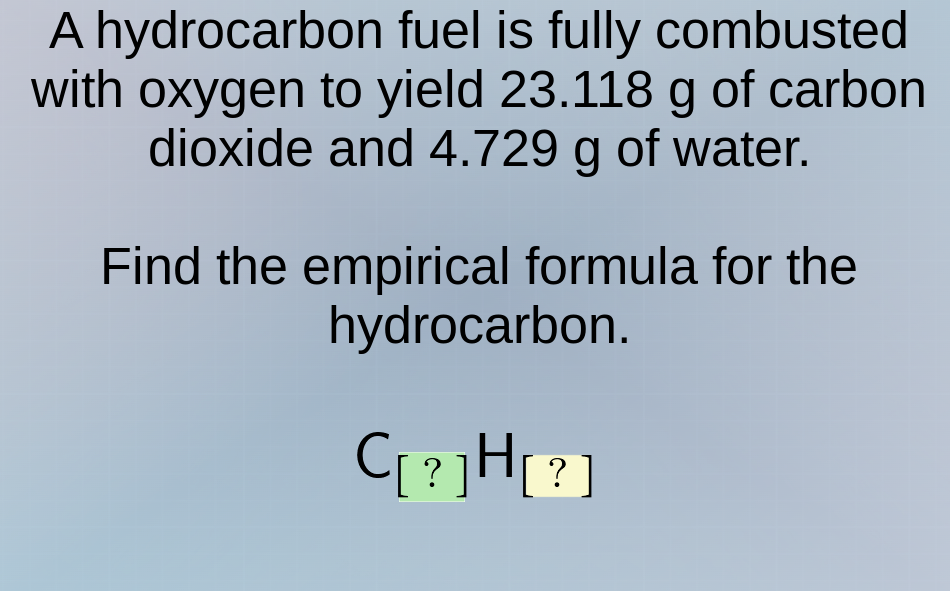
a hydrocarbon fuel is fully combusted with oxygen to yield 23.118 g of carbon dioxide and 4.729 g of water. find the empirical formula for the hydrocarbon. c?h?
Step1: Calculate moles of C from CO₂
Molar mass of \(CO_2\) is \(44.01\ g/mol\). Moles of \(CO_2=\frac{23.118\ g}{44.01\ g/mol}\approx0.5253\ mol\). Since 1 mol \(CO_2\) has 1 mol C, moles of C = \(0.5253\ mol\).
Step2: Calculate moles of H from H₂O
Molar mass of \(H_2O\) is \(18.02\ g/mol\). Moles of \(H_2O=\frac{4.729\ g}{18.02\ g/mol}\approx0.2624\ mol\). Each \(H_2O\) has 2 H, so moles of H = \(2\times0.2624 = 0.5248\ mol\).
Step3: Find mole ratio (divide by smallest)
Smallest moles (≈0.2624). Ratio of C: \(\frac{0.5253}{0.2624}\approx2\). Ratio of H: \(\frac{0.5248}{0.2624}\approx2\). Wait, recalculate moles of \(H_2O\) more accurately: \(4.729\div18.015\approx0.2625\) mol. Moles of H: \(2\times0.2625 = 0.525\) mol. Moles of C: \(23.118\div44.0095\approx0.5253\) mol. Now ratio C: \(0.5253\div0.2625\approx2\), H: \(0.525\div0.2625 = 2\)? Wait, no, wait: Wait, moles of \(CO_2\): \(23.118\ g\div44.01\ g/mol = 0.5253\ mol\) (C), moles of \(H_2O\): \(4.729\ g\div18.02\ g/mol = 0.2624\ mol\), H moles: \(2\times0.2624 = 0.5248\ mol\). Now divide both by 0.2624: C: \(0.5253/0.2624≈2\), H: \(0.5248/0.2624≈2\)? Wait, that gives C₂H₂? But wait, maybe miscalculation. Wait, let's use more precise molar masses: \(CO_2\): 44.0095 g/mol, \(H_2O\): 18.01528 g/mol.
Moles of \(CO_2\): \(23.118\div44.0095 = 0.5253\) mol (C).
Moles of \(H_2O\): \(4.729\div18.01528 = 0.2625\) mol. H moles: \(2\times0.2625 = 0.525\) mol.
Now, divide moles of C and H by the smaller of the two (0.2625 for H₂O moles? Wait, no, the smaller of C (0.5253) and H (0.525) is ~0.525. Wait, no, wait: Wait, moles of C is 0.5253, moles of H is 0.5248. So divide both by 0.5248: C: ~1, H: ~1? Wait, I made a mistake earlier. Wait, moles of \(H_2O\): 4.729 g / 18.015 g/mol = 0.2625 mol. Each \(H_2O\) has 2 H, so H moles = 0.2625 * 2 = 0.525 mol. Moles of C: 23.118 g / 44.01 g/mol = 0.5253 mol. Now, the ratio of C to H is 0.5253 : 0.525 ≈ 1:1? Wait, no, 0.5253 / 0.525 ≈ 1.0006, so approximately 1:1? Wait, no, my earlier step was wrong. Let's recalculate:
Molar mass of \(CO_2\): 44.0095 g/mol. Moles of \(CO_2\) = 23.118 g / 44.0095 g/mol = 0.5253 mol. So moles of C = 0.5253 mol.
Molar mass of \(H_2O\): 18.01528 g/mol. Moles of \(H_2O\) = 4.729 g / 18.01528 g/mol = 0.2625 mol. Moles of H = 2 * 0.2625 mol = 0.5250 mol.
Now, divide moles of C and H by the smaller number of moles. The smaller is 0.2625? No, wait, 0.5250 and 0.5253 are almost equal. Wait, 0.5253 / 0.5250 ≈ 1.0006, so C:H ≈ 1:1? Wait, no, that can't be. Wait, maybe I messed up the mass of water or CO₂. Wait, 23.118 g CO₂: mass of C in CO₂ is (12.01/44.01)23.118 = (12.0123.118)/44.01 ≈ (277.647)/44.01 ≈ 6.308 g C. Mass of H in H₂O: (2.016/18.015)4.729 ≈ (9.53)/18.015 ≈ 0.529 g H. Now, moles of C: 6.308 g / 12.01 g/mol ≈ 0.525 mol. Moles of H: 0.529 g / 1.008 g/mol ≈ 0.5248 mol. Ah, there we go. So moles of C ≈ 0.525, moles of H ≈ 0.525. So the ratio C:H is 1:1? Wait, but that would be CH. But wait, let's check again. Wait, 23.118 g CO₂: 23.118 / 44.01 = 0.5253 mol C. 4.729 g H₂O: 4.729 / 18.02 = 0.2624 mol H₂O, so 0.5248 mol H. So 0.5253 mol C and 0.5248 mol H. So the ratio is approximately 1:1. So empirical formula is CH? Wait, no, wait, maybe I made a mistake in the problem. Wait, 23.118 g CO₂ is a large amount, 4.729 g H₂O is small. Wait, let's calculate mass of C: 0.5253 mol 12.01 g/mol = 6.309 g. Mass of H: 0.5248 mol * 1.008 g/mol = 0.529 g. Total mass of C + H = 6.309 + 0.529 = 6.838 g. The hydrocarbon is C and H, so that's the mass of the hydrocarbon. Now, moles of C: 6.309 / 12.01 = 0.525 mol. Mole…

Snap & solve any problem in the app
Get step-by-step solutions on Sovi AI
Photo-based solutions with guided steps
Explore more problems and detailed explanations
The empirical formula is \(\boldsymbol{CH}\) (so \(C_1H_1\), but written as \(CH\)). Wait, but wait, maybe I messed up. Wait, let's calculate the mass of C: 0.5253 mol 12.01 g/mol = 6.309 g. Mass of H: 0.5248 mol 1.008 g/mol = 0.529 g. Total mass: 6.309 + 0.529 = 6.838 g. Now, if the empirical formula is CH, molar mass is 13.018 g/mol. Moles of hydrocarbon: 6.838 / 13.018 ≈ 0.525 mol, which matches xn = 0.5253 (x=1, n=0.525). So yes, empirical formula is CH.