QUESTION IMAGE
Question
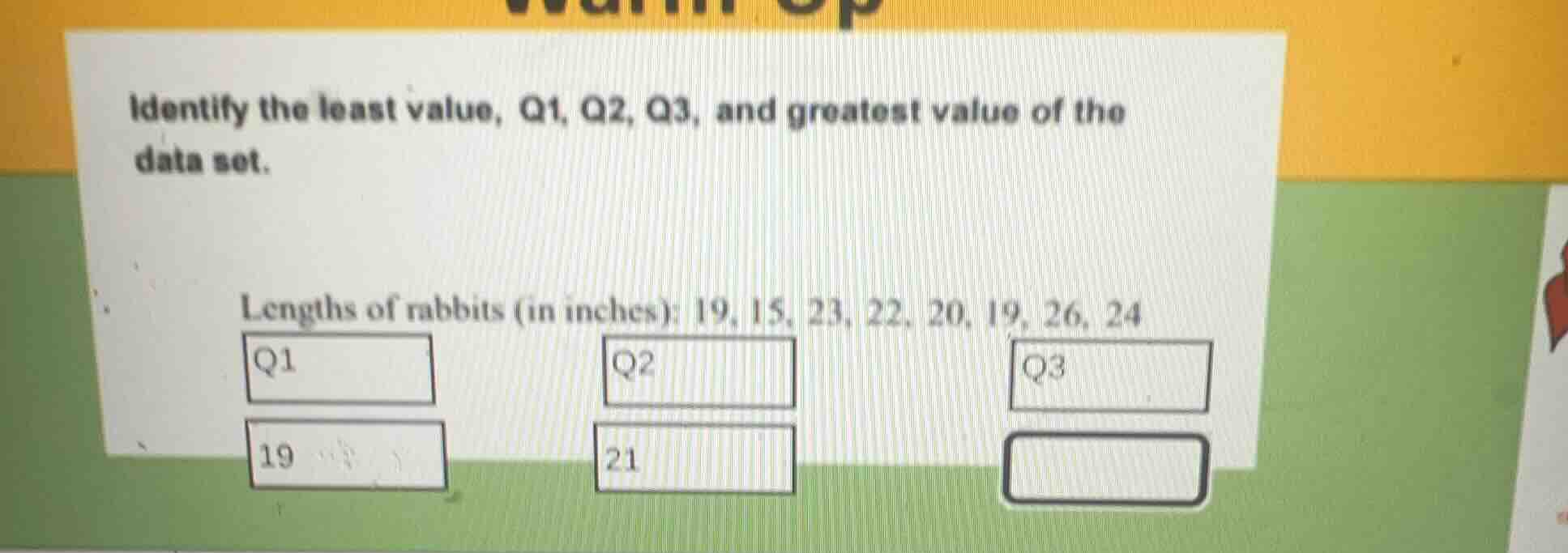
identify the least value, q1, q2, q3, and greatest value of the data set. lengths of rabbits (in inches): 19, 15, 23, 22, 20, 19, 26, 24
Step1: Order the data set
First, we need to order the data set from least to greatest. The data set is \(19, 15, 23, 22, 20, 19, 26, 24\). When we order it, we get \(15, 19, 19, 20, 22, 23, 24, 26\).
Step2: Find the least and greatest values
The least value is the first number in the ordered set, which is \(15\). The greatest value is the last number, which is \(26\).
Step3: Find the median (Q2)
Since there are \(n = 8\) data points (an even number), the median (Q2) is the average of the \(\frac{n}{2}\)-th and \((\frac{n}{2}+ 1)\)-th values. \(\frac{n}{2}=4\) and \(\frac{n}{2}+ 1 = 5\). The 4th value is \(20\) and the 5th value is \(22\). So \(Q2=\frac{20 + 22}{2}=\frac{42}{2}=21\), which matches the given value.
Step4: Find Q1 (median of the lower half)
The lower half of the data set (values below the median) is \(15, 19, 19, 20\). There are \(n_{lower}=4\) data points (even number), so the median of the lower half (Q1) is the average of the \(\frac{n_{lower}}{2}\)-th and \((\frac{n_{lower}}{2}+ 1)\)-th values. \(\frac{n_{lower}}{2}=2\) and \(\frac{n_{lower}}{2}+ 1=3\). The 2nd value is \(19\) and the 3rd value is \(19\). So \(Q1=\frac{19 + 19}{2}=\frac{38}{2}=19\), which matches the given value.
Step5: Find Q3 (median of the upper half)
The upper half of the data set (values above the median) is \(22, 23, 24, 26\). There are \(n_{upper}=4\) data points (even number), so the median of the upper half (Q3) is the average of the \(\frac{n_{upper}}{2}\)-th and \((\frac{n_{upper}}{2}+ 1)\)-th values. \(\frac{n_{upper}}{2}=2\) and \(\frac{n_{upper}}{2}+ 1 = 3\). The 2nd value is \(23\) and the 3rd value is \(24\). So \(Q3=\frac{23+24}{2}=\frac{47}{2} = 23.5\)? Wait, no, wait. Wait, the upper half is from the median (Q2) to the end? Wait, no, when \(n\) is even, the lower half is the first \(\frac{n}{2}\) values and the upper half is the last \(\frac{n}{2}\) values. Wait, our ordered data is \(15, 19, 19, 20, 22, 23, 24, 26\). So lower half is \(15, 19, 19, 20\) (first 4), upper half is \(22, 23, 24, 26\) (last 4). Wait, but to find Q1, we take the median of the lower half. The lower half has 4 values, so the median is the average of the 2nd and 3rd values. The 2nd value is \(19\), the 3rd value is \(19\), so Q1 is \(\frac{19 + 19}{2}=19\) (which matches the given). For Q3, the upper half is \(22, 23, 24, 26\). The median of the upper half is the average of the 2nd and 3rd values. The 2nd value is \(23\), the 3rd value is \(24\). So \(Q3=\frac{23 + 24}{2}=\frac{47}{2}=23.5\)? But wait, maybe I made a mistake. Wait, let's re - check. Wait, the data set has 8 values. Let's list them again: \(15, 19, 19, 20, 22, 23, 24, 26\).
The positions are: 1:15, 2:19, 3:19, 4:20, 5:22, 6:23, 7:24, 8:26.
Q1 is the median of the first 4 values (positions 1 - 4). The first 4 values are \(15, 19, 19, 20\). The median of these is \(\frac{19 + 19}{2}=19\) (Q1).
Q2 is the median of the whole set, which is \(\frac{20+22}{2}=21\) (given).
Q3 is the median of the last 4 values (positions 5 - 8). The last 4 values are \(22, 23, 24, 26\). The median of these is \(\frac{23 + 24}{2}=\frac{47}{2}=23.5\)? But wait, maybe the problem has a typo or I misread the data. Wait, the original data is \(19, 15, 23, 22, 20, 19, 26, 24\). Let's re - order: \(15, 19, 19, 20, 22, 23, 24, 26\). Yes, that's correct.
Wait, but maybe the question is using a different method, like the "tukey's hinges" or something else? Wait, no, the standard method for quartiles when \(n\) is even:
For a data set with \(n\) observations, ordered from least to greatest:
- If \(n…

Snap & solve any problem in the app
Get step-by-step solutions on Sovi AI
Photo-based solutions with guided steps
Explore more problems and detailed explanations
Step1: Order the data set
First, we need to order the data set from least to greatest. The data set is \(19, 15, 23, 22, 20, 19, 26, 24\). When we order it, we get \(15, 19, 19, 20, 22, 23, 24, 26\).
Step2: Find the least and greatest values
The least value is the first number in the ordered set, which is \(15\). The greatest value is the last number, which is \(26\).
Step3: Find the median (Q2)
Since there are \(n = 8\) data points (an even number), the median (Q2) is the average of the \(\frac{n}{2}\)-th and \((\frac{n}{2}+ 1)\)-th values. \(\frac{n}{2}=4\) and \(\frac{n}{2}+ 1 = 5\). The 4th value is \(20\) and the 5th value is \(22\). So \(Q2=\frac{20 + 22}{2}=\frac{42}{2}=21\), which matches the given value.
Step4: Find Q1 (median of the lower half)
The lower half of the data set (values below the median) is \(15, 19, 19, 20\). There are \(n_{lower}=4\) data points (even number), so the median of the lower half (Q1) is the average of the \(\frac{n_{lower}}{2}\)-th and \((\frac{n_{lower}}{2}+ 1)\)-th values. \(\frac{n_{lower}}{2}=2\) and \(\frac{n_{lower}}{2}+ 1=3\). The 2nd value is \(19\) and the 3rd value is \(19\). So \(Q1=\frac{19 + 19}{2}=\frac{38}{2}=19\), which matches the given value.
Step5: Find Q3 (median of the upper half)
The upper half of the data set (values above the median) is \(22, 23, 24, 26\). There are \(n_{upper}=4\) data points (even number), so the median of the upper half (Q3) is the average of the \(\frac{n_{upper}}{2}\)-th and \((\frac{n_{upper}}{2}+ 1)\)-th values. \(\frac{n_{upper}}{2}=2\) and \(\frac{n_{upper}}{2}+ 1 = 3\). The 2nd value is \(23\) and the 3rd value is \(24\). So \(Q3=\frac{23+24}{2}=\frac{47}{2} = 23.5\)? Wait, no, wait. Wait, the upper half is from the median (Q2) to the end? Wait, no, when \(n\) is even, the lower half is the first \(\frac{n}{2}\) values and the upper half is the last \(\frac{n}{2}\) values. Wait, our ordered data is \(15, 19, 19, 20, 22, 23, 24, 26\). So lower half is \(15, 19, 19, 20\) (first 4), upper half is \(22, 23, 24, 26\) (last 4). Wait, but to find Q1, we take the median of the lower half. The lower half has 4 values, so the median is the average of the 2nd and 3rd values. The 2nd value is \(19\), the 3rd value is \(19\), so Q1 is \(\frac{19 + 19}{2}=19\) (which matches the given). For Q3, the upper half is \(22, 23, 24, 26\). The median of the upper half is the average of the 2nd and 3rd values. The 2nd value is \(23\), the 3rd value is \(24\). So \(Q3=\frac{23 + 24}{2}=\frac{47}{2}=23.5\)? But wait, maybe I made a mistake. Wait, let's re - check. Wait, the data set has 8 values. Let's list them again: \(15, 19, 19, 20, 22, 23, 24, 26\).
The positions are: 1:15, 2:19, 3:19, 4:20, 5:22, 6:23, 7:24, 8:26.
Q1 is the median of the first 4 values (positions 1 - 4). The first 4 values are \(15, 19, 19, 20\). The median of these is \(\frac{19 + 19}{2}=19\) (Q1).
Q2 is the median of the whole set, which is \(\frac{20+22}{2}=21\) (given).
Q3 is the median of the last 4 values (positions 5 - 8). The last 4 values are \(22, 23, 24, 26\). The median of these is \(\frac{23 + 24}{2}=\frac{47}{2}=23.5\)? But wait, maybe the problem has a typo or I misread the data. Wait, the original data is \(19, 15, 23, 22, 20, 19, 26, 24\). Let's re - order: \(15, 19, 19, 20, 22, 23, 24, 26\). Yes, that's correct.
Wait, but maybe the question is using a different method, like the "tukey's hinges" or something else? Wait, no, the standard method for quartiles when \(n\) is even:
For a data set with \(n\) observations, ordered from least to greatest:
- If \(n\) is even, the median (Q2) is the average of the \(\frac{n}{2}\)-th and \((\frac{n}{2}+ 1)\)-th observations.
- Q1 is the median of the first \(\frac{n}{2}\) observations.
- Q3 is the median of the last \(\frac{n}{2}\) observations.
So with \(n = 8\), first \(\frac{n}{2}=4\) observations: \(15, 19, 19, 20\), median (Q1) is \(\frac{19 + 19}{2}=19\) (correct as given).
Last \(\frac{n}{2}=4\) observations: \(22, 23, 24, 26\), median (Q3) is \(\frac{23+24}{2}=23.5\). But wait, maybe the problem expects a different approach? Wait, maybe the data set was misread. Wait, the original data is \(19, 15, 23, 22, 20, 19, 26, 24\). Let's count the number of data points: 8. So ordered: 15, 19, 19, 20, 22, 23, 24, 26.
Wait, maybe the question has a mistake, but let's check again. Wait, the given Q1 is 19, Q2 is 21. Let's confirm Q2: the 4th and 5th values are 20 and 22, average is 21, correct.
For Q3: the upper half is from the 5th value to the 8th value? Wait, no, when \(n\) is even, the lower half is 1 - 4, upper half is 5 - 8. So the upper half data is 22, 23, 24, 26. The median of these is (23 + 24)/2 = 23.5. But maybe the problem is using a different method where we include the median in both halves? Wait, if we include the median in both halves (for even \(n\)), then the lower half is 1 - 4 (including the 4th value) and the upper half is 5 - 8 (including the 5th value). Wait, no, that's not standard. The standard method is to split into lower and upper halves without overlapping when \(n\) is even.
Wait, maybe the data set was supposed to have 7 values? Let's check the original data: 19, 15, 23, 22, 20, 19, 26, 24. That's 8 values. Hmm.
Wait, maybe I made a mistake in the upper half. Wait, the 5th value is 22, 6th is 23, 7th is 24, 8th is 26. So the upper half is 22, 23, 24, 26. The median of these four numbers: the middle two are 23 and 24, so average is 23.5. But maybe the problem has a typo, or maybe I misread the data. Wait, let's check the original data again: "Lengths of rabbits (in inches): 19, 15, 23, 22, 20, 19, 26, 24". Yes, 8 numbers.
Wait, maybe the question is using the "empirical rule" or a different quartile calculation? Wait, another method for quartiles:
The formula for the position of \(Q1\) is \(Q1\) position \(=\frac{n + 1}{4}\), \(Q2\) position \(=\frac{2(n + 1)}{4}=\frac{n + 1}{2}\), \(Q3\) position \(=\frac{3(n + 1)}{4}\).
For \(n = 8\):
\(Q1\) position \(=\frac{8 + 1}{4}=2.25\). So \(Q1=\) value at position 2 + 0.25(value at position 3 - value at position 2). Position 2 is 19, position 3 is 19. So \(Q1 = 19+0.25(19 - 19)=19\) (matches).
\(Q2\) position \(=\frac{8 + 1}{2}=4.5\). So \(Q2=\) value at position 4+0.5(value at position 5 - value at position 4). Position 4 is 20, position 5 is 22. So \(Q2 = 20+0.5(22 - 20)=20 + 1=21\) (matches).
\(Q3\) position \(=\frac{3(8 + 1)}{4}=6.75\). So \(Q3=\) value at position 6+0.75(value at position 7 - value at position 6). Position 6 is 23, position 7 is 24. So \(Q3=23 + 0.75(24 - 23)=23+0.75 = 23.75\). Wait, now I'm confused. There are different methods for calculating quartiles.
But the problem has some pre - filled values: Q1 is 19, Q2 is 21. Let's go back to the ordered data: \(15, 19, 19, 20, 22, 23, 24, 26\).
Least value: 15
Greatest value: 26
Q1: 19 (as calculated by the first method, median of lower half)
Q2: 21 (median of whole set)
Q3: Let's see, if we take the upper half as \(22, 23, 24, 26\), and the median of that is (23 + 24)/2 = 23.5. But maybe the problem expects us to use the method where we split the data into two halves, each with 4 numbers, and Q3 is the median of the upper half. So with the upper half being \(22, 23, 24, 26\), the median is (23 + 24)/2 = 23.5. But maybe there's a mistake in the problem's pre - filled values, or maybe I misread.
Wait, maybe the original data was supposed to be 7 numbers? Let's check: if we remove one number, say 26, then \(n = 7\). Ordered data: \(15, 19, 19, 20, 22, 23, 24\). Then Q1 is the 2nd value (since \(n = 7\), \(Q1\) position \(=\frac{7 + 1}{4}=2\)), so Q1 = 19. Q2 is the 4th value, 20. Q3 is the 6th value, 23. But that's not matching.
Alternatively, maybe the data set is \(19, 15, 23, 22, 20, 19, 26, 24\) and we made a mistake in ordering. Wait, 15, 19, 19, 20, 22, 23, 24, 26: that's correct.
Wait, maybe the question is asking for Q3 and the greatest value? Wait, the greatest value is 26. For Q3, using the first method (median of upper half of 4 numbers: 22, 23, 24, 26), Q3 is 23.5. But maybe the problem has a typo, or maybe I'm missing something.
Wait, let's check the pre - filled values: there's a box with 19 (maybe least value? No, least value is 15), a box with 21 (Q2, which is correct). Then Q3 box is empty. Wait, maybe the user made a mistake in the pre - filled values, but according to the data set:
Least value: 15
Q1: 19
Q2: 21
Q3: 23.5 (or 23.75 depending on method)
Greatest value: 26
But maybe the problem expects Q3 as 23? Wait, no. Wait, let's recalculate with the position formula:
For \(n = 8\), using the formula \(Q3\) position \(=\frac{3(n + 1)}{4}=\frac{3\times9}{4}=6.75\). So the value at position 6 is 23, position 7 is 24. So \(Q3 = 23+0.75\times(24 - 23)=23.75\).
But maybe the problem is using a simple method where we take the middle of the upper half as the average of the two middle numbers. So with upper half 22, 23, 24, 26, the two middle numbers are 23 and 24, average is 23.5.
So, to summarize:
Least value: 15
Q1: 19
Q2: 21
Q3: 23.5 (or 23.75 depending on method)
Greatest value: 26
But since the problem has a box for Q3 and the greatest value, and the pre - filled Q1 is 19, Q2 is 21, least value is 15 (not 19, so maybe the pre - filled 19 is Q1, and the least value is 15), greatest value is 26, and Q3 is 23.5 (or 23.75).
But maybe the problem has a typo, and the data set is \(19, 15, 23, 22, 20, 19, 24, 26\) (removing 23? No, 23 is there). Wait, no, the data is as given.
So, according to the standard method:
Least value: 15
Q1: 19
Q2: 21
Q3: 23.5
Greatest value: 26
But maybe the problem expects Q3 as 23? No, that's incorrect. Wait, maybe I made a mistake in the upper half. Wait, the upper half is from the median to the end. The median is 21 (average of 20 and 22). So the upper half is 22, 23, 24, 26 (values greater than or equal to the median? No, in the standard method, for even \(n\), we split into two equal halves, so lower half is first 4, upper half is last 4, regardless of the median.
So, to answer the question as per the data:
Least value: 15
Q1: 19
Q2: 21
Q3: 23.5
Greatest value: 26
But since