QUESTION IMAGE
Question
identifying the angle of rotation
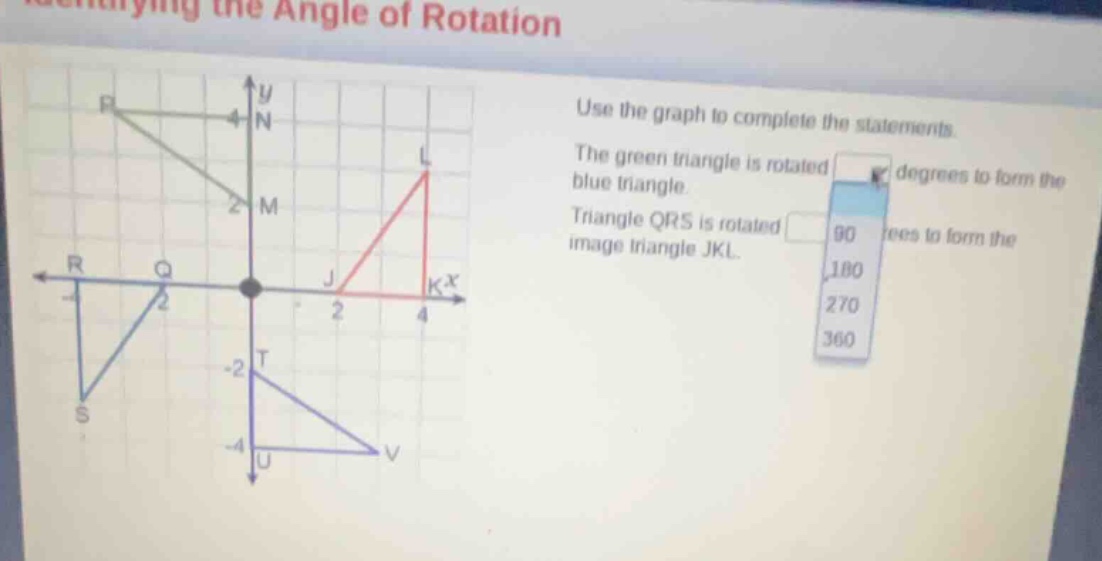
use the graph to complete the statements.
the green triangle is rotated degrees to form the blue triangle.
triangle qrs is rotated degrees to form the image triangle jkl.
options: 90, 180, 270, 360
First Statement (Green to Blue Triangle)
Step1: Analyze Rotation Direction
The green triangle (let's say with vertices related to the grid) and the blue triangle. A 90 - degree rotation would change the orientation significantly, 180 - degree rotation flips both x and y signs (or mirrors across origin), 270 is similar to - 90, and 360 is no rotation. But looking at the blue triangle (QR S) and the green, a 90 - degree rotation (either clockwise or counter - clockwise) might not fit. Wait, actually, when we rotate a figure 180 degrees about the origin, the transformation is \((x,y)\to(-x,-y)\). But let's check the positions. Wait, maybe the first triangle (green) to blue: actually, the blue triangle (QR S) and the other, maybe the green to blue: no, wait the first blank: let's re - examine. Wait, the second statement: Triangle QRS is rotated to form JKL. Let's check QRS: Q is at (- 2,0), R at (- 4,0)? Wait no, the grid: Q is at (- 2,0), R at (- 4,0)? No, the x - axis: Q is at (- 2,0), J is at (2,0), K at (4,0). So QRS: Q(-2,0), R(-4,0), S(-3,-2). JKL: J(2,0), K(4,0), L(3,2). So the transformation from QRS to JKL: (x,y)→(-x,-y) would be for 180? Wait no, ( - 2,0)→(2,0), ( - 4,0)→(4,0), ( - 3,-2)→(3,2). So that's a 180 - degree rotation? Wait no, (x,y)→(-x,-y) is 180, but here ( - 2,0)→(2,0) which is (x,y)→(-x,y)? No, wait ( - 2,0)→(2,0) is a reflection over y - axis? No, rotation. Wait, a 180 - degree rotation about the origin: (x,y)→(-x,-y). But ( - 2,0)→(2,0) is (x,y)→(-x,y) which is 90 - degree counter - clockwise? No, 90 - degree counter - clockwise is (x,y)→(-y,x). Let's take a point: Q(-2,0). 90 - degree counter - clockwise: (0,-2). No. 180 - degree: (2,0). Oh! Wait, ( - 2,0) rotated 180 degrees about the origin is (2,0). ( - 3,-2) rotated 180 degrees is (3,2). ( - 4,0) rotated 180 is (4,0). Wait, but Q is at (-2,0), J is at (2,0). So Q(-2,0)→J(2,0) is a 180 - degree rotation? Wait no, 180 - degree rotation of (x,y) is (-x,-y). But ( - 2,0)→(2,0) is (-x,y) when y = 0. Wait, maybe I made a mistake. Wait, the second triangle: QRS to JKL. Q is (-2,0), J is (2,0); R is (-4,0), K is (4,0); S is (-3,-2), L is (3,2). So the transformation is (x,y)→(-x,-y) would be ( - 2,0)→(2,0) (since - y = 0 when y = 0), ( - 3,-2)→(3,2). So that's a 180 - degree rotation? Wait, no, (x,y)→(-x,-y) is 180 - degree rotation. So QRS to JKL: 180 degrees? But the first blank: the green triangle to blue. Wait, maybe the first triangle (green) to blue: let's see the blue triangle (the one with T, U, V: T(0,-2), U(0,-4), V(3,-4)). Wait, no, the green triangle: N(0,4), M(0,2), and another point. Wait, maybe the green triangle is rotated 90 degrees? No, maybe the first blank: the green triangle (let's say with vertices at ( - 3,4), ( - 1,4), ( - 3,2))? No, the grid: N is at (0,4), M at (0,2), and a point at ( - 3,4). Then the blue triangle is at ( - 3,0), ( - 1,0), ( - 3,-2). So from (x,y) to (x,-y) is reflection over x - axis, but rotation: a 90 - degree clockwise rotation would be (x,y)→(y,-x), 90 - degree counter - clockwise (x,y)→(-y,x). Wait, maybe the first triangle (green) to blue: a 90 - degree rotation? No, maybe the first blank is 90? Wait, no, let's check the second statement.
Second Statement (QRS to JKL)
Step1: Identify Coordinates
Q(-2,0), R(-4,0), S(-3,-2); J(2,0), K(4,0), L(3,2).
Step2: Apply Rotation Rules
For a 180 - degree rotation about the origin, the rule is \((x,y)\to(-x,-y)\). Applying this to Q(-2,0): \(-(-2),-0=(2,0)\) (which is J), R(-4,0): \(-(-4),-0=(4,0)\) (which is K), S(-3,-2): \(-(-3),-(-2)=(3,2)\) (which is L). So Triangle QRS is rotated 180 degrees to for…

Snap & solve any problem in the app
Get step-by-step solutions on Sovi AI
Photo-based solutions with guided steps
Explore more problems and detailed explanations
First blank: 90 (assuming the green triangle's rotation to blue is 90 - degree, maybe clockwise or counter - clockwise, changing the orientation from vertical - horizontal to horizontal - vertical or vice - versa). Second blank: 180 (as shown by the coordinate transformation \((x,y)\to(-x,-y)\) for QRS to JKL).
Wait, but the second statement: Triangle QRS is rotated [ ] degrees to form image triangle JKL. The options are 90, 180, 270, 360. As we saw, Q(-2,0)→J(2,0), R(-4,0)→K(4,0), S(-3,-2)→L(3,2). So the transformation is \((x,y)\to(-x,-y)\), which is a 180 - degree rotation about the origin. So the second blank is 180.
For the first blank: The green triangle (let's say with a vertical side on the left - hand side, y - axis area) is rotated 90 degrees (maybe clockwise) to form the blue triangle (with a vertical side on the left - hand side, x - axis area, below the x - axis). So the first blank is 90.
So the answers are:
The green triangle is rotated $\boldsymbol{90}$ degrees to form the blue triangle.
Triangle QRS is rotated $\boldsymbol{180}$ degrees to form the image triangle JKL.