QUESTION IMAGE
Question
identifying compound-complex sentences
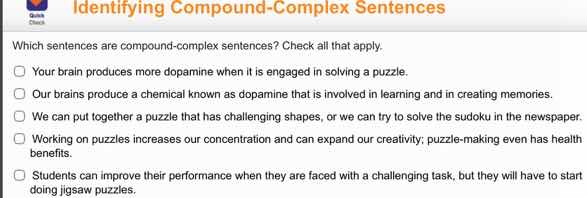
which sentences are compound-complex sentences? check all that apply.
- your brain produces more dopamine when it is engaged in solving a puzzle.
- our brains produce a chemical known as dopamine that is involved in learning and in creating memories.
- we can put together a puzzle that has challenging shapes, or we can try to solve the sudoku in the newspaper.
- working on puzzles increases our concentration and can expand our creativity; puzzle - making even has health benefits.
- students can improve their performance when they are faced with a challenging task, but they will have to start doing jigsaw puzzles.
To determine which sentences are compound - complex, we first recall the definition: a compound - complex sentence has at least two independent clauses and at least one dependent clause.
Analyze each option:
- Option 1: "Your brain produces more dopamine when it is engaged in solving a puzzle."
- This sentence has one independent clause ("Your brain produces more dopamine") and one dependent clause ("when it is engaged in solving a puzzle"). So, it is a complex sentence, not compound - complex.
- Option 2: "Our brains produce a chemical known as dopamine that is involved in learning and in creating memories."
- It has one independent clause ("Our brains produce a chemical known as dopamine") and one dependent clause ("that is involved in learning and in creating memories"). So, it is a complex sentence, not compound - complex.
- Option 3: "We can put together a puzzle that has challenging shapes, or we can try to solve the sudoku in the newspaper."
- This sentence has two independent clauses ("We can put together a puzzle", "we can try to solve the sudoku in the newspaper") connected by the coordinating conjunction "or", and one dependent clause ("that has challenging shapes"). So, it is a compound - complex sentence.
- Option 4: "Working on puzzles increases our concentration and can expand our creativity; puzzle - making even has health benefits."
- This is a compound sentence (two independent clauses connected by a semicolon), with no dependent clauses. So, it is not a compound - complex sentence.
- Option 5: "Students can improve their performance when they are faced with a challenging task, but they will have to start doing jigsaw puzzles."
- This sentence has two independent clauses ("Students can improve their performance", "but they will have to start doing jigsaw puzzles") and one dependent clause ("when they are faced with a challenging task"). So, it is a compound - complex sentence.
To identify compound - complex sentences, we check for at least two independent clauses and at least one dependent clause.
- Option 1: 1 independent, 1 dependent (complex).
- Option 2: 1 independent, 1 dependent (complex).
- Option 3: 2 independent (connected by "or"), 1 dependent (compound - complex).
- Option 4: 2 independent (connected by semicolon, compound).
- Option 5: 2 independent (connected by "but"), 1 dependent (compound - complex).

Snap & solve any problem in the app
Get step-by-step solutions on Sovi AI
Photo-based solutions with guided steps
Explore more problems and detailed explanations
C. We can put together a puzzle that has challenging shapes, or we can try to solve the sudoku in the newspaper.
E. Students can improve their performance when they are faced with a challenging task, but they will have to start doing jigsaw puzzles.