QUESTION IMAGE
Question
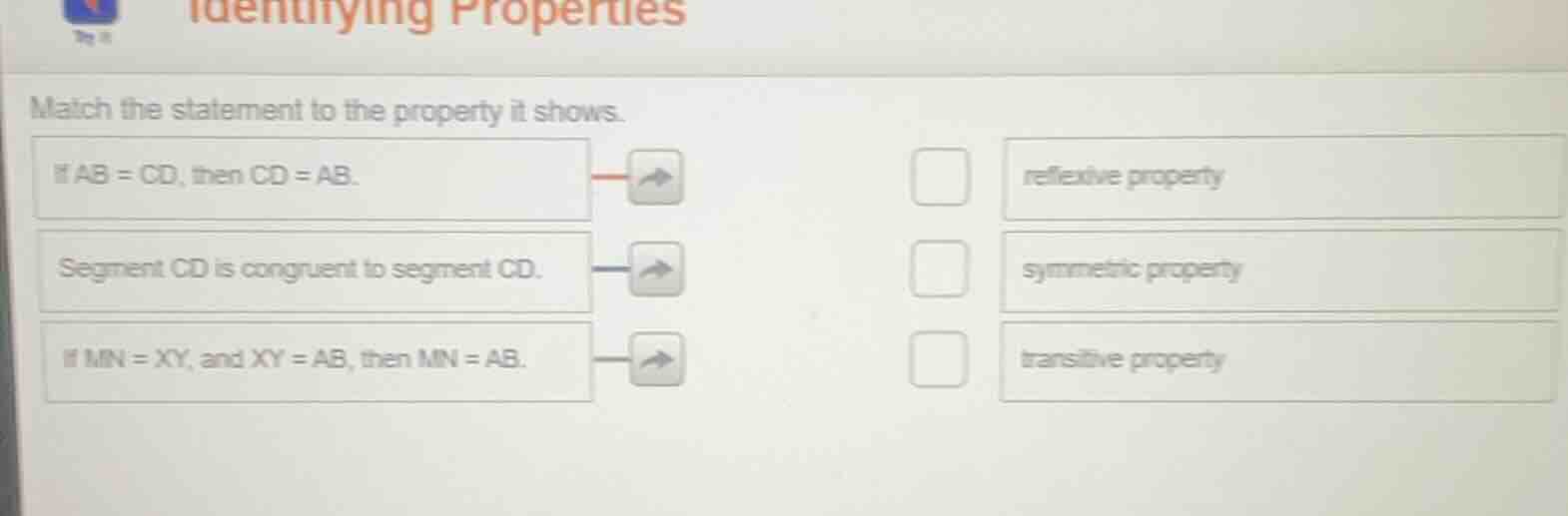
identifying properties
match the statement to the property it shows.
if ab = cd, then cd = ab.
segment cd is congruent to segment cd.
if mn = xy, and xy = ab, then mn = ab.
reflexive property
symmetric property
transitive property
Brief Explanations
- For the statement "If \( AB = CD \), then \( CD = AB \)": The symmetric property of equality (or congruence) states that if one quantity is equal (or congruent) to another, then the second is equal (or congruent) to the first. So this matches the symmetric property.
- For the statement "Segment \( CD \) is congruent to segment \( CD \)": The reflexive property of congruence (or equality) states that any quantity is congruent (or equal) to itself. So this matches the reflexive property.
- For the statement "If \( MN = XY \), and \( XY = AB \), then \( MN = AB \)": The transitive property of equality (or congruence) states that if \( a = b \) and \( b = c \), then \( a = c \). So this matches the transitive property.

Snap & solve any problem in the app
Get step-by-step solutions on Sovi AI
Photo-based solutions with guided steps
Explore more problems and detailed explanations
- "If \( AB = CD \), then \( CD = AB \)" → symmetric property
- "Segment \( CD \) is congruent to segment \( CD \)" → reflexive property
- "If \( MN = XY \), and \( XY = AB \), then \( MN = AB \)" → transitive property