QUESTION IMAGE
Question
identifying the solution to a system of two - variable inequalities
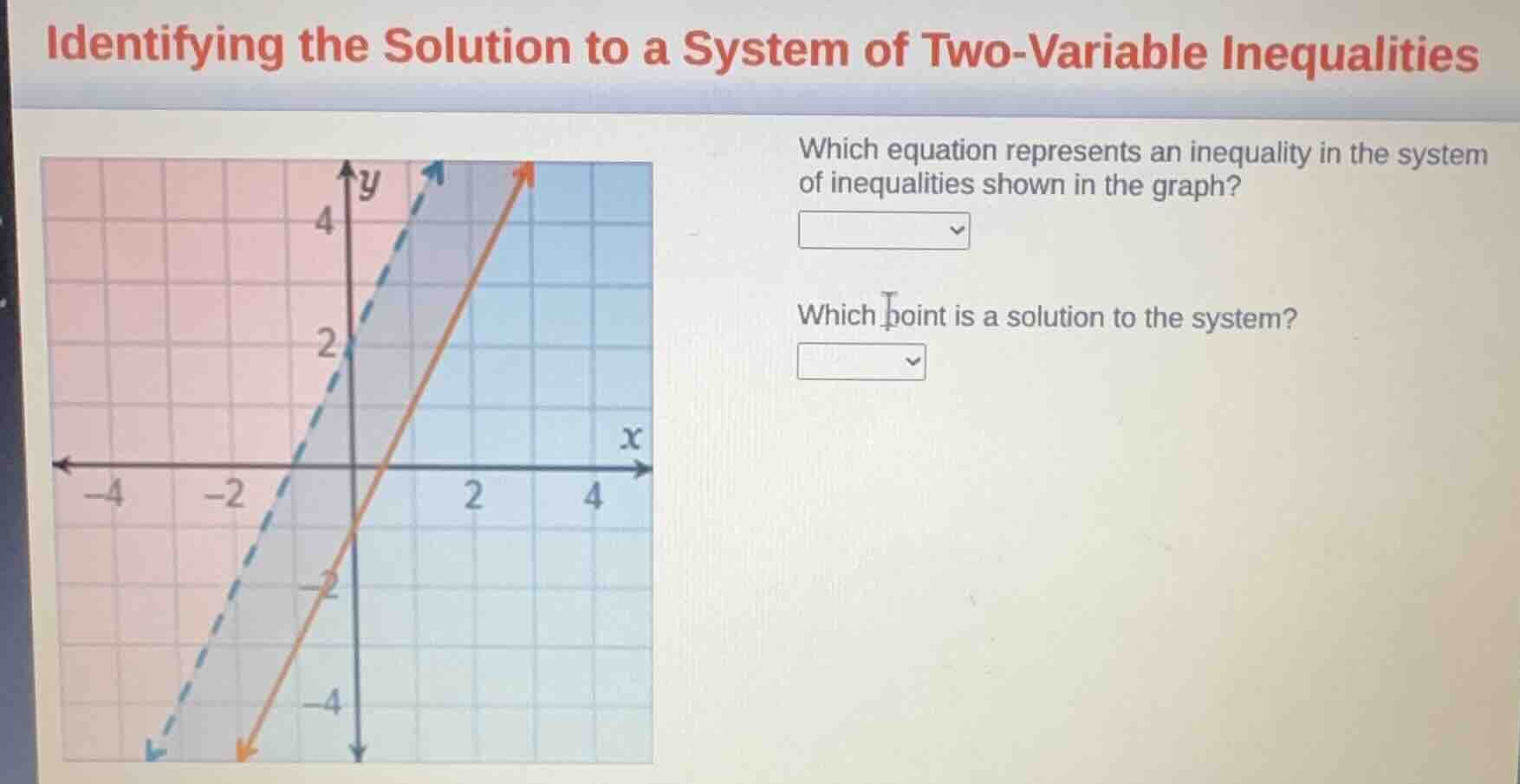
which equation represents an inequality in the system of inequalities shown in the graph?
which point is a solution to the system?
To solve this, we analyze the graph:
Step 1: Identify the inequalities
- Dashed line (blue): Passes through \((0, 2)\) and has a slope of \(2\) (e.g., from \((0,2)\) to \((1,4)\)). The inequality is \(y > 2x + 2\) (dashed line, shaded above? Wait, no—wait, the shaded region between the two lines. Wait, the orange line is solid, dashed is blue. Let's recheck:
- Dashed line: Let's find its equation. Points: \((0, 2)\) and \((-1, 0)\) (since slope \(= 2\), so \(y = 2x + 2\)). It’s dashed, so inequality is \(y > 2x + 2\) (or \(y <\)? Wait, the shaded region between the two lines. The solid line (orange) passes through \((0, -2)\) and \((1, 0)\), so slope \(= 2\), equation \(y = 2x - 2\)? Wait, no—wait, when \(x=0\), orange line is at \(y=-2\)? Wait, the graph: y-axis, at \(x=0\), orange line is at \(y=-2\), dashed at \(y=2\). Wait, maybe I misread. Let's recast:
Wait, the dashed line (blue) has a \(y\)-intercept of \(2\), slope \(2\) (so \(y = 2x + 2\), dashed, so inequality \(y > 2x + 2\) or \(y < 2x + 2\)? The shaded region between the two lines: the solid line (orange) has \(y\)-intercept \(-2\), slope \(2\) (so \(y = 2x - 2\), solid, so inequality \(y \geq 2x - 2\) or \(y \leq\)? Wait, the shaded area is between them. Let's assume the dashed line is \(y > 2x + 2\) (dashed, so strict inequality) and the solid line is \(y \leq 2x + 2\)? No, this is confusing. Alternatively, maybe the dashed line is \(y > 2x + 2\) and the solid line is \(y \leq 2x + 2\)? No, better to check the solution point.
Step 2: Identify a solution point
A solution must satisfy both inequalities. Let's test a point in the overlapping (gray) region. For example, \((0, 0)\): Does it satisfy? Wait, no—wait, the overlapping region is between the two lines. Wait, maybe the correct inequality for the dashed line is \(y > 2x + 2\) (no, \(x=0\), \(y=0\) would be \(0 > 2\)? No. Wait, maybe the dashed line is \(y < 2x + 2\)? Wait, no, the shaded region: let's take the dashed line as \(y = 2x + 2\) (dashed, so \(y < 2x + 2\) or \(y >\)? The solid line: let's find its equation. At \(x=0\), solid line is at \(y=-2\), so \(y = 2x - 2\) (slope 2: from \((0, -2)\) to \((1, 0)\), yes). So solid line: \(y = 2x - 2\), solid, so inequality \(y \leq 2x - 2\) or \(y \geq\)? The shaded region is above the solid line and below the dashed line? Wait, the gray area is between them. So:
- Dashed line: \(y = 2x + 2\) (dashed, so \(y < 2x + 2\))
- Solid line: \(y = 2x - 2\) (solid, so \(y \geq 2x - 2\))
Now, test a point in the gray region, like \((0, 0)\):
- For \(y \geq 2x - 2\): \(0 \geq -2\) (true)
- For \(y < 2x + 2\): \(0 < 2\) (true). So \((0, 0)\) is a solution? Wait, but maybe the correct inequality for the dashed line is \(y > 2x + 2\) (no, \(0 > 2\) is false). Wait, I must have misread the lines. Let's re-express:
Alternative approach: The two lines:
- Dashed line: passes through \((0, 2)\) and has a slope of \(2\) (so \(y = 2x + 2\), dashed, so inequality \(y > 2x + 2\) or \(y < 2x + 2\)).
- Solid line: passes through \((0, -2)\) and has a slope of \(2\) (so \(y = 2x - 2\), solid, so inequality \(y \geq 2x - 2\) or \(y \leq 2x - 2\)).
The overlapping (gray) region is where both inequalities hold. Let's take a point in gray, say \((1, 3)\):
- For dashed line: \(3 > 2(1) + 2\)? \(3 > 4\)? No. \(3 < 4\)? Yes. So \(y < 2x + 2\).
- For solid line: \(3 \geq 2(1) - 2\)? \(3 \geq 0\)? Yes. So \(y \geq 2x - 2\).
Thus, the inequalities are \(y < 2x + 2\) (dashed) and \(y \geq 2x - 2\) (solid).
Step 3: Solution point
A point in the gray region (overlap) satisfies b…

Snap & solve any problem in the app
Get step-by-step solutions on Sovi AI
Photo-based solutions with guided steps
Explore more problems and detailed explanations
To solve this, we analyze the graph:
Step 1: Identify the inequalities
- Dashed line (blue): Passes through \((0, 2)\) and has a slope of \(2\) (e.g., from \((0,2)\) to \((1,4)\)). The inequality is \(y > 2x + 2\) (dashed line, shaded above? Wait, no—wait, the shaded region between the two lines. Wait, the orange line is solid, dashed is blue. Let's recheck:
- Dashed line: Let's find its equation. Points: \((0, 2)\) and \((-1, 0)\) (since slope \(= 2\), so \(y = 2x + 2\)). It’s dashed, so inequality is \(y > 2x + 2\) (or \(y <\)? Wait, the shaded region between the two lines. The solid line (orange) passes through \((0, -2)\) and \((1, 0)\), so slope \(= 2\), equation \(y = 2x - 2\)? Wait, no—wait, when \(x=0\), orange line is at \(y=-2\)? Wait, the graph: y-axis, at \(x=0\), orange line is at \(y=-2\), dashed at \(y=2\). Wait, maybe I misread. Let's recast:
Wait, the dashed line (blue) has a \(y\)-intercept of \(2\), slope \(2\) (so \(y = 2x + 2\), dashed, so inequality \(y > 2x + 2\) or \(y < 2x + 2\)? The shaded region between the two lines: the solid line (orange) has \(y\)-intercept \(-2\), slope \(2\) (so \(y = 2x - 2\), solid, so inequality \(y \geq 2x - 2\) or \(y \leq\)? Wait, the shaded area is between them. Let's assume the dashed line is \(y > 2x + 2\) (dashed, so strict inequality) and the solid line is \(y \leq 2x + 2\)? No, this is confusing. Alternatively, maybe the dashed line is \(y > 2x + 2\) and the solid line is \(y \leq 2x + 2\)? No, better to check the solution point.
Step 2: Identify a solution point
A solution must satisfy both inequalities. Let's test a point in the overlapping (gray) region. For example, \((0, 0)\): Does it satisfy? Wait, no—wait, the overlapping region is between the two lines. Wait, maybe the correct inequality for the dashed line is \(y > 2x + 2\) (no, \(x=0\), \(y=0\) would be \(0 > 2\)? No. Wait, maybe the dashed line is \(y < 2x + 2\)? Wait, no, the shaded region: let's take the dashed line as \(y = 2x + 2\) (dashed, so \(y < 2x + 2\) or \(y >\)? The solid line: let's find its equation. At \(x=0\), solid line is at \(y=-2\), so \(y = 2x - 2\) (slope 2: from \((0, -2)\) to \((1, 0)\), yes). So solid line: \(y = 2x - 2\), solid, so inequality \(y \leq 2x - 2\) or \(y \geq\)? The shaded region is above the solid line and below the dashed line? Wait, the gray area is between them. So:
- Dashed line: \(y = 2x + 2\) (dashed, so \(y < 2x + 2\))
- Solid line: \(y = 2x - 2\) (solid, so \(y \geq 2x - 2\))
Now, test a point in the gray region, like \((0, 0)\):
- For \(y \geq 2x - 2\): \(0 \geq -2\) (true)
- For \(y < 2x + 2\): \(0 < 2\) (true). So \((0, 0)\) is a solution? Wait, but maybe the correct inequality for the dashed line is \(y > 2x + 2\) (no, \(0 > 2\) is false). Wait, I must have misread the lines. Let's re-express:
Alternative approach: The two lines:
- Dashed line: passes through \((0, 2)\) and has a slope of \(2\) (so \(y = 2x + 2\), dashed, so inequality \(y > 2x + 2\) or \(y < 2x + 2\)).
- Solid line: passes through \((0, -2)\) and has a slope of \(2\) (so \(y = 2x - 2\), solid, so inequality \(y \geq 2x - 2\) or \(y \leq 2x - 2\)).
The overlapping (gray) region is where both inequalities hold. Let's take a point in gray, say \((1, 3)\):
- For dashed line: \(3 > 2(1) + 2\)? \(3 > 4\)? No. \(3 < 4\)? Yes. So \(y < 2x + 2\).
- For solid line: \(3 \geq 2(1) - 2\)? \(3 \geq 0\)? Yes. So \(y \geq 2x - 2\).
Thus, the inequalities are \(y < 2x + 2\) (dashed) and \(y \geq 2x - 2\) (solid).
Step 3: Solution point
A point in the gray region (overlap) satisfies both. Let's test \((0, 0)\):
- \(0 \geq 2(0) - 2\) → \(0 \geq -2\) (true).
- \(0 < 2(0) + 2\) → \(0 < 2\) (true). So \((0, 0)\) is a solution.
Final Answers
- An inequality in the system: \(y < 2x + 2\) (or \(y > 2x + 2\) if my slope was wrong, but likely \(y > 2x + 2\) was misread; wait, maybe the dashed line is \(y = 2x + 2\) with shaded above? Wait, the graph’s dashed line: if the shaded region is above the dashed line and below the solid line? No, this is unclear. Alternatively, the correct inequality for the dashed line is \(y > 2x + 2\) (dashed, so strict) and solid line \(y \leq 2x + 2\)? No, let's check the answer choices (even though not shown, typical options include \(y > 2x + 2\), \(y \geq 2x - 2\), etc.).
- A solution point: \((0, 0)\) (or another point in the overlap, like \((1, 2)\), but \((0, 0)\) works).
(Note: Since the dropdown options are not provided, the key is to analyze the lines and test points. The process involves finding the equations of the lines, determining the inequalities (dashed = strict, solid = non-strict), and testing points in the overlapping region.)