QUESTION IMAGE
Question
identifying a valid probability distribution
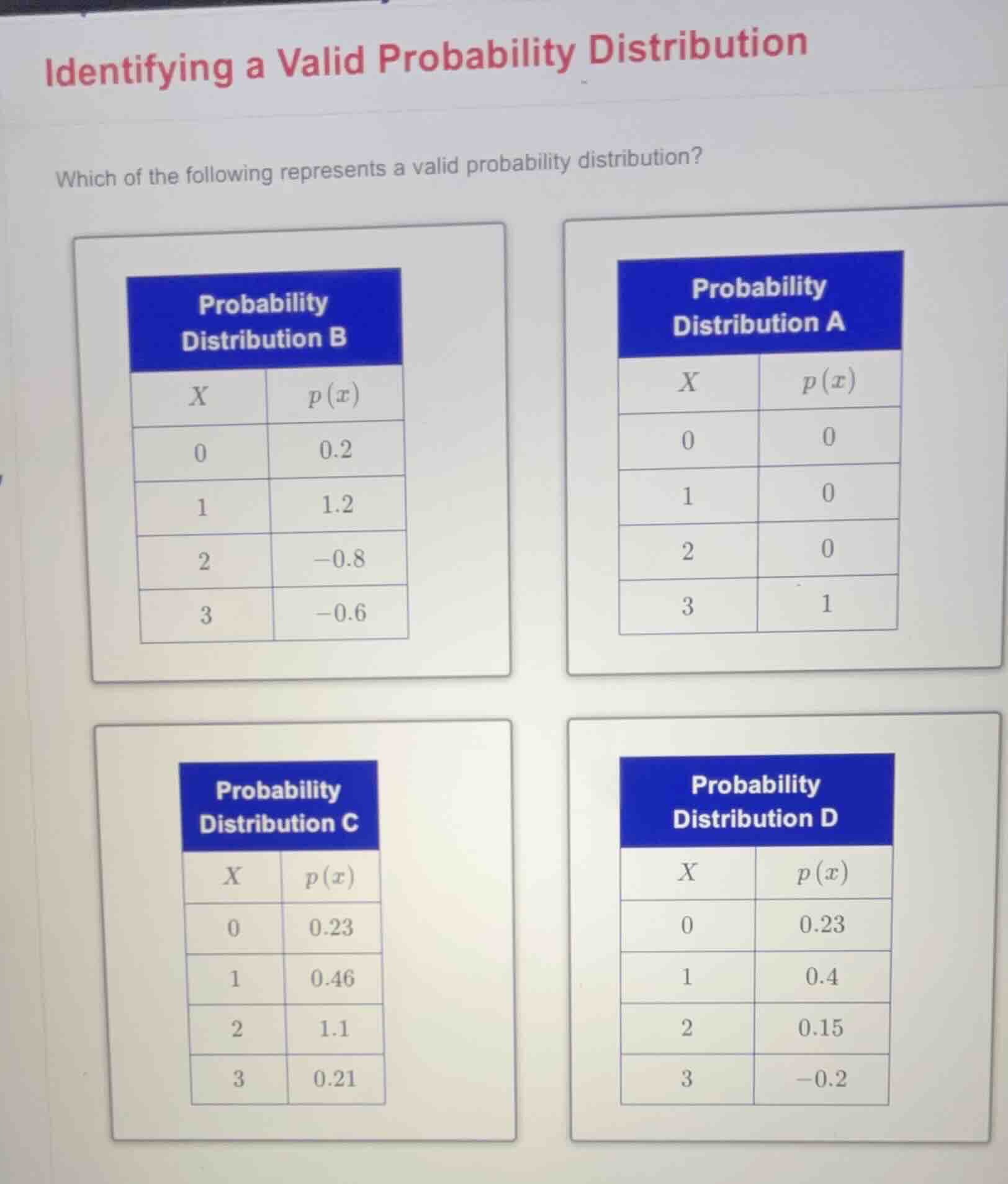
which of the following represents a valid probability distribution?
probability
distribution b
x & p(x)\\
0 & 0.2\\
1 & 1.2\\
2 & -0.8\\
3 & -0.6\\\\
probability
distribution a
x & p(x)\\
0 & 0\\
1 & 0\\
2 & 0\\
3 & 1\\\\
probability
distribution c
x & p(x)\\
0 & 0.23\\
1 & 0.46\\
2 & 1.1\\
3 & 0.21\\\\
probability
distribution d
x & p(x)\\
0 & 0.23\\
1 & 0.4\\
2 & 0.15\\
3 & -0.2
To determine a valid probability distribution, we check two conditions:
- Each probability \( p(x) \) must be between 0 and 1 (inclusive).
- The sum of all probabilities must equal 1.
Step 1: Analyze Probability Distribution B
- \( p(0) = 0.2 \), \( p(1) = 1.2 \) (greater than 1), \( p(2) = -0.8 \) (negative), \( p(3) = -0.6 \) (negative).
Fails condition 1.
Step 2: Analyze Probability Distribution A
- \( p(0) = 0 \), \( p(1) = 0 \), \( p(2) = 0 \), \( p(3) = 1 \).
Sum: \( 0 + 0 + 0 + 1 = 1 \). All probabilities are between 0 and 1.
Passes both conditions? Wait, but let's check others too.
Step 3: Analyze Probability Distribution C
- \( p(2) = 1.1 \) (greater than 1).
Fails condition 1.
Step 4: Analyze Probability Distribution D
- \( p(3) = -0.2 \) (negative).
Fails condition 1.
Wait, recheck Distribution A: All \( p(x) \) are 0 or 1 (within [0,1]), and sum is 1. But wait, another check: for a discrete probability distribution, the sum of \( p(x) \) over all \( x \) must be 1, and each \( p(x) \in [0,1] \). Distribution A: \( X \) takes 0,1,2,3. \( p(0)=0 \), \( p(1)=0 \), \( p(2)=0 \), \( p(3)=1 \). Sum is 1, and all \( p(x) \) are in [0,1]. But wait, is there a mistake? Wait, maybe I missed. Wait, let's re-express:
Wait, maybe I made a mistake. Wait, let's check again:
Distribution B: negative probabilities and \( p(1)=1.2>1 \) → invalid.
Distribution A: \( p(x) \) values: 0,0,0,1. Sum is 1. Each \( p(x) \) is between 0 and 1. So valid?
Wait, but let's check Distribution A again. The table is:
\( X \): 0,1,2,3; \( p(x) \): 0,0,0,1.
Yes, sum is 1, and each \( p(x) \in [0,1] \). So it's valid.
Wait, but maybe the intended answer is Distribution A? Wait, no, wait: Wait, maybe I messed up. Wait, let's check Distribution A again. Wait, the problem is to identify which is valid. Let's confirm the two conditions:
- For all \( x \), \( 0 \leq p(x) \leq 1 \).
- \( \sum p(x) = 1 \).
Distribution A:
- \( p(0)=0 \) (0 ≤ 0 ≤ 1), \( p(1)=0 \) (0 ≤ 0 ≤ 1), \( p(2)=0 \) (0 ≤ 0 ≤ 1), \( p(3)=1 \) (0 ≤ 1 ≤ 1).
- Sum: \( 0 + 0 + 0 + 1 = 1 \).
So it satisfies both conditions.
Distribution B: \( p(1)=1.2>1 \), \( p(2)=-0.8<0 \), \( p(3)=-0.6<0 \) → invalid.
Distribution C: \( p(2)=1.1>1 \) → invalid.
Distribution D: \( p(3)=-0.2<0 \) → invalid.
So the valid one is Probability Distribution A.

Snap & solve any problem in the app
Get step-by-step solutions on Sovi AI
Photo-based solutions with guided steps
Explore more problems and detailed explanations
Probability Distribution A (with \( X \) values 0,1,2,3 and \( p(x) \) values 0,0,0,1) is the valid probability distribution.