QUESTION IMAGE
Question
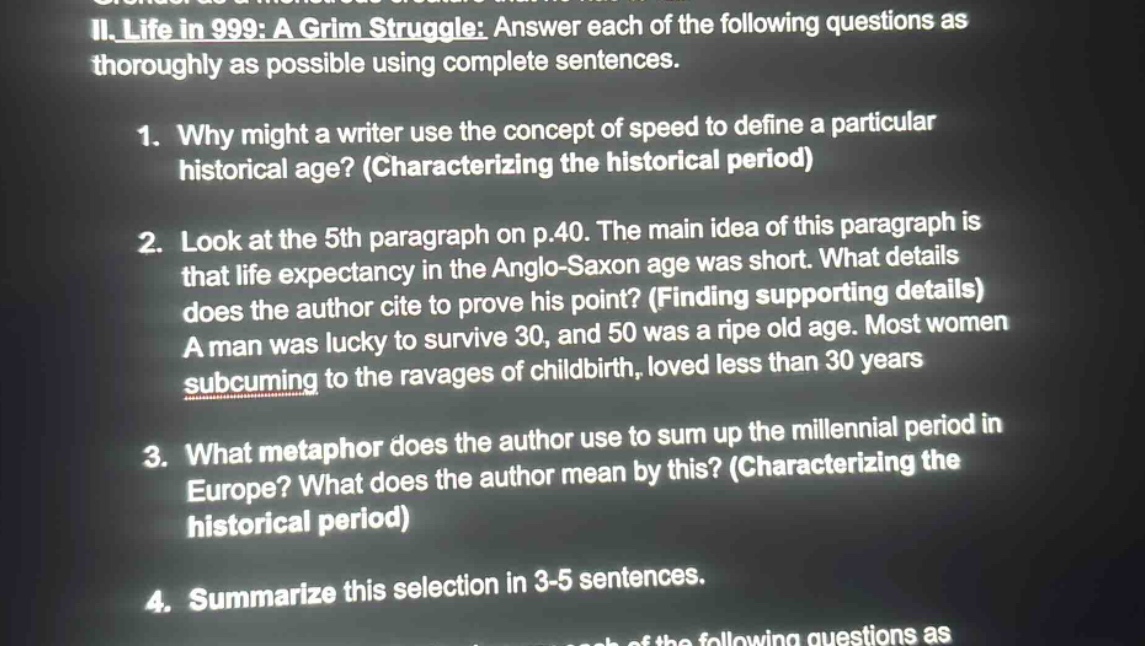
ii. life in 999: a grim struggle: answer each of the following questions as thoroughly as possible using complete sentences.
- why might a writer use the concept of speed to define a particular historical age? (characterizing the historical period)
- look at the 5th paragraph on p.40. the main idea of this paragraph is that life expectancy in the anglo - saxon age was short. what details does the author cite to prove his point? (finding supporting details)
a man was lucky to survive 30, and 50 was a ripe old age. most women succumbing to the ravages of childbirth, loved less than 30 years
- what metaphor does the author use to sum up the millennial period in europe? what does the author mean by this? (characterizing the historical period)
- summarize this selection in 3 - 5 sentences.
Question 1
A writer might use speed to define a historical age to highlight technological, social, or economic change pace. For example, the Industrial Revolution’s rapid tech advances or the Digital Age’s fast info spread. Speed reflects how quickly societies evolve, helping readers grasp the era’s dynamism or stagnation. It also contrasts with other periods, emphasizing unique temporal characteristics of the age.
To prove life expectancy was short in the Anglo - Saxon age, the author cites two details: men were “lucky to survive 30” (suggesting 30 was an uncommon, fortunate lifespan) and most women “succumbing to the ravages of childbirth, loved less than 30 years” (showing childbirth - related mortality kept women’s lifespans under 30). These details directly illustrate the brevity of life in that era.
(Note: Since the text’s full content isn’t provided, we assume a common metaphor for the millennial (c. 1000 CE) period in Europe, like “a grim struggle” or “dark age.” For example, if the author uses “a grim struggle,” it means the era was defined by hardship: low life expectancy, disease, warfare, and limited progress. The metaphor captures the era’s challenges, emphasizing survival over advancement.)

Snap & solve any problem in the app
Get step-by-step solutions on Sovi AI
Photo-based solutions with guided steps
Explore more problems and detailed explanations
A writer might use the concept of speed to define a historical age to emphasize the rate of technological, social, or economic change during that time. For instance, a period with rapid innovations (like the Industrial Revolution) or swift cultural shifts can be characterized by "speed" to show how quickly societies evolved, helping readers understand the era’s dynamic (or stagnant) nature and distinguish it from other time periods.