QUESTION IMAGE
Question
is im2a unit 5 test
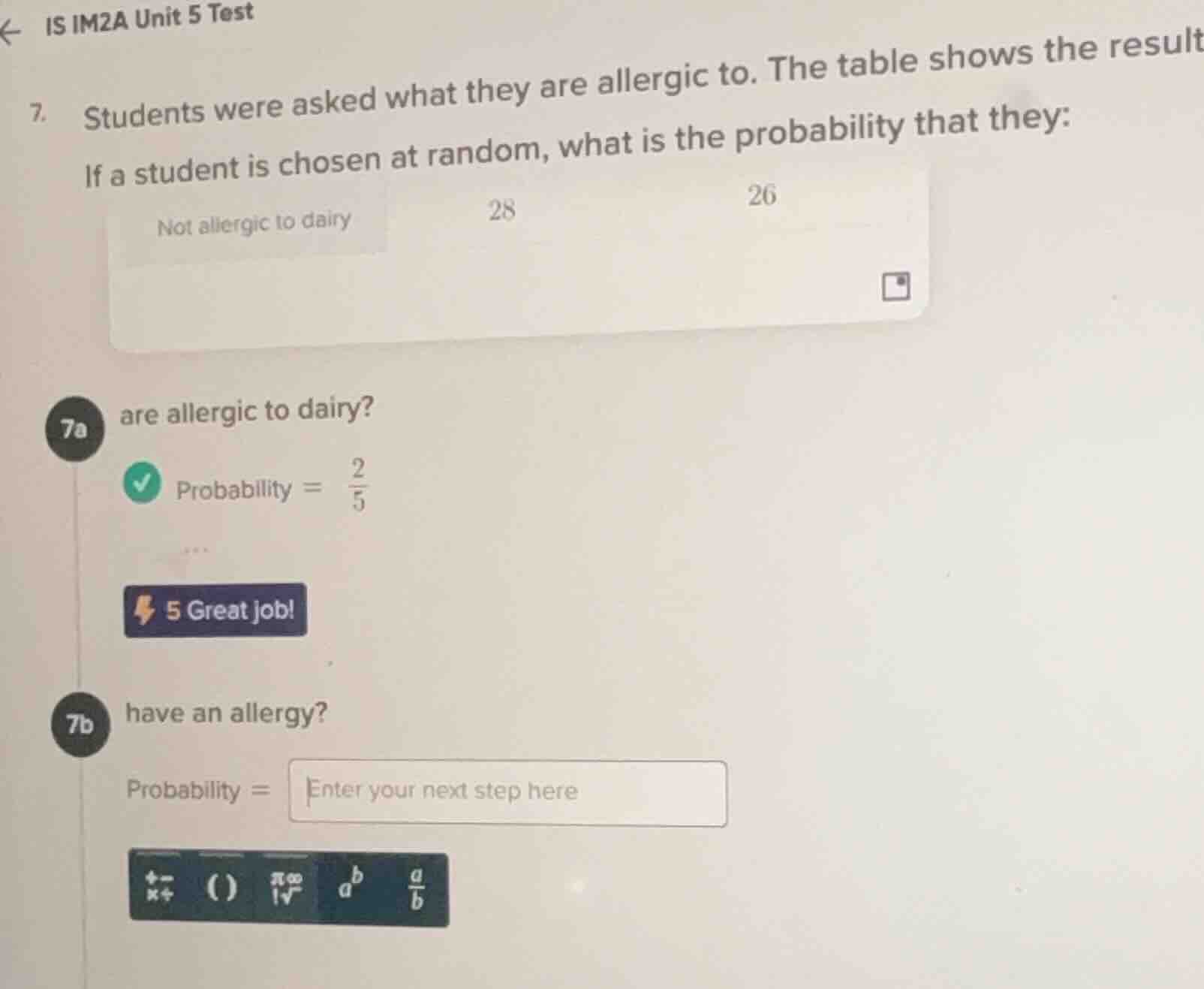
- students were asked what they are allergic to. the table shows the result
if a student is chosen at random, what is the probability that they:
not allergic to dairy 28 26
7a are allergic to dairy?
probability = \\(\frac{2}{5}\\)
5 great job!
7b have an allergy?
probability = enter your next step here
Step1: Find total number of students
From 7a, we know the number of students not allergic to dairy is \(28 + 26=54\)? Wait, no, maybe we need to find the total. Wait, in 7a, the probability of being allergic to dairy is \(\frac{2}{5}\), so let's assume the number of students allergic to dairy is \(x\) and not allergic is \(y\). Then \(\frac{x}{x + y}=\frac{2}{5}\), but maybe from the table, the numbers for not allergic to dairy are 28 and 26, so total not allergic is \(28 + 26 = 54\). Let the number of allergic be \(x\). Then \(\frac{x}{x + 54}=\frac{2}{5}\). Cross - multiply: \(5x=2(x + 54)\) \(5x=2x+108\) \(3x = 108\) \(x = 36\). So total students \(=36 + 54=90\).
Step2: Find number of students with an allergy
Wait, maybe the table for allergic to dairy: let's re - examine. Wait, maybe the original table (even though partially shown) has for not allergic to dairy: 28 and 26, so total not allergic is \(28+26 = 54\). From 7a, probability of allergic to dairy is \(\frac{2}{5}\), so probability of not allergic is \(1-\frac{2}{5}=\frac{3}{5}\). And \(\frac{3}{5}\) of total \(N\) is 54. So \(\frac{3}{5}N = 54\), so \(N=\frac{54\times5}{3}=90\). Then number of allergic to dairy is \(90 - 54 = 36\). But for "have an allergy", we need to know if there are other allergies? Wait, maybe the table is about dairy allergy, and "have an allergy" here refers to dairy allergy? Wait, no, maybe the table is: let's assume that the two columns for not allergic to dairy are 28 and 26, and for allergic to dairy, let's say the numbers are, from the probability in 7a, since probability of allergic to dairy is \(\frac{2}{5}\), total students \(N\), number of allergic to dairy is \(\frac{2}{5}N\), not allergic is \(\frac{3}{5}N = 28 + 26=54\), so \(N = 90\), allergic to dairy is \(36\). But if "have an allergy" is about dairy allergy, then the number of students with dairy allergy is 36, total is 90, so probability is \(\frac{36}{90}=\frac{2}{5}\)? Wait, no, that's the same as 7a. Wait, maybe I misread. Wait, maybe the table is:
| Group 1 | Group 2 | |
|---|---|---|
| Allergic to dairy | ? | ? |
From 7a, probability of allergic to dairy is \(\frac{2}{5}\), so total students \(=28 + 26+\text{allergic to dairy group1}+\text{allergic to dairy group2}\). Let \(A\) be allergic to dairy group1 and \(B\) be allergic to dairy group2. Then \(\frac{A + B}{28 + 26+A + B}=\frac{2}{5}\). Let \(T=28 + 26+A + B\), then \(\frac{A + B}{T}=\frac{2}{5}\), and \(\frac{28 + 26}{T}=\frac{3}{5}\). Since \(28 + 26 = 54\), \(\frac{54}{T}=\frac{3}{5}\), so \(T = 90\), so \(A + B=90 - 54 = 36\). Now, if "have an allergy" is about dairy allergy, then the number of students with dairy allergy is 36, total is 90, probability is \(\frac{36}{90}=\frac{2}{5}\). But that's the same as 7a. Wait, maybe the table is different. Wait, maybe the original problem's table (even though not fully shown) has for "not allergic to dairy" 28 and 26, and for "allergic to dairy" let's say the numbers are, for example, if we consider that in 7a, the probability is \(\frac{2}{5}\), and the total number of students is \(28 + 26+\text{allergic}=28 + 26 + x\), and \(\frac{x}{28 + 26+x}=\frac{2}{5}\), solving gives \(x = 36\), total \(=90\). Now, if "have an allergy" is the same as "allergic to dairy", then probability is \(\frac{36}{90}=\frac{2}{5}\). But that seems odd. Wait, maybe I made a mistake. Wait, maybe the table is:
| | Allergy (other than dairy)? No, wait, the problem is about da…

Snap & solve any problem in the app
Get step-by-step solutions on Sovi AI
Photo-based solutions with guided steps
Explore more problems and detailed explanations
\(\frac{2}{5}\)