QUESTION IMAGE
Question
x=
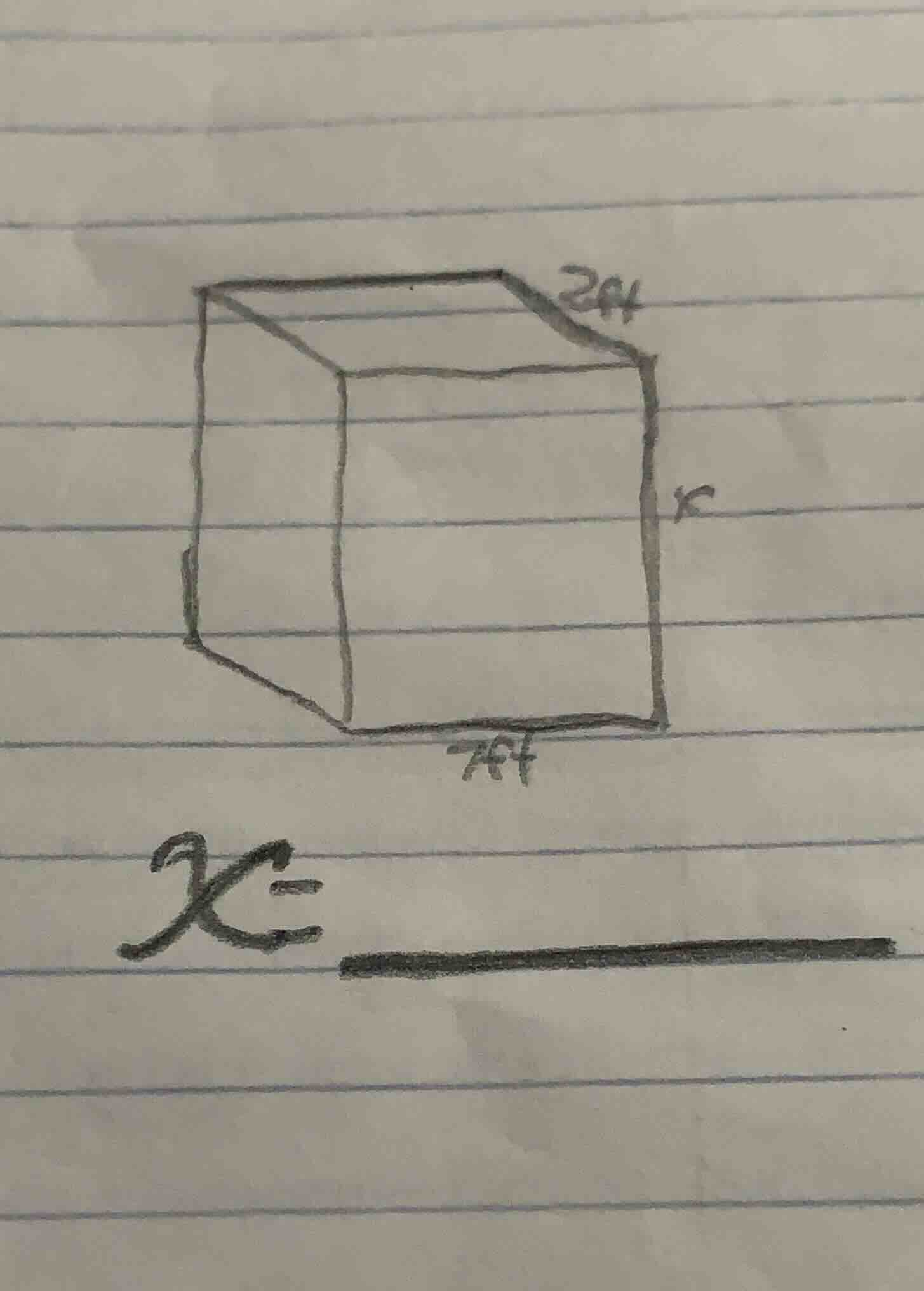
(the image shows a three - dimensional figure, with some side lengths marked as 2 ft, x, etc.)
Step1: Identify the shape and formula
The figure appears to be a rectangular prism (or a box) with volume related to its dimensions. Wait, actually, if we assume it's a rectangular prism with length \( x \) ft, width \( x \) ft, and height \( x \) ft? No, wait, the top side is 24 (maybe 24 square feet? Wait, maybe it's a rectangular prism with length \( x \), width \( x \), and the area of the top face is 24? Wait, the bottom is \( x \) ft, the side is \( x \), and the top area is 24? Wait, maybe it's a square base? Wait, maybe the volume or surface area? Wait, maybe it's a rectangular prism where the area of the top face is length times width, and if length and width are \( x \) and \( x \)? No, wait, the drawing shows a rectangular prism with length \( x \) ft, width \( x \) ft, and the area of the top face is 24 square feet? Wait, maybe the top face is a square? Wait, no, maybe the figure is a cube? Wait, no, the top is labeled 24, and the side is \( x \), bottom is \( x \). Wait, maybe it's a rectangular prism with length \( x \), width \( x \), and the area of the top face (which is a rectangle) is \( x \times x = 24 \)? Wait, that would be a square. Wait, maybe the area of the top face is 24, so \( x^2 = 24 \)? No, wait, maybe the volume? Wait, no, the drawing is a bit unclear. Wait, maybe it's a rectangular prism with length \( x \), width \( x \), and height \( x \), but the top area is 24. Wait, no, maybe the figure is a square-based prism where the area of the base (top or bottom) is \( x \times x \) and that area is 24? Wait, no, maybe the perimeter? No, the labels are 24 (maybe area) and \( x \) (length and width). So if it's a square with side length \( x \), and area 24, then \( x^2 = 24 \), so \( x = \sqrt{24} = 2\sqrt{6} \approx 4.899 \). But wait, maybe the figure is a rectangular prism with length \( x \), width \( x \), and the area of the top face is 24, so \( x \times x = 24 \), so \( x = \sqrt{24} = 2\sqrt{6} \) or approximately 4.899. But maybe I misinterpret. Wait, maybe the figure is a cube? No, the top is 24. Wait, maybe the volume is 24, and it's a cube? No, volume of cube is \( x^3 \). Wait, maybe the surface area? No, surface area of cube is \( 6x^2 \). Wait, maybe the figure is a rectangular prism with length \( x \), width \( x \), and height \( x \), and the area of one face is 24. So \( x^2 = 24 \), so \( x = \sqrt{24} = 2\sqrt{6} \approx 4.899 \). Alternatively, maybe the figure is a rectangle with length \( x \) and width \( x \), area 24. So \( x^2 = 24 \), so \( x = \sqrt{24} = 2\sqrt{6} \) or \( \approx 4.899 \). But maybe the problem is that the area of the square (top face) is 24, so \( x^2 = 24 \), so \( x = \sqrt{24} = 2\sqrt{6} \) or simplified. Wait, maybe the figure is a square with area 24, so side length \( x = \sqrt{24} = 2\sqrt{6} \approx 4.899 \). But let's check. If the top face is a square with side length \( x \), and area 24, then \( x^2 = 24 \), so \( x = \sqrt{24} = 2\sqrt{6} \) (exact form) or approximately 4.90.
Step2: Solve for \( x \)
If the area of the square (top face) is 24, then:
\( x^2 = 24 \)
Take the square root of both sides:
\( x = \sqrt{24} = \sqrt{4 \times 6} = \sqrt{4} \times \sqrt{6} = 2\sqrt{6} \approx 4.899 \)

Snap & solve any problem in the app
Get step-by-step solutions on Sovi AI
Photo-based solutions with guided steps
Explore more problems and detailed explanations
\( x = 2\sqrt{6} \) (or approximately \( 4.90 \))