QUESTION IMAGE
Question
impacts of industrialization
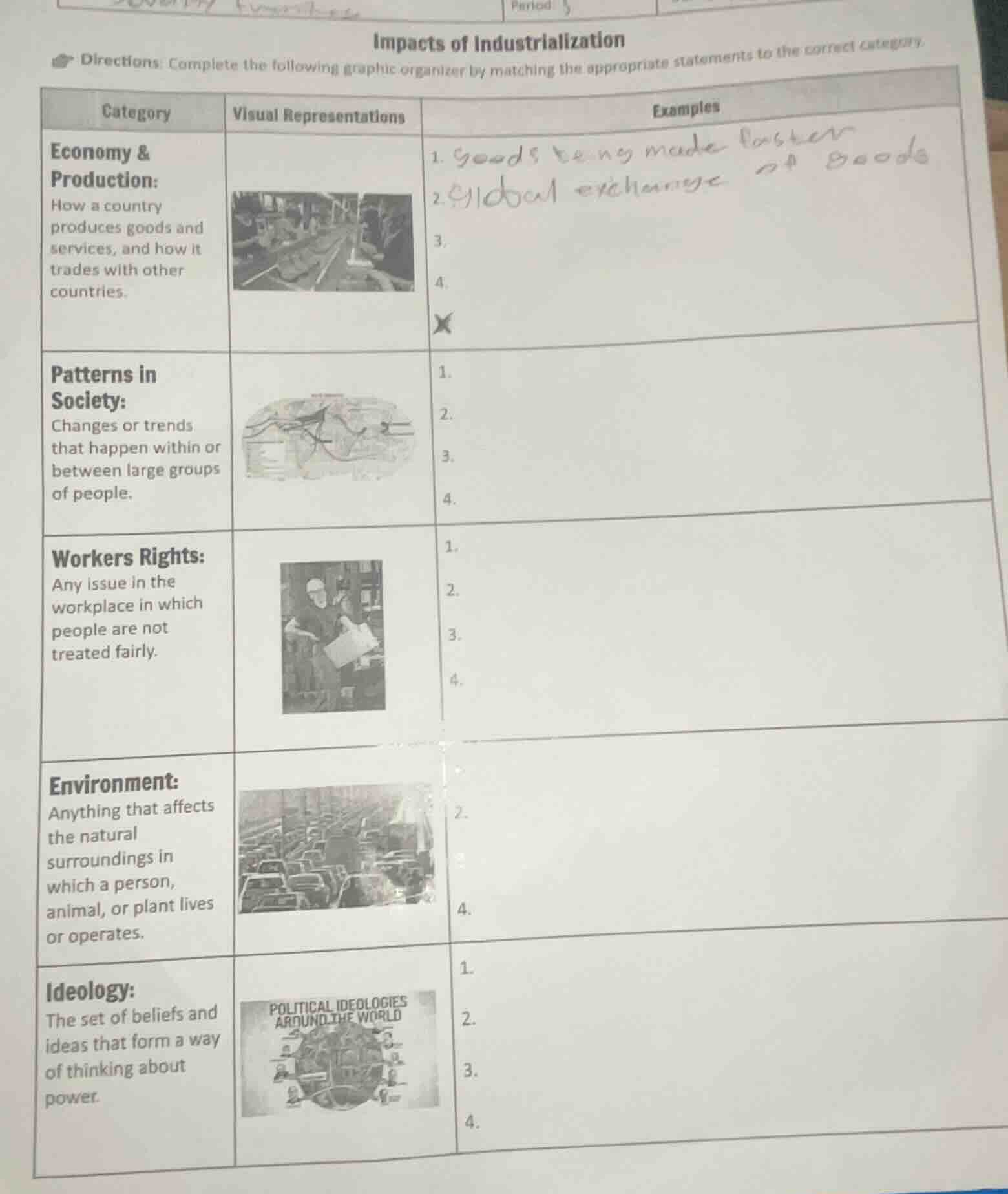
directions: complete the following graphic organizer by matching the appropriate statements to the correct category.
| category | visual representations | examples |
|---|
| economy & production:
how a country
produces goods and
services, and how it
trades with other
countries. | image | 1. goods being made faster
- global exchange of goods
3.
4.
x |
| patterns in
society:
changes or trends
that happen within or
between large groups
of people. | image | 1.
2.
3.
- |
| workers rights:
any issue in the
workplace in which
people are not
treated fairly. | image | 1.
2.
3.
- |
| environment:
anything that affects
the natural
surroundings in
which a person,
animal, or plant lives
or operates. | image | 1.
2.
3.
- |
| ideology:
the set of beliefs and
ideas that form a way
of thinking about
power. | image with text: political ideologies around the world | 1.
2.
3.
- |
To complete this graphic organizer on the impacts of industrialization, we analyze each category and provide relevant examples:
1. Economy & Production
This category focuses on how goods/services are produced and traded.
- Example 1: Goods being made faster (due to factory systems/machinery).
- Example 2: Global exchange of goods (international trade, colonial trade networks).
- Example 3: Growth of factories (shift from cottage industries to mass production).
- Example 4: Rise of capitalism (private ownership of production, profit motive).
2. Patterns in Society
This category looks at trends in large groups.
- Example 1: Urbanization (people moving from rural to urban areas for factory jobs).
- Example 2: Growth of the working class (new social class of industrial laborers).
- Example 3: Population growth (improved food production, medical care).
- Example 4: Rise of consumer culture (demand for mass - produced goods).
3. Workers Rights
This category deals with unfair workplace issues.
- Example 1: Long working hours (12 - 16 hour days, 6 - 7 days a week).
- Example 2: Child labor (children as young as 5 - 6 working in factories).
- Example 3: Low wages (workers paid barely enough to survive).
- Example 4: Unsafe working conditions (no safety regulations, high injury rates).
4. Environment
This category focuses on impacts on natural surroundings.
- Example 1: Air pollution (factories emitting smoke, coal - fired engines).
- Example 2: Water pollution (factories dumping waste into rivers).
- Example 3: Deforestation (logging for timber, fuel, and factory expansion).
- Example 4: Loss of biodiversity (habitat destruction from industrial development).
5. Ideology
This category looks at belief systems about power.
- Example 1: Socialism (rise of ideas about workers’ ownership of production).
- Example 2: Communism (Marxist ideas about classless society).
- Example 3: Laissez - faire capitalism (minimal government intervention in economy).
- Example 4: Nationalism (growth of national identity, industrial competition between nations).
These examples align with the definitions of each category and the historical context of industrialization.

Snap & solve any problem in the app
Get step-by-step solutions on Sovi AI
Photo-based solutions with guided steps
Explore more problems and detailed explanations
To complete this graphic organizer on the impacts of industrialization, we analyze each category and provide relevant examples:
1. Economy & Production
This category focuses on how goods/services are produced and traded.
- Example 1: Goods being made faster (due to factory systems/machinery).
- Example 2: Global exchange of goods (international trade, colonial trade networks).
- Example 3: Growth of factories (shift from cottage industries to mass production).
- Example 4: Rise of capitalism (private ownership of production, profit motive).
2. Patterns in Society
This category looks at trends in large groups.
- Example 1: Urbanization (people moving from rural to urban areas for factory jobs).
- Example 2: Growth of the working class (new social class of industrial laborers).
- Example 3: Population growth (improved food production, medical care).
- Example 4: Rise of consumer culture (demand for mass - produced goods).
3. Workers Rights
This category deals with unfair workplace issues.
- Example 1: Long working hours (12 - 16 hour days, 6 - 7 days a week).
- Example 2: Child labor (children as young as 5 - 6 working in factories).
- Example 3: Low wages (workers paid barely enough to survive).
- Example 4: Unsafe working conditions (no safety regulations, high injury rates).
4. Environment
This category focuses on impacts on natural surroundings.
- Example 1: Air pollution (factories emitting smoke, coal - fired engines).
- Example 2: Water pollution (factories dumping waste into rivers).
- Example 3: Deforestation (logging for timber, fuel, and factory expansion).
- Example 4: Loss of biodiversity (habitat destruction from industrial development).
5. Ideology
This category looks at belief systems about power.
- Example 1: Socialism (rise of ideas about workers’ ownership of production).
- Example 2: Communism (Marxist ideas about classless society).
- Example 3: Laissez - faire capitalism (minimal government intervention in economy).
- Example 4: Nationalism (growth of national identity, industrial competition between nations).
These examples align with the definitions of each category and the historical context of industrialization.