QUESTION IMAGE
Question
includes the skills you need to find, analyze, and use information.
practice these skills by researching the federalists and the anti-federalists. use the internet to find arguments each group gave for or against the constitution. write an essay evaluating the arguments. which writer used better reasoning to support his or her claim? be sure to cite the sources you used in your essay.
write to learn
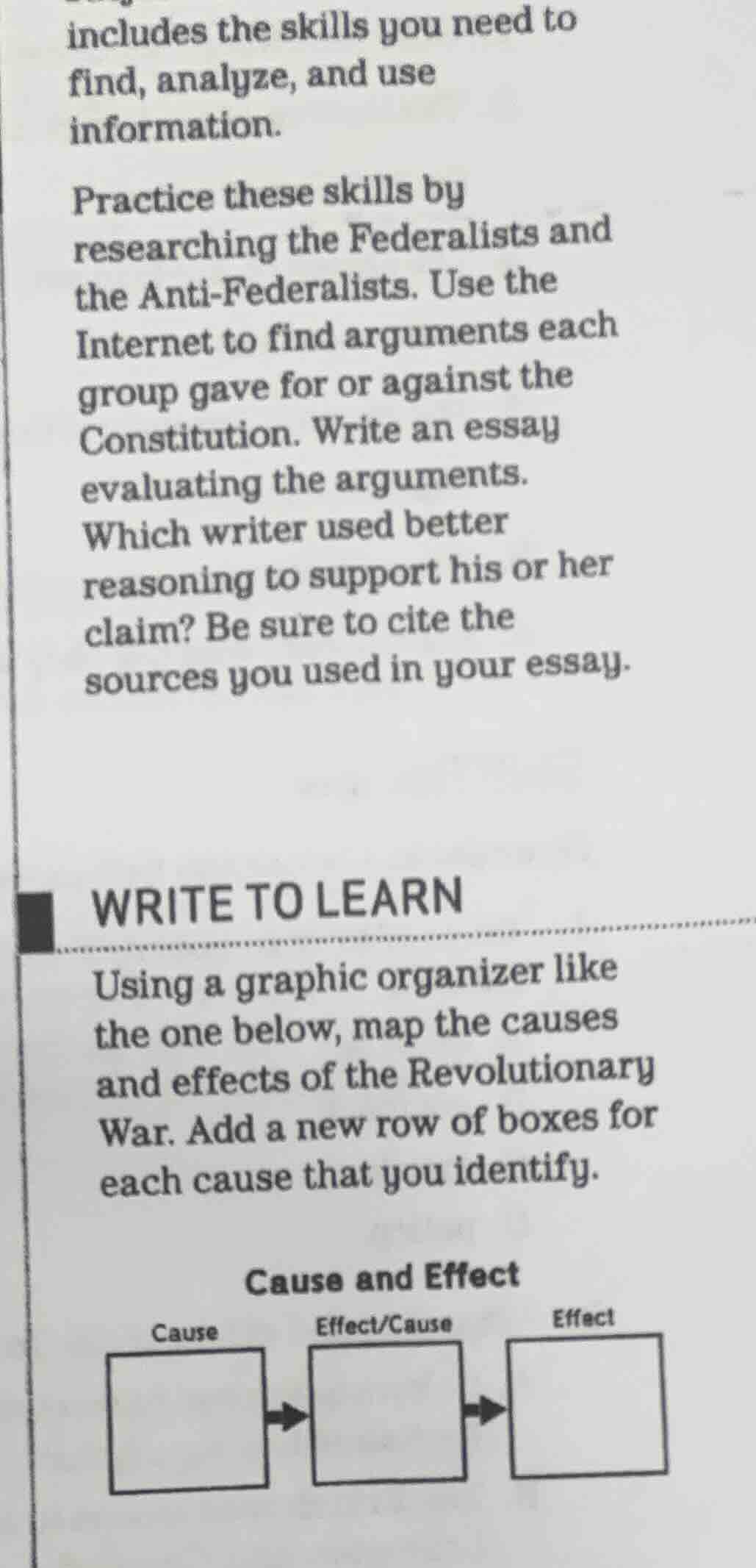
using a graphic organizer like the one below, map the causes and effects of the revolutionary war. add a new row of boxes for each cause that you identify.
cause and effect
For the Revolutionary War cause-effect map:
- First, identify a core initial cause, then its immediate outcome that acts as a subsequent cause, and the final linked effect.
- Expand by adding new rows for additional causal chains.
For the Federalist/Anti-Federalist essay:
- Research primary sources (e.g., Federalist Papers, Anti-Federalist writings like Brutus essays) to gather each group's key arguments for/against the Constitution.
- Evaluate the logical consistency, evidence use, and long-term validity of each side's reasoning to determine which had stronger support for their claims, then cite all sources properly.

Snap & solve any problem in the app
Get step-by-step solutions on Sovi AI
Photo-based solutions with guided steps
Explore more problems and detailed explanations
Revolutionary War Cause and Effect Map (Example Rows):
| Cause | Effect/Cause | Effect |
|---|---|---|
| Boston Tea Party (1773) | British Passage of Coercive Acts (Intolerable Acts) | Formation of First Continental Congress (1774) |
| Battles of Lexington and Concord (1775) | Second Continental Congress Organizes Continental Army | Official Start of the Revolutionary War |
Federalist/Anti-Federalist Essay Guidance:
- Federalist Key Arguments: Supported a strong central government to fix weaknesses of the Articles of Confederation, argued for separation of powers (executive, legislative, judicial branches) to prevent tyranny (Federalist No. 51), and claimed a large republic would control factionalism (Federalist No. 10).
- Anti-Federalist Key Arguments: Warned a strong central government would trample state and individual rights, argued the Constitution lacked a bill of rights, and claimed a large republic would be too distant from ordinary citizens (e.g., Brutus No. 1).
- Reasoning Evaluation: The Federalists' reasoning was more structurally sound, as their focus on separation of powers and checks and balances provided a practical framework to address the Articles of Confederation's failures. However, the Anti-Federalists' push for a bill of rights was a critical correction that was later added as the first 10 amendments to the Constitution. When evaluating "better reasoning," the Federalists' ability to propose a functional, scalable system for governance gives their arguments an edge, though the Anti-Federalists' successful advocacy for individual rights was a vital, enduring contribution. Cite specific essays (e.g., Federalist No. 10, Brutus No. 1) and historical context to support this evaluation.