QUESTION IMAGE
Question
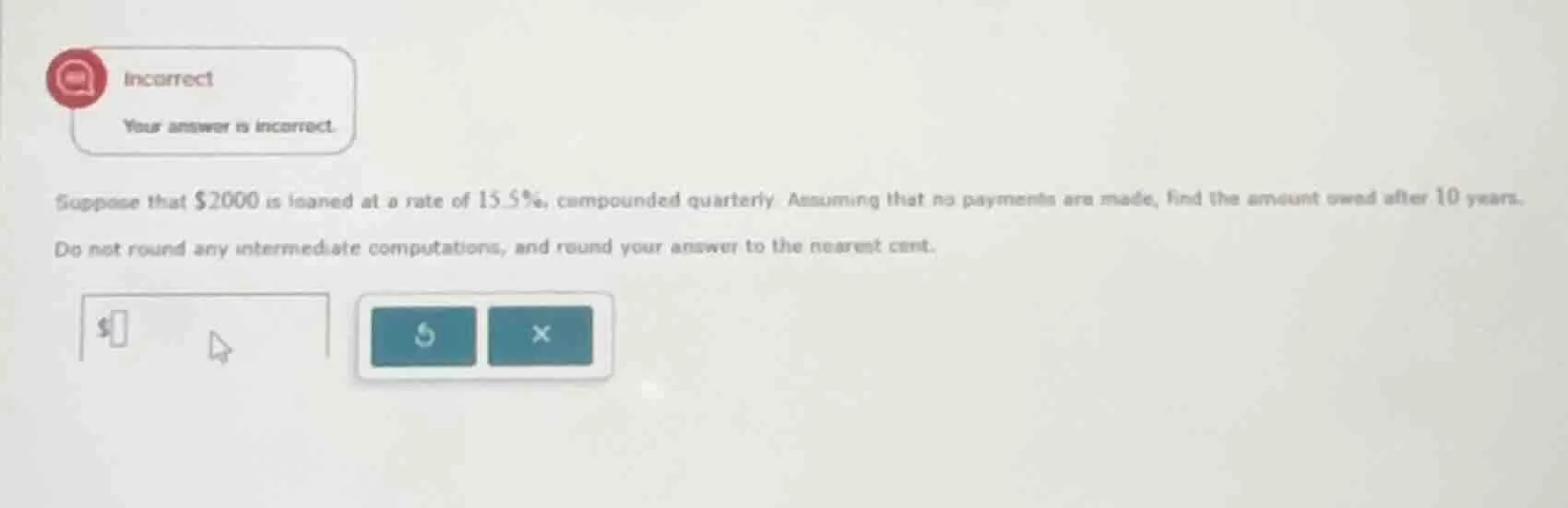
incorrect your answer is incorrect. suppose that $2000 is loaned at a rate of 15.5%, compounded quarterly. assuming that no payments are made, find the amount owed after 10 years. do not round any intermediate computations, and round your answer to the nearest cent.
Step1: Recall the compound - interest formula
The formula for compound interest is $A = P(1+\frac{r}{n})^{nt}$, where:
- $A$ is the amount of money accumulated after $n$ years, including interest.
- $P$ is the principal amount (the initial amount of money).
- $r$ is the annual interest rate (in decimal form).
- $n$ is the number of times that interest is compounded per year.
- $t$ is the time the money is invested or borrowed for, in years.
Given that $P=\$2000$, $r = 15.5\%=0.155$, $n = 4$ (because interest is compounded quarterly, and there are 4 quarters in a year), and $t = 10$ years.
Step2: Substitute the values into the formula
First, calculate the value of $\frac{r}{n}$: $\frac{0.155}{4}=0.03875$
Then, calculate the value of $nt$: $nt=4\times10 = 40$
Now, calculate $(1 +\frac{r}{n})^{nt}=(1 + 0.03875)^{40}$
Then, $A=2000\times(1 + 0.03875)^{40}$
First, calculate $(1.03875)^{40}$. Using a calculator (without rounding intermediate steps), $(1.03875)^{40}\approx4.847553$
Then, $A = 2000\times4.847553=9695.106$
Step3: Round to the nearest cent
Since we need to round to the nearest cent, and the number is $9695.106$, the amount owed after 10 years is $\$9695.11$ (because the third decimal place is 6, which is greater than or equal to 5, so we round up the second decimal place).

Snap & solve any problem in the app
Get step-by-step solutions on Sovi AI
Photo-based solutions with guided steps
Explore more problems and detailed explanations
$\$9695.11$