QUESTION IMAGE
Question
independent practice
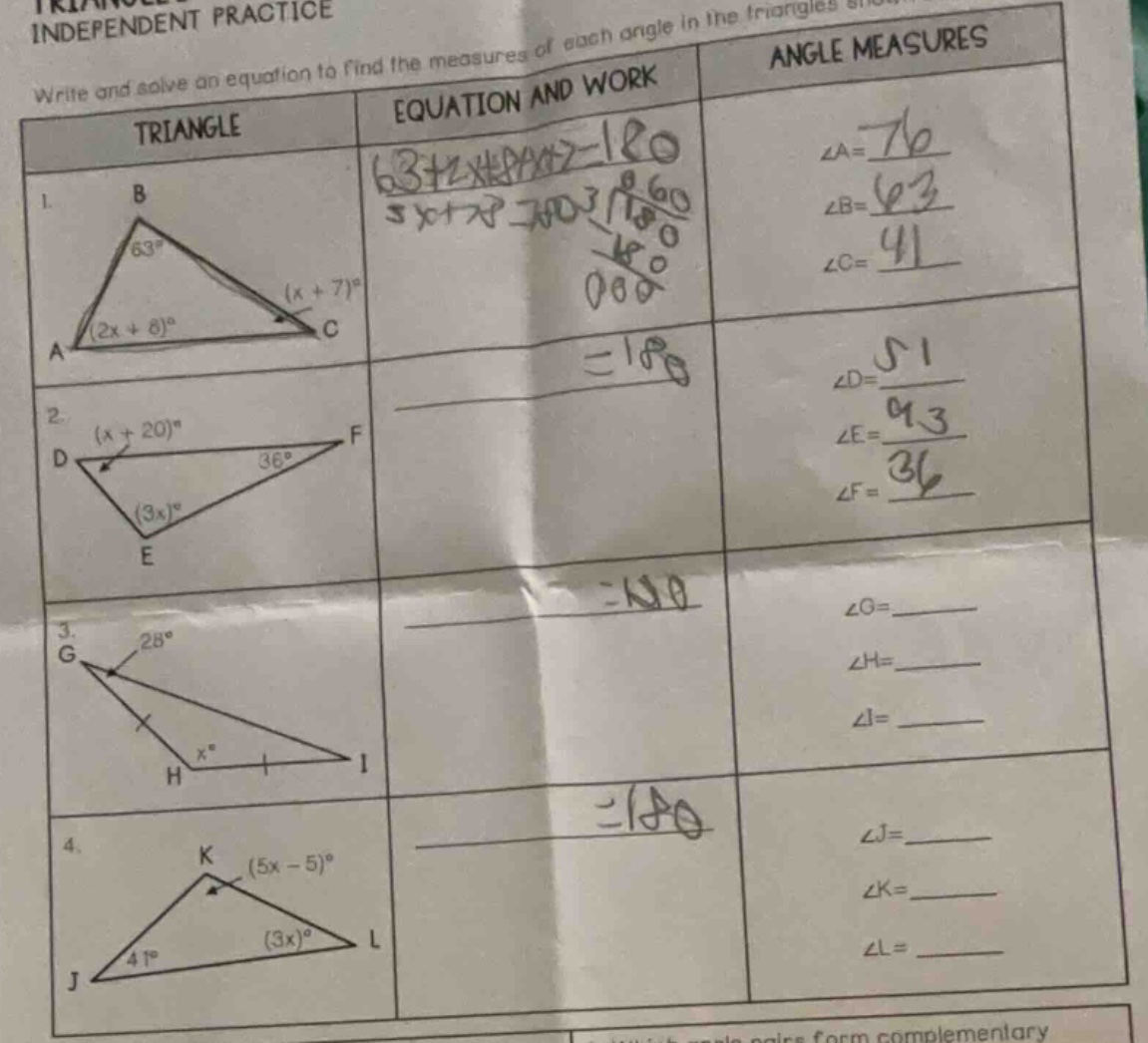
write and solve an equation to find the measures of each angle in the triangles
| triangle | equation and work | angle measures |
|---|---|---|
| 2. triangle with vertices d, e, f. angle at d: (x + 20)°, angle at e: (3x)°, angle at f: 36° | (with a handwritten \=180\) | ∠d = 51, ∠e = 93, ∠f = 36 |
| 3. triangle with vertices g, h, i. angle at g: 28°, sides gh and gi are marked (isosceles?); angle at h: x° | (with a handwritten \=180\) | ∠g =, ∠h =, ∠i = |
| 4. triangle with vertices j, k, l. angle at j: 41°, angle at k: (5x - 5)°, angle at l: (3x)° | (with a handwritten \=180\) | ∠j =, ∠k =, ∠l = |
(and a partial line about \angle pairs form complementary\)
Response
Problem 1:
Step1: Sum of angles in a triangle is \(180^\circ\). So, \(63 + (2x + 8) + (x + 7) = 180\).
Step2: Simplify the left side: \(63 + 2x + 8 + x + 7 = 3x + 78\). So, \(3x + 78 = 180\).
Step3: Subtract 78 from both sides: \(3x = 180 - 78 = 102\).
Step4: Divide by 3: \(x = \frac{102}{3} = 34\).
Step5: Find each angle: \(\angle A = 2(34) + 8 = 76^\circ\), \(\angle B = 63^\circ\), \(\angle C = 34 + 7 = 41^\circ\).
Step1: Sum of angles in a triangle is \(180^\circ\). So, \((x + 20) + 3x + 36 = 180\).
Step2: Simplify the left side: \(4x + 56 = 180\).
Step3: Subtract 56: \(4x = 180 - 56 = 124\).
Step4: Divide by 4: \(x = 31\).
Step5: Find each angle: \(\angle D = 31 + 20 = 51^\circ\), \(\angle E = 3(31) = 93^\circ\), \(\angle F = 36^\circ\).
Step1: The triangle is isosceles (two sides marked equal), so \(\angle H = \angle I = x\). Sum of angles: \(28 + x + x = 180\).
Step2: Simplify: \(28 + 2x = 180\).
Step3: Subtract 28: \(2x = 180 - 28 = 152\).
Step4: Divide by 2: \(x = 76\). So, \(\angle G = 28^\circ\), \(\angle H = 76^\circ\), \(\angle I = 76^\circ\).

Snap & solve any problem in the app
Get step-by-step solutions on Sovi AI
Photo-based solutions with guided steps
Explore more problems and detailed explanations
\(\angle A = 76^\circ\), \(\angle B = 63^\circ\), \(\angle C = 41^\circ\)