QUESTION IMAGE
Question
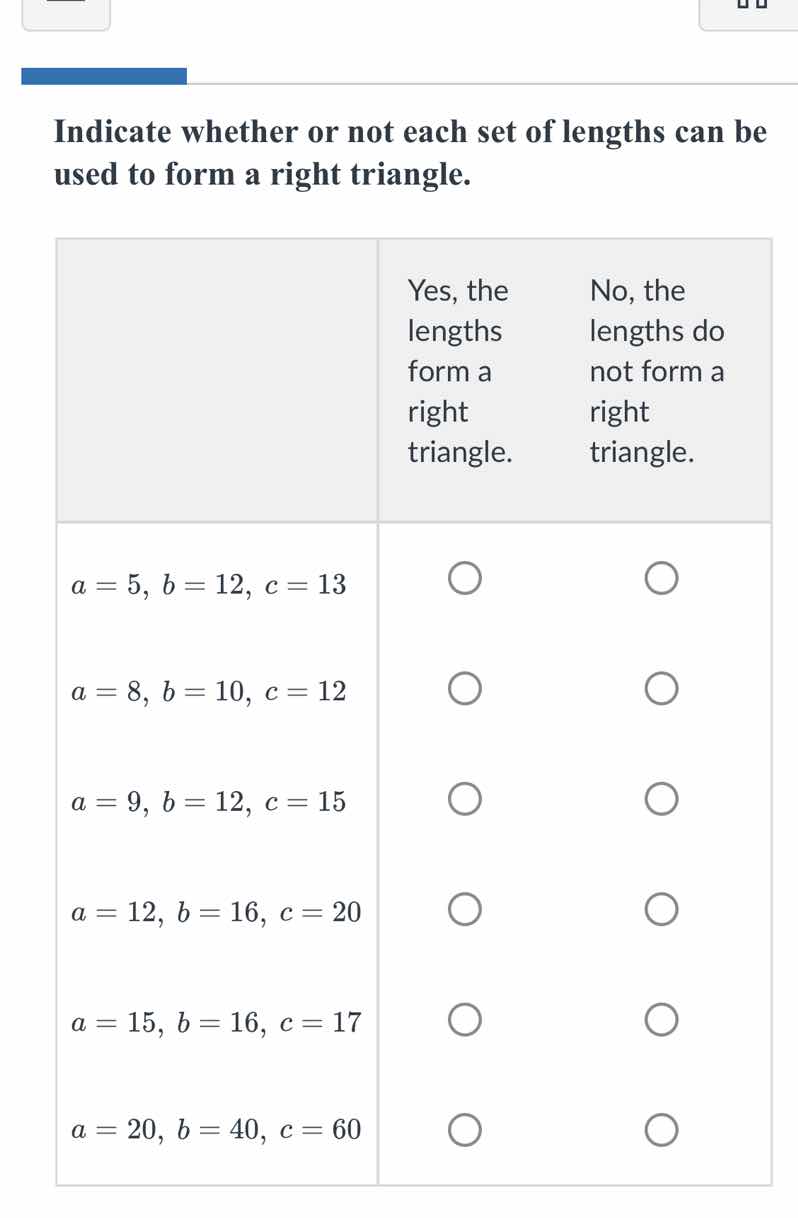
indicate whether or not each set of lengths can be used to form a right triangle.
| yes, the lengths form a right triangle. | no, the lengths do not form a right triangle. | |
|---|---|---|
| $a = 8, b = 10, c = 12$ | $\bigcirc$ | $\bigcirc$ |
| $a = 9, b = 12, c = 15$ | $\bigcirc$ | $\bigcirc$ |
| $a = 12, b = 16, c = 20$ | $\bigcirc$ | $\bigcirc$ |
| $a = 15, b = 16, c = 17$ | $\bigcirc$ | $\bigcirc$ |
| $a = 20, b = 40, c = 60$ | $\bigcirc$ | $\bigcirc$ |
To determine if a set of lengths can form a right triangle, we use the Pythagorean theorem, which states that for a right triangle with legs \(a\) and \(b\) and hypotenuse \(c\) (where \(c\) is the longest side), \(a^2 + b^2 = c^2\). We will apply this theorem to each set of lengths.
For \(a = 5\), \(b = 12\), \(c = 13\)
Step 1: Calculate \(a^2 + b^2\)
\(a^2 + b^2=5^2 + 12^2=25 + 144 = 169\)
Step 2: Calculate \(c^2\)
\(c^2 = 13^2=169\)
Since \(a^2 + b^2=c^2\) (\(169 = 169\)), the lengths form a right triangle. So we choose "Yes, the lengths form a right triangle."
For \(a = 8\), \(b = 10\), \(c = 12\)
Step 1: Calculate \(a^2 + b^2\)
\(a^2 + b^2=8^2+10^2 = 64 + 100=164\)
Step 2: Calculate \(c^2\)
\(c^2=12^2 = 144\)
Since \(164
eq144\), the lengths do not form a right triangle. So we choose "No, the lengths do not form a right triangle."
For \(a = 9\), \(b = 12\), \(c = 15\)
Step 1: Calculate \(a^2 + b^2\)
\(a^2 + b^2=9^2+12^2=81 + 144 = 225\)
Step 2: Calculate \(c^2\)
\(c^2=15^2 = 225\)
Since \(a^2 + b^2=c^2\) (\(225=225\)), the lengths form a right triangle. So we choose "Yes, the lengths form a right triangle."
For \(a = 12\), \(b = 16\), \(c = 20\)
Step 1: Calculate \(a^2 + b^2\)
\(a^2 + b^2=12^2+16^2=144 + 256=400\)
Step 2: Calculate \(c^2\)
\(c^2=20^2 = 400\)
Since \(a^2 + b^2=c^2\) (\(400 = 400\)), the lengths form a right triangle. So we choose "Yes, the lengths form a right triangle."
For \(a = 15\), \(b = 16\), \(c = 17\)
Step 1: Calculate \(a^2 + b^2\)
\(a^2 + b^2=15^2+16^2=225+256 = 481\)
Step 2: Calculate \(c^2\)
\(c^2=17^2=289\)
Since \(481
eq289\), the lengths do not form a right triangle. So we choose "No, the lengths do not form a right triangle."
For \(a = 20\), \(b = 40\), \(c = 60\)
Step 1: Check triangle inequality (pre - check)
For a triangle to be formed, the sum of any two sides must be greater than the third side. But \(20 + 40=60\), which does not satisfy the triangle inequality (\(20 + 40\) is not greater than \(60\)), so it can't be a triangle, let alone a right triangle. So we choose "No, the lengths do not form a right triangle."
Final Answers:
- \(a = 5\), \(b = 12\), \(c = 13\): Yes, the lengths form a right triangle.
- \(a = 8\), \(b = 10\), \(c = 12\): No, the lengths do not form a right triangle.
- \(a = 9\), \(b = 12\), \(c = 15\): Yes, the lengths form a right triangle.
- \(a = 12\), \(b = 16\), \(c = 20\): Yes, the lengths form a right triangle.
- \(a = 15\), \(b = 16\), \(c = 17\): No, the lengths do not form a right triangle.
- \(a = 20\), \(b = 40\), \(c = 60\): No, the lengths do not form a right triangle.

Snap & solve any problem in the app
Get step-by-step solutions on Sovi AI
Photo-based solutions with guided steps
Explore more problems and detailed explanations
To determine if a set of lengths can form a right triangle, we use the Pythagorean theorem, which states that for a right triangle with legs \(a\) and \(b\) and hypotenuse \(c\) (where \(c\) is the longest side), \(a^2 + b^2 = c^2\). We will apply this theorem to each set of lengths.
For \(a = 5\), \(b = 12\), \(c = 13\)
Step 1: Calculate \(a^2 + b^2\)
\(a^2 + b^2=5^2 + 12^2=25 + 144 = 169\)
Step 2: Calculate \(c^2\)
\(c^2 = 13^2=169\)
Since \(a^2 + b^2=c^2\) (\(169 = 169\)), the lengths form a right triangle. So we choose "Yes, the lengths form a right triangle."
For \(a = 8\), \(b = 10\), \(c = 12\)
Step 1: Calculate \(a^2 + b^2\)
\(a^2 + b^2=8^2+10^2 = 64 + 100=164\)
Step 2: Calculate \(c^2\)
\(c^2=12^2 = 144\)
Since \(164
eq144\), the lengths do not form a right triangle. So we choose "No, the lengths do not form a right triangle."
For \(a = 9\), \(b = 12\), \(c = 15\)
Step 1: Calculate \(a^2 + b^2\)
\(a^2 + b^2=9^2+12^2=81 + 144 = 225\)
Step 2: Calculate \(c^2\)
\(c^2=15^2 = 225\)
Since \(a^2 + b^2=c^2\) (\(225=225\)), the lengths form a right triangle. So we choose "Yes, the lengths form a right triangle."
For \(a = 12\), \(b = 16\), \(c = 20\)
Step 1: Calculate \(a^2 + b^2\)
\(a^2 + b^2=12^2+16^2=144 + 256=400\)
Step 2: Calculate \(c^2\)
\(c^2=20^2 = 400\)
Since \(a^2 + b^2=c^2\) (\(400 = 400\)), the lengths form a right triangle. So we choose "Yes, the lengths form a right triangle."
For \(a = 15\), \(b = 16\), \(c = 17\)
Step 1: Calculate \(a^2 + b^2\)
\(a^2 + b^2=15^2+16^2=225+256 = 481\)
Step 2: Calculate \(c^2\)
\(c^2=17^2=289\)
Since \(481
eq289\), the lengths do not form a right triangle. So we choose "No, the lengths do not form a right triangle."
For \(a = 20\), \(b = 40\), \(c = 60\)
Step 1: Check triangle inequality (pre - check)
For a triangle to be formed, the sum of any two sides must be greater than the third side. But \(20 + 40=60\), which does not satisfy the triangle inequality (\(20 + 40\) is not greater than \(60\)), so it can't be a triangle, let alone a right triangle. So we choose "No, the lengths do not form a right triangle."
Final Answers:
- \(a = 5\), \(b = 12\), \(c = 13\): Yes, the lengths form a right triangle.
- \(a = 8\), \(b = 10\), \(c = 12\): No, the lengths do not form a right triangle.
- \(a = 9\), \(b = 12\), \(c = 15\): Yes, the lengths form a right triangle.
- \(a = 12\), \(b = 16\), \(c = 20\): Yes, the lengths form a right triangle.
- \(a = 15\), \(b = 16\), \(c = 17\): No, the lengths do not form a right triangle.
- \(a = 20\), \(b = 40\), \(c = 60\): No, the lengths do not form a right triangle.