QUESTION IMAGE
Question
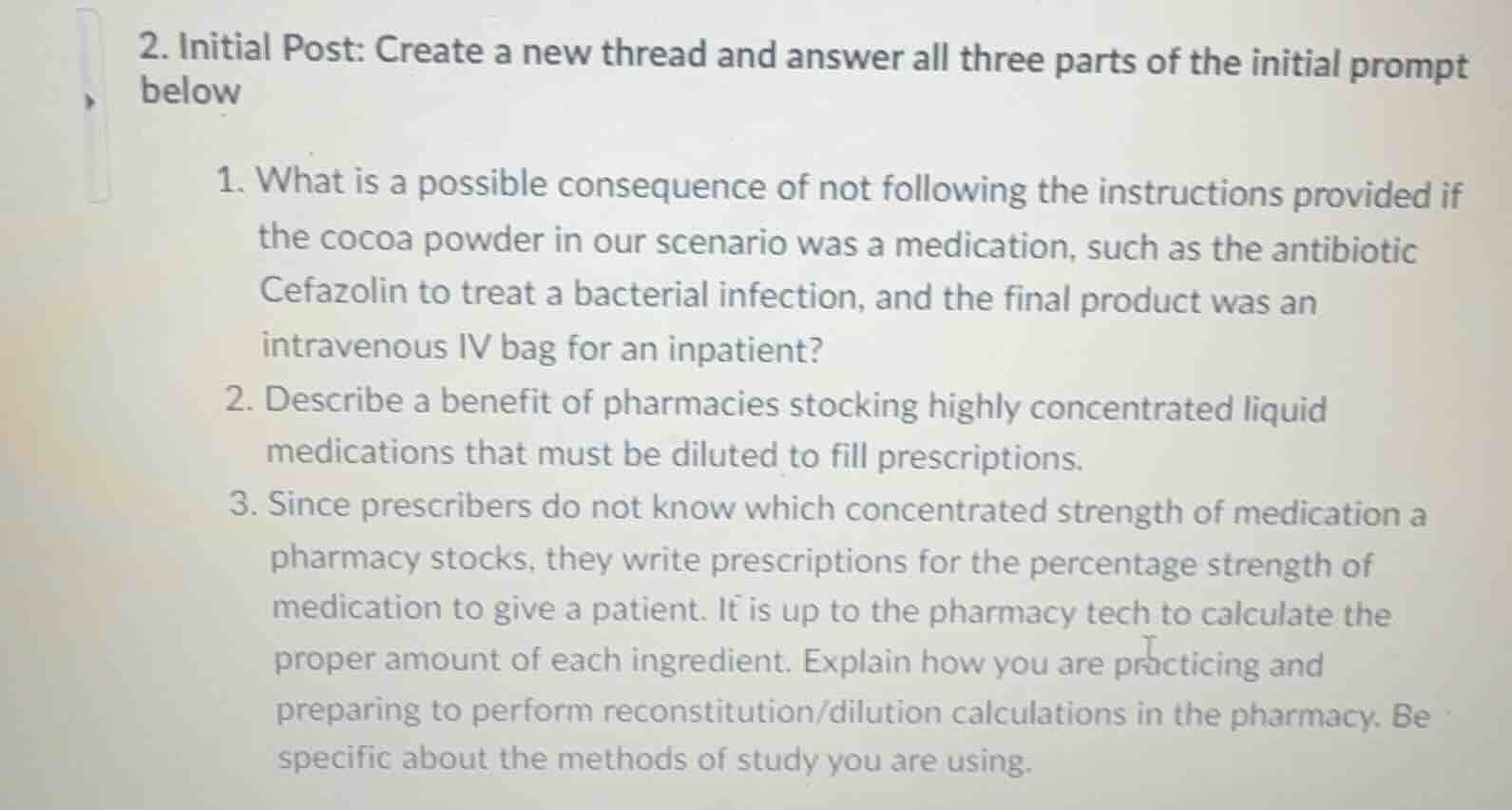
- initial post: create a new thread and answer all three parts of the initial prompt below
- what is a possible consequence of not following the instructions provided if the cocoa powder in our scenario was a medication, such as the antibiotic cefazolin to treat a bacterial infection, and the final product was an intravenous iv bag for an inpatient?
- describe a benefit of pharmacies stocking highly concentrated liquid medications that must be diluted to fill prescriptions.
- since prescribers do not know which concentrated strength of medication a pharmacy stocks, they write prescriptions for the percentage strength of medication to give a patient. it is up to the pharmacy tech to calculate the proper amount of each ingredient. explain how you are practicing and preparing to perform reconstitution/dilution calculations in the pharmacy. be specific about the methods of study you are using.
Part 1
If instructions for preparing the IV bag with Cefazolin (like reconstitution/dilution) are not followed, the dosage could be incorrect. Under - dosing would mean the antibiotic is not effective, allowing the bacterial infection to persist, spread, or develop resistance. Over - dosing could cause adverse reactions like kidney damage (a known risk with Cefazolin) or allergic reactions, harming the inpatient. Also, incorrect preparation might lead to contamination, causing sepsis or other infections.
Stocking highly concentrated liquid medications reduces storage space. A small volume of concentrated medication can be diluted to make multiple doses, so pharmacies don't need to store large volumes of ready - to - use doses. It also allows for greater flexibility in filling prescriptions as the same concentrated stock can be used to prepare different dosages by adjusting the dilution, meeting various patient needs efficiently.
Step 1: Identify the need for calculation methods
Reconstitution/dilution calculations in pharmacy rely on formulas like $C_1V_1 = C_2V_2$ (where $C_1$ = initial concentration, $V_1$ = initial volume, $C_2$ = final concentration, $V_2$ = final volume). To practice, I study this formula thoroughly, understanding each variable's meaning.
Step 2: Use practice problems
I solve numerous practice problems from pharmacy technician textbooks or online resources. For example, if a concentrated medication has $C_1 = 100\ mg/mL$ and the prescription needs $C_2 = 10\ mg/mL$ with $V_2 = 50\ mL$, I use $V_1=\frac{C_2V_2}{C_1}$ to find the volume of concentrated medication needed ($V_1=\frac{10\ mg/mL\times50\ mL}{100\ mg/mL}=5\ mL$).
Step 3: Flashcards for unit conversions
Since pharmacy uses different units (mg, g, mL, etc.), I make flashcards with unit conversion factors (e.g., $1\ g = 1000\ mg$, $1\ L = 1000\ mL$) and practice converting between them while solving dilution problems.
Step 4: Simulate real - world scenarios
I role - play as a pharmacy tech, taking sample prescriptions with percentage strengths and using the concentration - volume formula to calculate the amount of concentrated medication and diluent needed. This helps in applying the knowledge in a practical context.

Snap & solve any problem in the app
Get step-by-step solutions on Sovi AI
Photo-based solutions with guided steps
Explore more problems and detailed explanations
A possible consequence is ineffective treatment (if under - dosed, the bacteria survive/spread), adverse drug reactions (if over - dosed, e.g., kidney damage with Cefazolin), or infections from contamination.