QUESTION IMAGE
Question
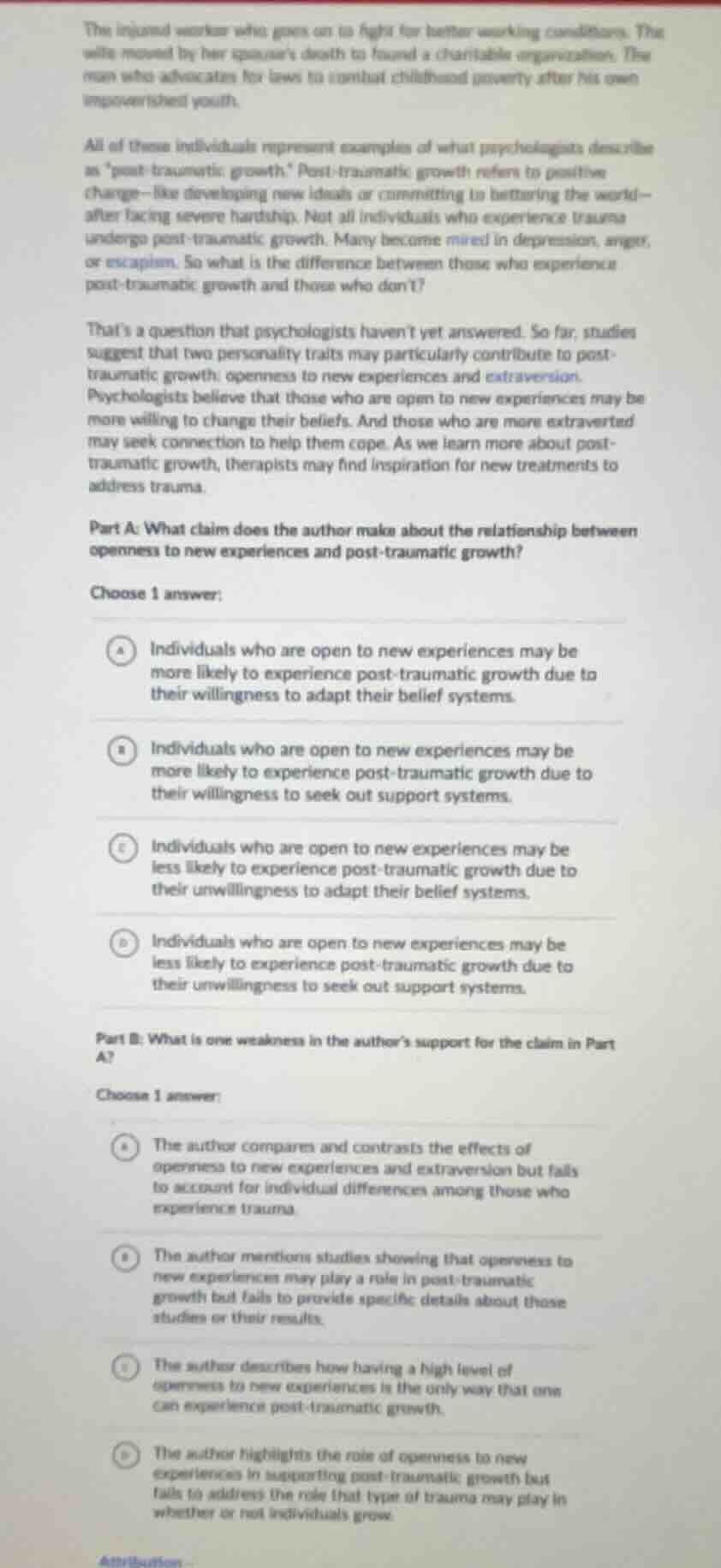
the injured worker who goes on to fight for better working conditions. the wife moved by her spouse’s death to found a charitable organization. the man who advocates for laws to combat childhood poverty after his own impoverished youth.
all of these individuals represent examples of what psychologists describe as “post - traumatic growth.” post - traumatic growth refers to positive change—like developing new ideals or committing to bettering the world—after facing severe hardship. not all individuals who experience trauma undergo post - traumatic growth. many become mired in depression, anger, or escapism. so what is the difference between those who experience post - traumatic growth and those who don’t?
that’s a question that psychologists haven’t yet answered. so far, studies suggest that two personality traits may particularly contribute to post - traumatic growth: openness to new experiences and extraversion. psychologists believe that those who are open to new experiences may be more willing to change their beliefs. and those who are more extraverted may seek connection to help them cope. as we learn more about post - traumatic growth, therapists may find inspiration for new treatments to address trauma.
part a: what claim does the author make about the relationship between openness to new experiences and post - traumatic growth?
choose 1 answer:
a individuals who are open to new experiences may be more likely to experience post - traumatic growth due to their willingness to adapt their belief systems.
b individuals who are open to new experiences may be more likely to experience post - traumatic growth due to their willingness to seek out support systems.
c individuals who are open to new experiences may be less likely to experience post - traumatic growth due to their unwillingness to adapt their belief systems.
d individuals who are open to new experiences may be less likely to experience post - traumatic growth due to their unwillingness to seek out support systems.
part b: what is one weakness in the author’s support for the claim in part a?
choose 1 answer:
a the author compares and contrasts the effects of openness to new experiences and extraversion but fails to account for individual differences among those who experience trauma.
b the author mentions studies showing that openness to new experiences may play a role in post - traumatic growth but fails to provide specific details about those studies or their results.
c the author describes how having a high level of openness to new experiences is the only way that one can experience post - traumatic growth.
d the author highlights the role of openness to new experiences in supporting post - traumatic growth but fails to address the role that type of trauma may play in whether or not individuals grow.
Part A
To solve this, we analyze each option by referring to the text. The text says "Psychologists believe that those who are open to new experiences may be more willing to change their beliefs" in relation to post - traumatic growth.
- Option A: Matches the text as it says open individuals may be more likely to experience post - traumatic growth due to willingness to adapt beliefs.
- Option B: The text says extroverts seek support, not open - to - new - experiences individuals, so this is wrong.
- Option C: The text says open individuals are more willing to change beliefs, so this (less likely due to unwillingness) is wrong.
- Option D: The text links extroversion to seeking support, not openness, so this is wrong.
We analyze each option against the text's support for the claim in Part A. The text says "studies suggest that two personality traits... openness to new experiences and extraversion" but does not give specific details about the studies.
- Option A: The author does not compare/contrast the effects of the two traits in a way that ignores individual differences among trauma - experienced people, so this is wrong.
- Option B: The author mentions studies about openness and post - traumatic growth but provides no specific study details, which is a weakness.
- Option C: The text says two traits may contribute, not that openness is the only way, so this is wrong.
- Option D: The text's focus is on personality traits, and the type of trauma is not part of the author's support for the claim about openness, so this is not a weakness in the support for the Part A claim.

Snap & solve any problem in the app
Get step-by-step solutions on Sovi AI
Photo-based solutions with guided steps
Explore more problems and detailed explanations
A. Individuals who are open to new experiences may be more likely to experience post - traumatic growth due to their willingness to adapt their belief systems.