QUESTION IMAGE
Question
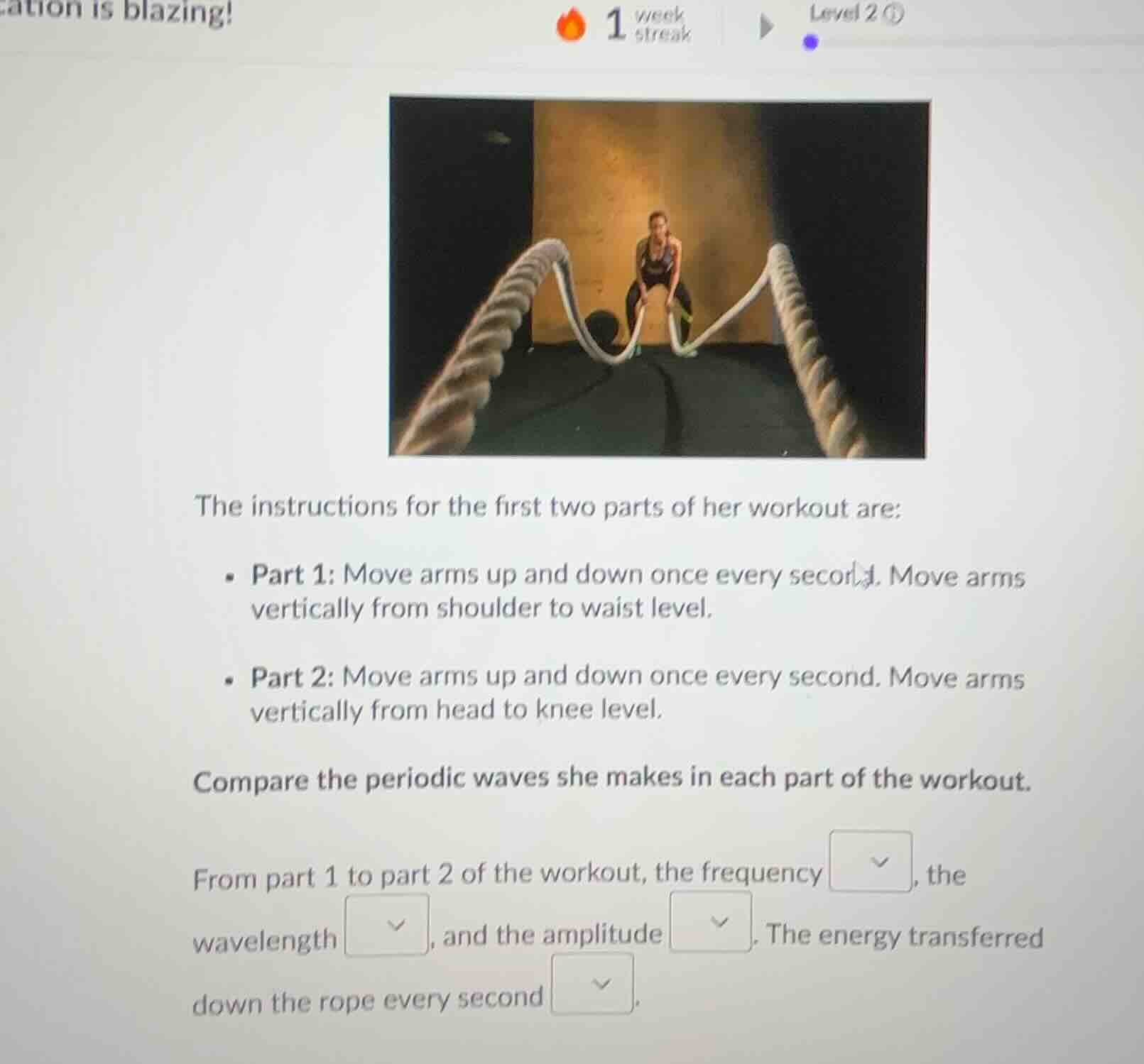
the instructions for the first two parts of her workout are: - part 1: move arms up and down once every second. move arms vertically from shoulder to waist level. - part 2: move arms up and down once every second. move arms vertically from head to knee level. compare the periodic waves she makes in each part of the workout. from part 1 to part 2 of the workout, the frequency, the wavelength, and the amplitude. the energy transferred down the rope every second.
Step1: Analyze frequency
Frequency is the number of cycles per second. In both parts, arms move up/down once per second, so frequency is unchanged.
Step2: Analyze wavelength
Wave speed $v$ on a rope depends on tension and mass per unit length (constant here). Using $v = f\lambda$, since $v$ and $f$ are constant, $\lambda$ (wavelength) stays the same.
Step3: Analyze amplitude
Amplitude is maximum displacement from equilibrium. Part 2 has a larger vertical range (head to knee vs shoulder to waist), so amplitude increases.
Step4: Analyze energy transfer
Wave power (energy per second) is proportional to $f^2 A^2 v$. Since $f$ and $v$ are constant, and $A$ increases, energy transfer increases.

Snap & solve any problem in the app
Get step-by-step solutions on Sovi AI
Photo-based solutions with guided steps
Explore more problems and detailed explanations
From part 1 to part 2 of the workout, the frequency stays the same, the wavelength stays the same, and the amplitude increases. The energy transferred down the rope every second increases.