QUESTION IMAGE
Question
instructions
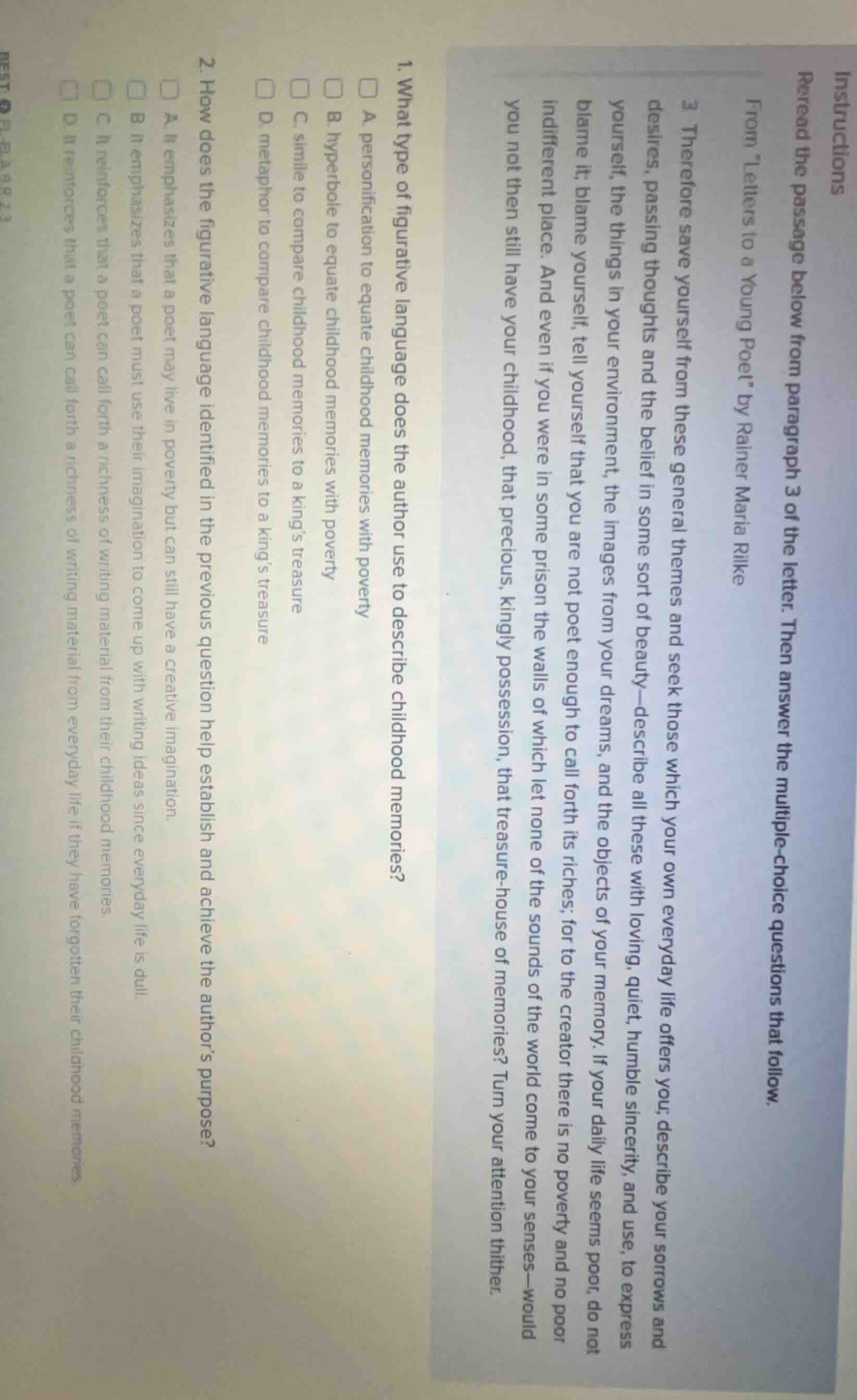
reread the passage below from paragraph 3 of the letter. then answer the multiple - choice questions that follow.
from “letters to a young poet” by rainer maria rilke
3 therefore, save yourself from these general themes and seek those which your own everyday life offers you; describe your sorrows and desires, passing thoughts and the belief in some sort of beauty—describe all these with loving, quiet, humble sincerity, and use, to express yourself, the things in your environment, the images from your dreams, and the objects of your memory. if your daily life seems poor, do not blame it; blame yourself, tell yourself that you are not poet enough to call forth its riches; for to the creator there is no poverty and no poor indifferent place. and even if you were in some prison on the walls of which let none of the sounds of the world come to your senses—would you not then still have your childhood, that precious, kingly possession, that treasure - house of memories? turn your attention thither.
- what type of figurative language does the author use to describe childhood memories?
a. personification to equate childhood memories with poverty
b. hyperbole to equate childhood memories with poverty
c. simile to compare childhood memories to a king’s treasure
d. metaphor to compare childhood memories to a king’s treasure
- how does the figurative language identified in the previous question help establish and achieve the author’s purpose?
a. it emphasizes that a poet may live in poverty but can still have a creative imagination.
b. it emphasizes that a poet must use their imagination to come up with writing ideas since everyday life is dull.
c. it reinforces that a poet can call forth a richness of writing material from their childhood memories.
d. it reinforces that a poet can call forth a richness of writing material from everyday life if they have forgotten their childhood memories.
- The author directly compares childhood memories to a "kingly possession, that treasure-house of memories" without using "like" or "as", which is a metaphor. No personification, hyperbole, or simile matches this description.
- The figurative language frames childhood memories as a valuable, kingly treasure, reinforcing that poets can draw rich writing material from these memories, even if their daily life feels poor.

Snap & solve any problem in the app
Get step-by-step solutions on Sovi AI
Photo-based solutions with guided steps
Explore more problems and detailed explanations
- D. metaphor to compare childhood memories to a king's treasure
- C. It reinforces that a poet can call forth a richness of writing material from their childhood memories.