QUESTION IMAGE
Question
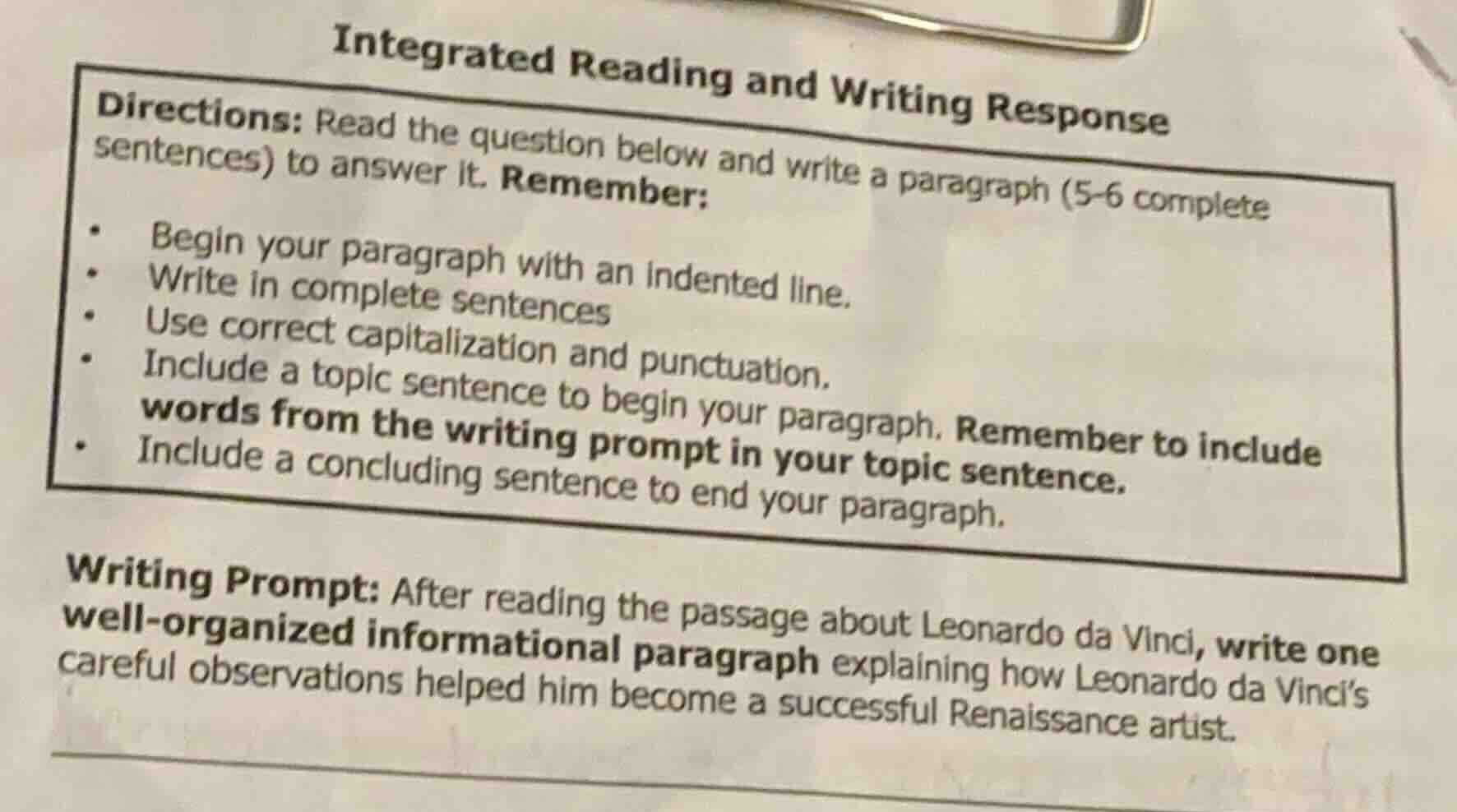
integrated reading and writing response
directions: read the question below and write a paragraph (5-6 complete sentences) to answer it. remember:
- begin your paragraph with an indented line.
- write in complete sentences
- use correct capitalization and punctuation.
- include a topic sentence to begin your paragraph. remember to include words from the writing prompt in your topic sentence.
- include a concluding sentence to end your paragraph.
writing prompt: after reading the passage about leonardo da vinci, write one well - organized informational paragraph explaining how leonardo da vinci’s careful observations helped him become a successful renaissance artist.
First, craft a topic sentence that includes prompt language, then use specific examples of Leonardo's observations (like studying human anatomy, nature's patterns) to link to his artistic success, and end with a concluding sentence tying his observational skill to his Renaissance legacy.

Snap & solve any problem in the app
Get step-by-step solutions on Sovi AI
Photo-based solutions with guided steps
Explore more problems and detailed explanations
Leonardo da Vinci’s careful observations were foundational to his success as a Renaissance artist, as they allowed him to infuse his work with unprecedented realism and depth. He spent countless hours dissecting human corpses to map muscle groups, bone structures, and facial expressions, which let him paint figures like the Mona Lisa with lifelike, subtle movements that felt deeply human. He also studied the natural world, observing how light hit tree leaves, the flow of water, and the way clouds shifted, then applied these details to landscapes in works such as The Last Supper to create immersive, believable settings. Unlike many artists of his time who relied on traditional, stylized representations, Leonardo’s commitment to observing the world as it truly was pushed the boundaries of Renaissance art and set a new standard for artistic accuracy. In the end, his relentless focus on careful, intentional observation turned him from a skilled craftsman into one of the most celebrated artists in history, embodying the Renaissance ideal of blending art and empirical inquiry.