QUESTION IMAGE
Question
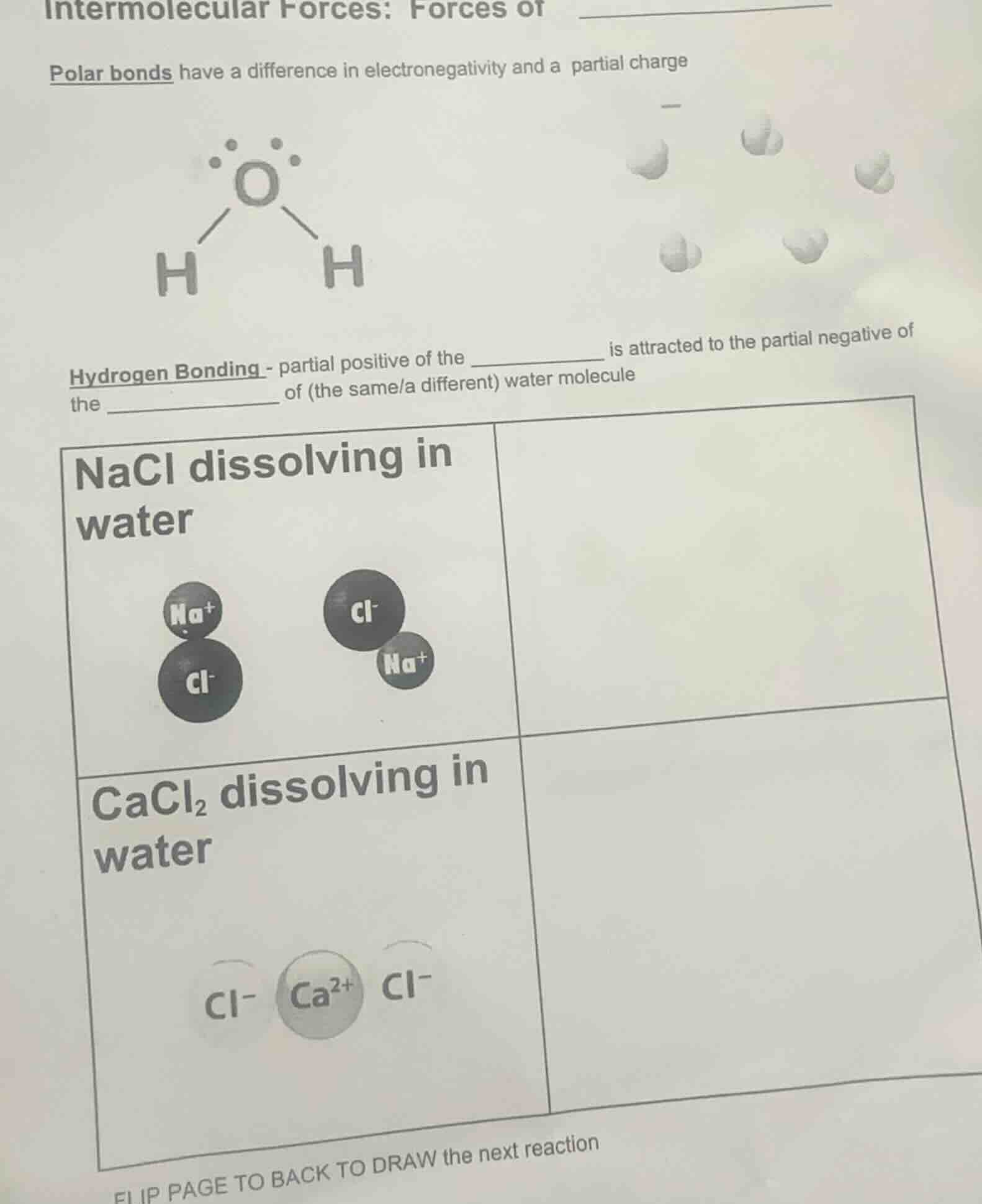
intermolecular forces: forces of
polar bonds have a difference in electronegativity and a partial charge
hydrogen bonding - partial positive of the __________ is attracted to the partial negative of
the __________ of (the same/a different) water molecule
nacl dissolving in
water
cacl₂ dissolving in
water
flip page to back to draw the next reaction
Brief Explanations
- For hydrogen bonding: In a water molecule, hydrogen carries a partial positive charge, and oxygen carries a partial negative charge. Hydrogen bonds form between different water molecules, with the partial positive H of one molecule attracted to the partial negative O of another.
- For NaCl dissolving: Water molecules surround separated ions. Partial negative O interacts with $\text{Na}^+$, partial positive H interacts with $\text{Cl}^-$.
- For $\text{CaCl}_2$ dissolving: Water molecules surround separated $\text{Ca}^{2+}$ (with partial negative O) and $\text{Cl}^-$ (with partial positive H).

Snap & solve any problem in the app
Get step-by-step solutions on Sovi AI
Photo-based solutions with guided steps
Explore more problems and detailed explanations
- Hydrogen Bonding blanks: partial positive of the hydrogen (H) is attracted to the partial negative of the oxygen (O) of a different water molecule
- NaCl dissolving in water (description for the box): Draw water molecules with their partial negative oxygen ends facing $\text{Na}^+$ ions, and partial positive hydrogen ends facing $\text{Cl}^-$ ions, showing the ions fully separated and surrounded by water.
- $\text{CaCl}_2$ dissolving in water (description for the box): Draw water molecules with their partial negative oxygen ends facing the $\text{Ca}^{2+}$ ion, and partial positive hydrogen ends facing each $\text{Cl}^-$ ion, showing the ions separated and surrounded by water.