QUESTION IMAGE
Question
1.7 1.2.4 interpret simple examples of representing elements and compounds
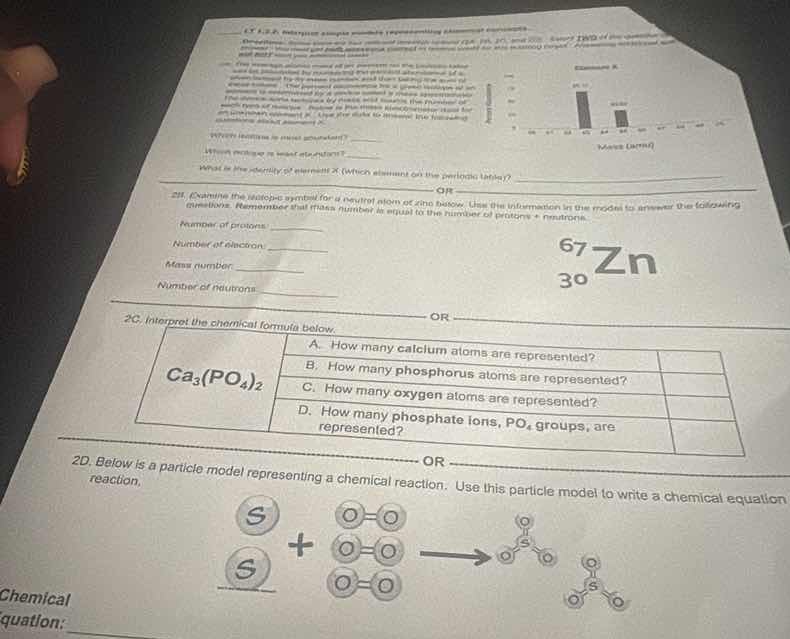
which isotope is more abundant?
what is the identity of element x (which element on the periodic table)?
2b. examine the isotopic symbol for a neutral atom of zinc below. use the information in the model to answer the following questions. remember that mass number is equal to the number of protons + neutrons.
number of protons:
number of electrons:
mass number:
number of neutrons:
\\(_{30}^{67}\text{zn}\\)
2c. interpret the chemical formula below.
\\(\text{ca}_3(\text{po}_4)_2\\)
| question | answer |
|---|---|
| b. how many phosphorus atoms are represented? | |
| c. how many oxygen atoms are represented? | |
| d. how many phosphate ions, \\(\text{po}_4\\) groups, are represented? |
2d. below is a particle model representing a chemical reaction. use this particle model to write a chemical equation for the reaction.
\\(\text{s}\\) + \\(\text{o=o}\\) \\(\
ightarrow\\)
chemical equation:
Sub - question 2B (for the \(^{67}_{30}\text{Zn}\) part)
Step 1: Determine the number of protons
The atomic number (the bottom number in the atomic symbol) represents the number of protons. For \(^{67}_{30}\text{Zn}\), the atomic number is 30, so the number of protons \(= 30\).
Step 2: Determine the number of electrons (for a neutral atom)
In a neutral atom, the number of electrons is equal to the number of protons. So the number of electrons \(= 30\).
Step 3: Determine the mass number
The mass number is the top number in the atomic symbol, so for \(^{67}_{30}\text{Zn}\), the mass number \(= 67\).
Step 4: Determine the number of neutrons
The number of neutrons is calculated by subtracting the atomic number from the mass number. So number of neutrons \(=\) mass number \(-\) atomic number \(= 67 - 30=37\).
Part A: Number of calcium atoms
In the formula \(\text{Ca}_3(\text{PO}_4)_2\), the subscript of \(\text{Ca}\) is 3, so the number of calcium atoms is 3.
Part B: Number of phosphorus atoms
In the formula, the subscript of \(\text{P}\) inside the parentheses is 1, and the subscript outside the parentheses is 2. So we multiply them: \(1\times2 = 2\), so the number of phosphorus atoms is 2.
Part C: Number of oxygen atoms
The subscript of \(\text{O}\) inside the parentheses is 4, and the subscript outside the parentheses is 2. So we calculate \(4\times2=8\), so the number of oxygen atoms is 8.
Part D: Number of phosphate ions (\(\text{PO}_4\) groups)
The subscript outside the parentheses of \((\text{PO}_4)\) is 2, so the number of phosphate ions is 2.
Step 1: Identify the reactants and products from the particle model
- Reactants: We have 2 atoms of sulfur (S) and 3 molecules of oxygen (\(\text{O}_2\)).
- Products: We have 2 molecules of sulfur trioxide (\(\text{SO}_3\)) (since each product molecule has 1 S and 3 O atoms, and there are 2 such molecules).
Step 2: Write the chemical equation
The reactants are \(\text{S}\) and \(\text{O}_2\), and the product is \(\text{SO}_3\). Balancing the equation:
- For sulfur: On the left, we have 2 S atoms. On the right, in \(\text{SO}_3\), if we have 2 molecules of \(\text{SO}_3\), we have 2 S atoms.
- For oxygen: On the left, 3 molecules of \(\text{O}_2\) give \(3\times2 = 6\) O atoms. On the right, 2 molecules of \(\text{SO}_3\) give \(2\times3=6\) O atoms.
- So the balanced chemical equation is \(2\text{S}+3\text{O}_2
ightarrow2\text{SO}_3\).

Snap & solve any problem in the app
Get step-by-step solutions on Sovi AI
Photo-based solutions with guided steps
Explore more problems and detailed explanations
- Number of protons: \(30\)
- Number of electrons: \(30\)
- Mass number: \(67\)
- Number of neutrons: \(37\)