QUESTION IMAGE
Question
an intro to evolution
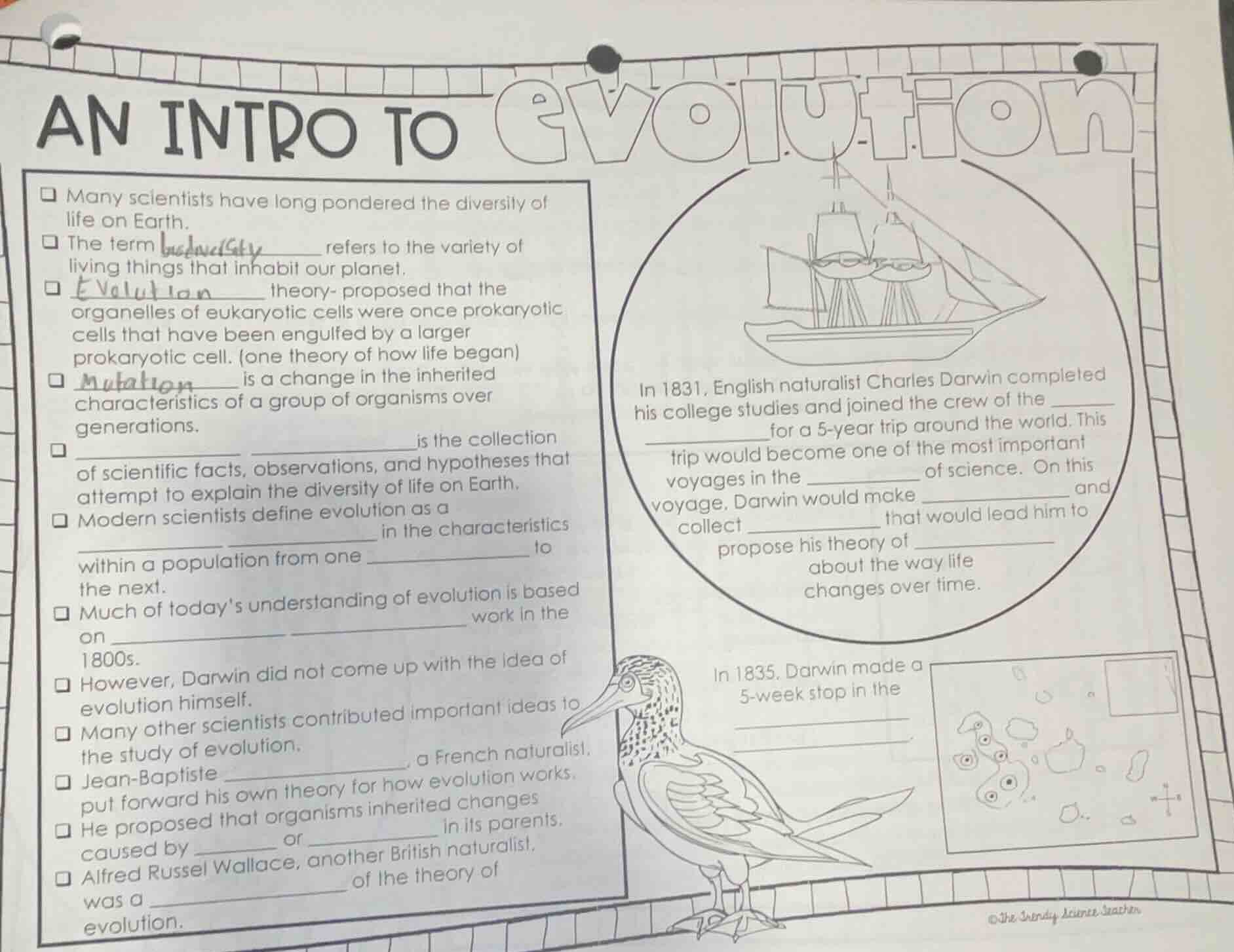
- many scientists have long pondered the diversity of life on earth.
- the term ______ refers to the variety of living things that inhabit our planet.
- ______ theory- proposed that the organelles of eukaryotic cells were once prokaryotic cells that have been engulfed by a larger prokaryotic cell. (one theory of how life began)
- ______ is a change in the inherited characteristics of a group of organisms over generations.
- ______ ______ is the collection of scientific facts, observations, and hypotheses that attempt to explain the diversity of life on earth.
- modern scientists define evolution as a ______ ____ in the characteristics within a population from one ______ to the next.
- much of todays understanding of evolution is based on ______ ______ work in the 1800s.
- however, darwin did not come up with the idea of evolution himself.
- many other scientists contributed important ideas to the study of evolution.
- jean - baptiste ______, a french naturalist, put forward his own theory for how evolution works.
- he proposed that organisms inherited changes caused by ____ or ____ in its parents.
- alfred russel wallace, another british naturalist, was a ________ of the theory of evolution.
in 1831, english naturalist charles darwin completed his college studies and joined the crew of the ____ for a 5 - year trip around the world. this trip would become one of the most important voyages in the __ of science. on this voyage, darwin would make __ and collect __ that would lead him to propose his theory of ____ about the way life changes over time.
in 1835, darwin made a 5 - week stop in the ______.
Filled in the blanks using key concepts and historical facts from evolutionary biology:
- The blank describing the variety of life is "biodiversity".
- The theory about eukaryotic cell origins is the "Endosymbiotic" theory.
- The collection of facts explaining life diversity is "Evolutionary theory".
- Modern evolution definition: change in heritable characteristics across "generations".
- Darwin's work builds on "Charles Darwin's" 19th-century research.
- Jean-Baptiste Lamarck was the French naturalist; he proposed changes from "use/disuse" or "acquired traits".
- Alfred Russel Wallace was a "co-developer" of evolution theory.
- Darwin joined the HMS Beagle, a voyage in the "history" of science, where he made "observations" and collected "specimens" to propose evolution by natural selection.
- Darwin's 1835 stop was in the "Galápagos Islands".

Snap & solve any problem in the app
Get step-by-step solutions on Sovi AI
Photo-based solutions with guided steps
Explore more problems and detailed explanations
Left column (top to bottom, empty blanks):
- Endosymbiotic
- Evolutionary theory
- heritable change; generation
- Charles Darwin's
- Lamarck; use and disuse
- co-developer
Right column (top to bottom, empty blanks):
- HMS Beagle
- history
- observations; specimens; evolution
- Galápagos Islands