QUESTION IMAGE
Question
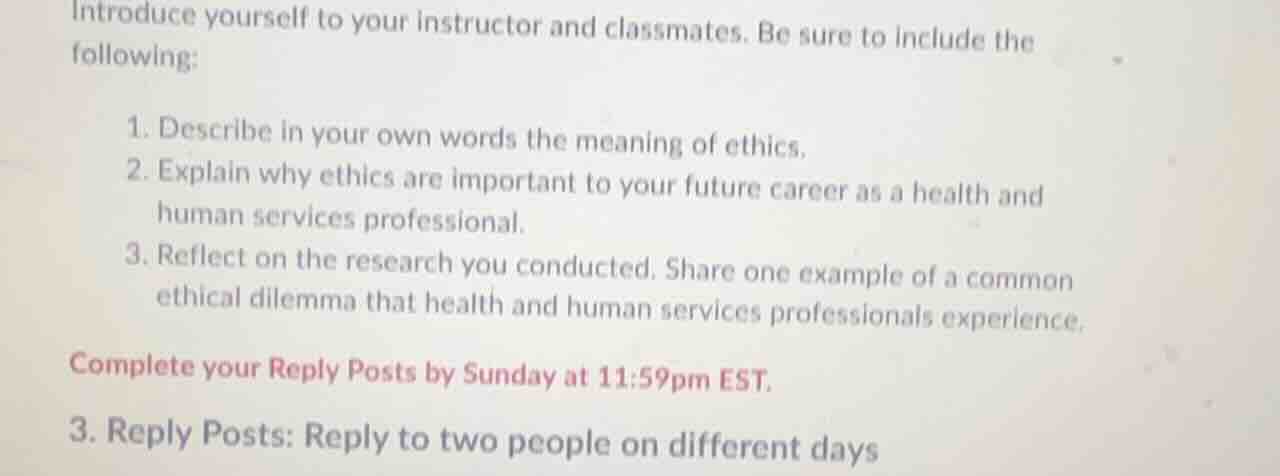
introduce yourself to your instructor and classmates. be sure to include the following:
- describe in your own words the meaning of ethics.
- explain why ethics are important to your future career as a health and human services professional.
- reflect on the research you conducted. share one example of a common ethical dilemma that health and human services professionals experience.
complete your reply posts by sunday at 11:59pm est.
- reply posts: reply to two people on different days
Brief Explanations
- Meaning of Ethics: Ethics refers to the moral principles and values that guide a person's behavior and decision - making. It helps in distinguishing between what is right and wrong, just and unjust, in various situations. For example, in a social context, it can involve concepts like honesty, fairness, and respect for others' rights.
- Importance of Ethics in Health and Human Services Career: In the health and human services field, professionals deal with vulnerable individuals (such as patients, the elderly, or those with disabilities). Ethics ensure that these professionals provide care and services in a way that respects the dignity, autonomy, and well - being of their clients. For instance, ethical behavior ensures that a healthcare provider does not disclose a patient's confidential medical information without proper authorization, which builds trust between the professional and the client. It also helps in making difficult decisions, like allocating limited resources (such as organ transplants) in a fair and just manner.
- Common Ethical Dilemma: One common ethical dilemma in health and human services is the issue of patient autonomy versus the professional's duty to protect. For example, a mentally ill patient may refuse treatment that the healthcare professional believes is necessary for the patient's well - being. The professional has to balance the patient's right to make their own decisions (autonomy) with the responsibility to ensure the patient's safety and health. Another example could be in social work, where a social worker may know that a client is engaging in behavior that is harmful to themselves or others, but the client does not want to accept help. The social worker then has to decide how to intervene while still respecting the client's rights.

Snap & solve any problem in the app
Get step-by-step solutions on Sovi AI
Photo-based solutions with guided steps
Explore more problems and detailed explanations
- Ethics are moral principles guiding behavior, distinguishing right from wrong.
- Ethics are important in health/human services to respect client dignity, autonomy, and well - being, and to make fair decisions (e.g., resource allocation, confidentiality).
- A common ethical dilemma: patient autonomy (refusing treatment) vs. professional duty to protect (e.g., a mentally ill patient refusing necessary treatment).