QUESTION IMAGE
Question
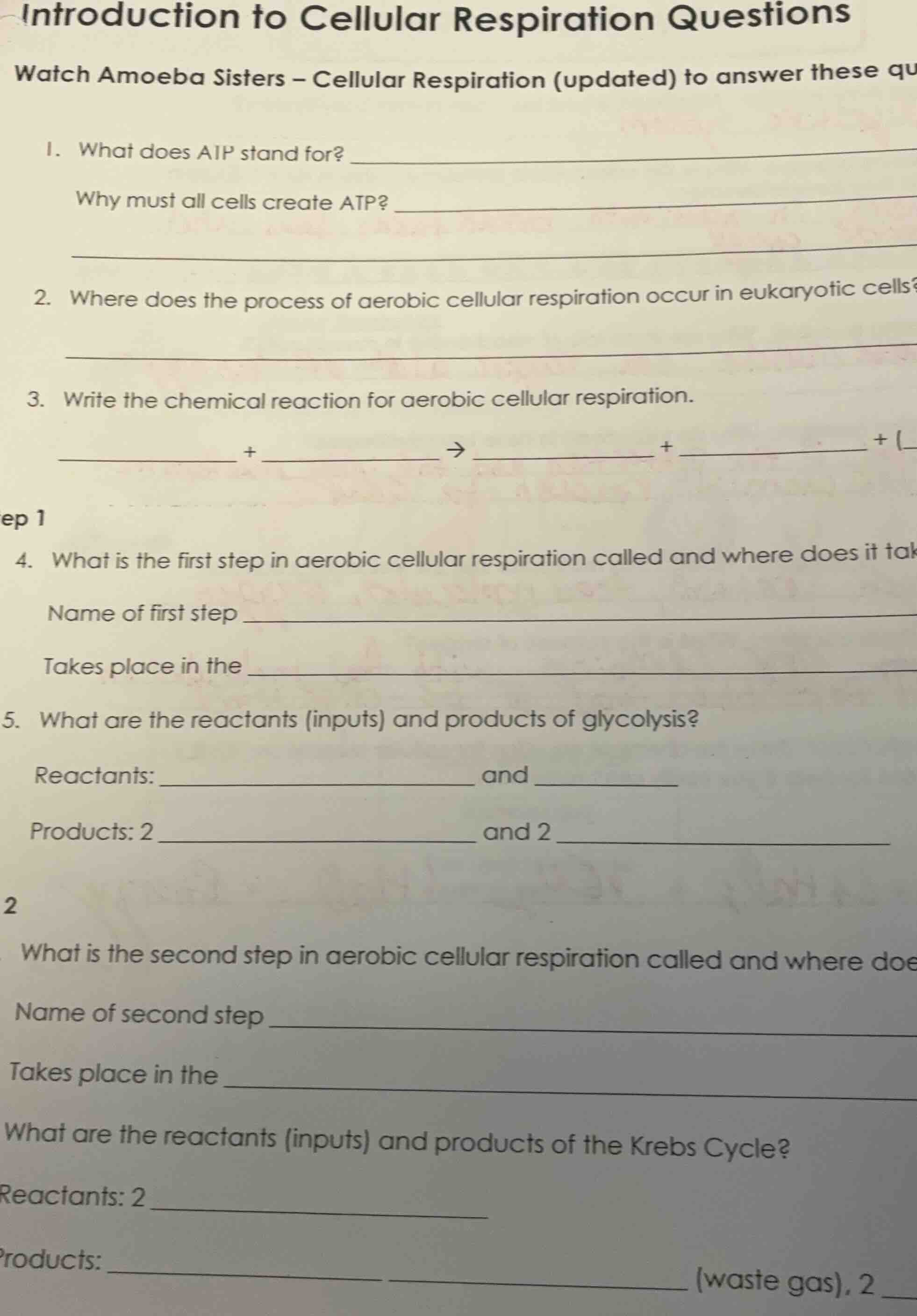
introduction to cellular respiration questions
watch amoeba sisters – cellular respiration (updated) to answer these qu
- what does atp stand for?
why must all cells create atp?
- where does the process of aerobic cellular respiration occur in eukaryotic cells?
- write the chemical reaction for aerobic cellular respiration.
____ + __ → __ + ____ + (
step 1
- what is the first step in aerobic cellular respiration called and where does it tak
name of first step
takes place in the
- what are the reactants (inputs) and products of glycolysis?
reactants: ____ and ____
products: 2 ____ and 2 ____
2
what is the second step in aerobic cellular respiration called and where doe
name of second step
takes place in the
what are the reactants (inputs) and products of the krebs cycle?
reactants: 2 ______
products: ____ __ (waste gas), 2 ____
Question 1
ATP stands for Adenosine Triphosphate. Cells must create ATP because it is the primary energy currency of the cell, used to power various cellular processes like metabolism, active transport, and biosynthesis.
Aerobic cellular respiration in eukaryotic cells occurs in the cytoplasm (for glycolysis) and the mitochondria (for the Krebs cycle and electron transport chain). The mitochondria are the main site for the later stages of aerobic respiration.
The chemical reaction for aerobic cellular respiration is the breakdown of glucose and oxygen to produce carbon dioxide, water, and ATP. The balanced equation is \( \text{C}_6\text{H}_{12}\text{O}_6 + 6\text{O}_2
ightarrow 6\text{CO}_2 + 6\text{H}_2\text{O} + \text{ATP (energy)} \).

Snap & solve any problem in the app
Get step-by-step solutions on Sovi AI
Photo-based solutions with guided steps
Explore more problems and detailed explanations
- ATP stands for: Adenosine Triphosphate
- Reason for cells to create ATP: ATP is the main energy source for cellular processes (e.g., metabolism, transport, biosynthesis).