QUESTION IMAGE
Question
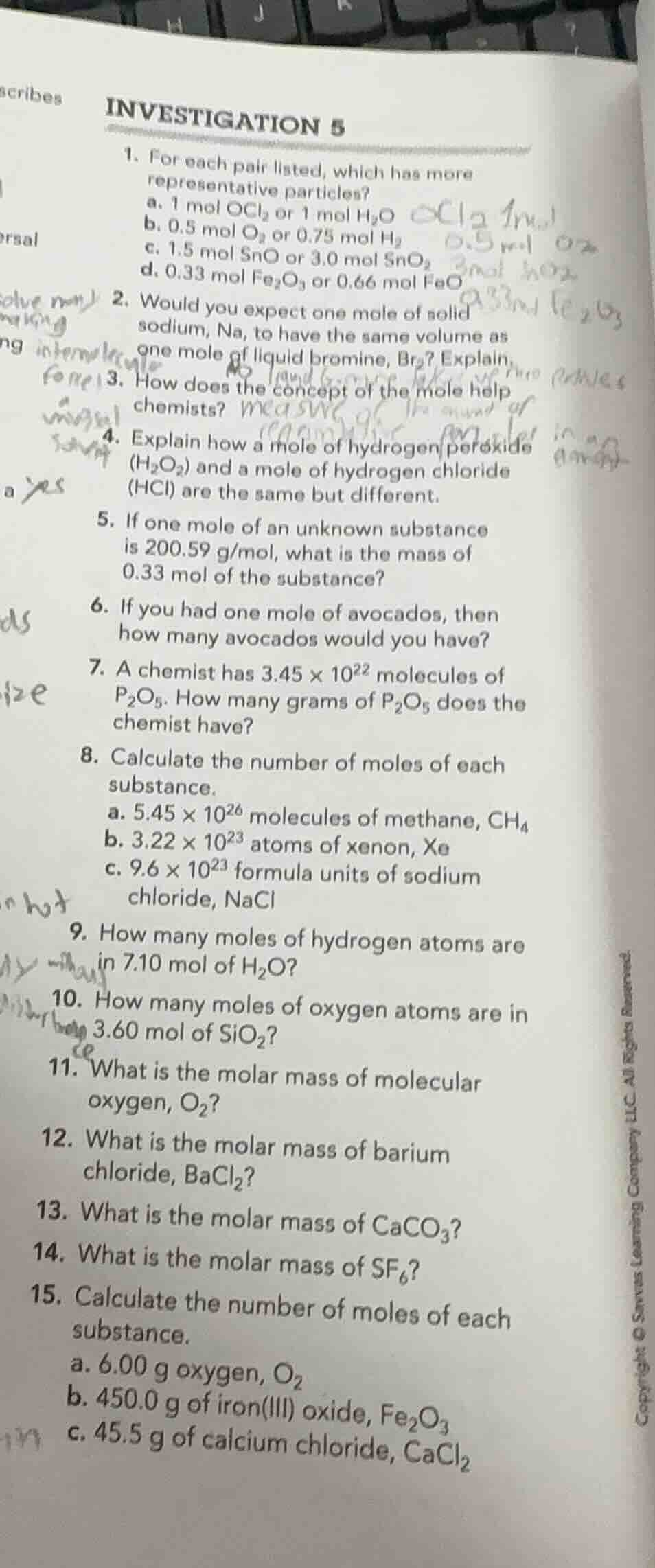
investigation 51. for each pair listed, which has more representative particles?a. 1 mol $\text{ocl}_2$ or 1 mol $\text{h}_2\text{o}$b. 0.5 mol $\text{o}_2$ or 0.75 mol $\text{h}_2$c. 1.5 mol $\text{sno}$ or 3.0 mol $\text{sno}_2$d. 0.33 mol $\text{fe}_2\text{o}_3$ or 0.66 mol $\text{feo}$2. would you expect one mole of solid sodium, $\text{na}$, to have the same volume as one mole of liquid bromine, $\text{br}_2$? explain.3. how does the concept of the mole help chemists?4. explain how a mole of hydrogen peroxide ($\text{h}_2\text{o}_2$) and a mole of hydrogen chloride ($\text{hcl}$) are the same but different.5. if one mole of an unknown substance is 200.59 g/mol, what is the mass of 0.33 mol of the substance?6. if you had one mole of avocados, then how many avocados would you have?7. a chemist has $3.45 \times 10^{22}$ molecules of $\text{p}_2\text{o}_5$. how many grams of $\text{p}_2\text{o}_5$ does the chemist have?8. calculate the number of moles of each substance.a. $5.45 \times 10^{26}$ molecules of methane, $\text{ch}_4$b. $3.22 \times 10^{23}$ atoms of xenon, $\text{xe}$c. $9.6 \times 10^{23}$ formula units of sodium chloride, $\text{nacl}$9. how many moles of hydrogen atoms are in 7.10 mol of $\text{h}_2\text{o}$?10. how many moles of oxygen atoms are in 3.60 mol of $\text{sio}_2$?11. what is the molar mass of molecular oxygen, $\text{o}_2$?12. what is the molar mass of barium chloride, $\text{bacl}_2$?13. what is the molar mass of $\text{caco}_3$?14. what is the molar mass of $\text{sf}_6$?15. calculate the number of moles of each substance.a. 6.00 g oxygen, $\text{o}_2$b. 450.0 g of iron(iii) oxide, $\text{fe}_2\text{o}_3$c. 45.5 g of calcium chloride, $\text{cacl}_2$
Question 1
Step1: Compare mole counts (equal moles)
1 mol of any substance has $6.022 \times 10^{23}$ particles. For a: 1 mol $\text{OCl}_2$ and 1 mol $\text{H}_2\text{O}$ have equal particles.
Step2: Compare mole counts (higher mole)
For b: $0.75 > 0.5$, so 0.75 mol $\text{H}_2$ has more particles.
Step3: Compare mole counts (higher mole)
For c: $3.0 > 1.5$, so 3.0 mol $\text{SnO}_2$ has more particles.
Step4: Calculate total particles per compound
For d: 0.33 mol $\text{Fe}_2\text{O}_3$ has $0.33 \times 5 = 1.65$ mol of particles; 0.66 mol $\text{FeO}$ has $0.66 \times 2 = 1.32$ mol of particles.
No, they would not have the same volume. Solids have much closer, tightly packed particles than liquids, and sodium (a solid) has a much higher density than liquid bromine. Molar volume depends on state of matter and density, so 1 mol of solid Na will have a far smaller volume than 1 mol of liquid $\text{Br}_2$.
The mole provides a standardized, measurable unit to convert between the microscopic (atoms/molecules) and macroscopic (mass/volume) scales. It lets chemists count large numbers of tiny particles using measurable mass values, making stoichiometry and chemical calculations feasible.

Snap & solve any problem in the app
Get step-by-step solutions on Sovi AI
Photo-based solutions with guided steps
Explore more problems and detailed explanations
a. They have the same number of representative particles
b. 0.75 mol $\text{H}_2$
c. 3.0 mol $\text{SnO}_2$
d. 0.33 mol $\text{Fe}_2\text{O}_3$
---