QUESTION IMAGE
Question
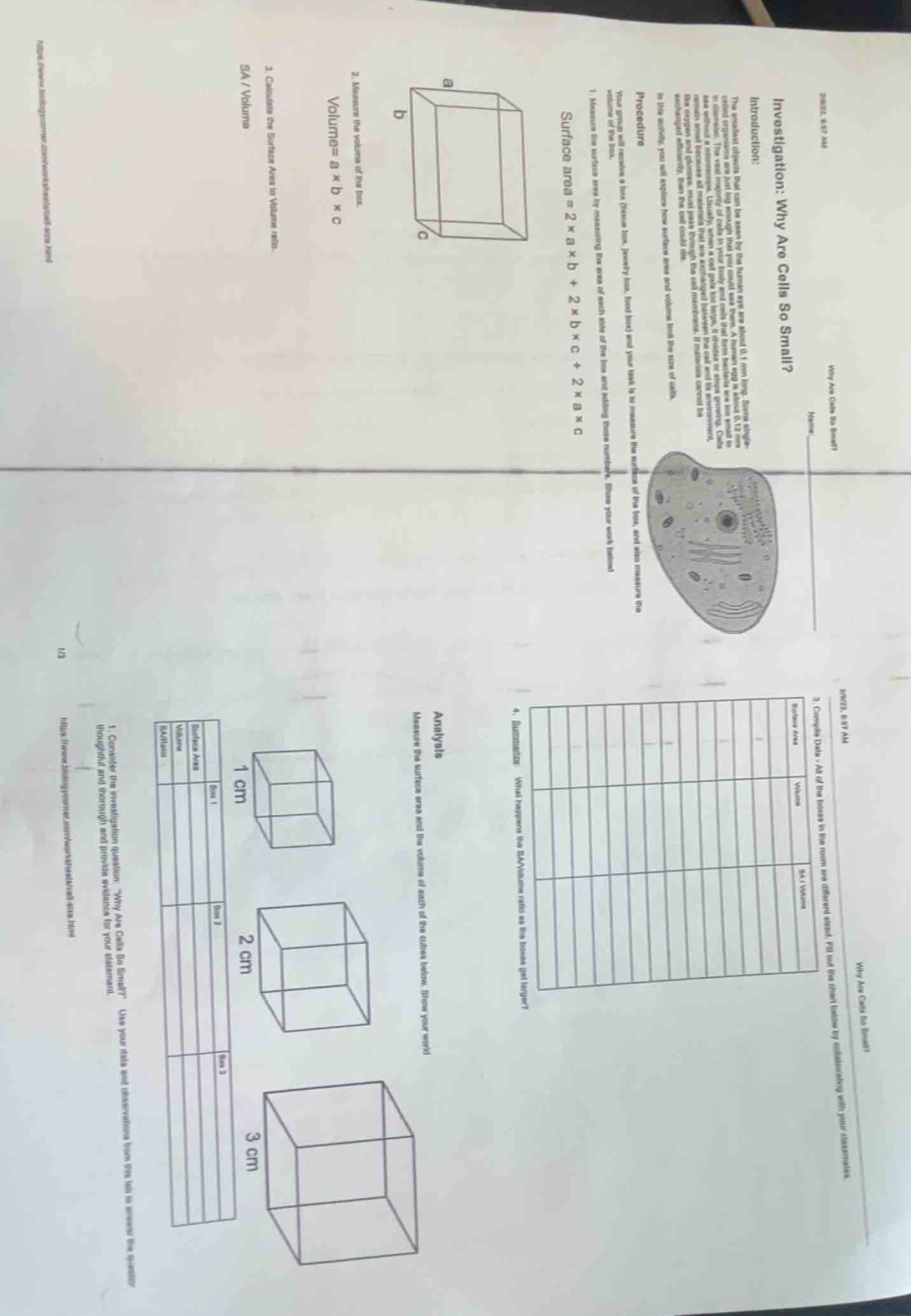
investigation: why are cells so small?
introduction:
the smallest objects that can be seen by the human eye are about 0.1 mm high. human beings are composed of cells. the vast majority of cells are too small to be seen by the naked eye. usually, they can only be seen under a microscope. a typical animal cell is about 0.01 mm in diameter, and a typical plant cell is about 0.02 mm in diameter. the size of cells is limited by the surface area to volume ratio. generally, the larger the cell, the smaller the surface area to volume ratio. therefore, the total surface area of the cell membrane will be insufficient to meet the needs of the cell for material exchange, and the cell will not be able to survive. in this activity, you will explore how surface area and volume limit the size of cells.
procedure
your group will receive a box (shoe box, jewelry box, food box) and your task is to measure the surface area of the box and also measure the volume of the box. then calculate the surface area to volume ratio.
- measure the surface area by measuring the area of each face of the box and adding them together. show your work below!
surface area = 2×a×b + 2×b×c + 2×a×c
- measure the volume of the box.
volume= a × b × c
- calculate the surface area to volume ratio.
sa/volume
analyze
measure the surface area and the volume of each of the cubes below. show your work!
- summarize: what happens to the sa/volume ratio as the boxes get larger?
- compile data - all the boxes in the room are different sizes. fill out the chart below by collaborating with your classmates.
- consider the investigation question: why are cells so small?
thoughtfully and thoroughly, and provide evidence for your statement. use your data and observations from this lab to answer the question.
Step1: Calculate SA for 1cm cube
Surface Area formula for cube: $SA = 6s^2$, where $s=1$ cm
$SA = 6\times(1)^2 = 6$ cm²
Step2: Calculate Volume for 1cm cube
Volume formula for cube: $V = s^3$, where $s=1$ cm
$V = (1)^3 = 1$ cm³
Step3: Calculate SA/Vol for 1cm cube
$\frac{SA}{V} = \frac{6}{1} = 6$
Step4: Calculate SA for 2cm cube
$SA = 6\times(2)^2 = 6\times4 = 24$ cm²
Step5: Calculate Volume for 2cm cube
$V = (2)^3 = 8$ cm³
Step6: Calculate SA/Vol for 2cm cube
$\frac{SA}{V} = \frac{24}{8} = 3$
Step7: Calculate SA for 3cm cube
$SA = 6\times(3)^2 = 6\times9 = 54$ cm²
Step8: Calculate Volume for 3cm cube
$V = (3)^3 = 27$ cm³
Step9: Calculate SA/Vol for 3cm cube
$\frac{SA}{V} = \frac{54}{27} = 2$
Step10: Summarize SA/Vol trend
As box size (side length) increases, the surface area to volume ratio decreases.
Step11: Answer core investigation question
Cells rely on surface area to exchange nutrients/waste with the environment. A higher SA/Vol ratio means more surface area per unit volume for efficient exchange. As cells grow larger, their SA/Vol ratio drops, making it impossible to exchange materials fast enough to support the cell's volume, so cells must stay small.

Snap & solve any problem in the app
Get step-by-step solutions on Sovi AI
Photo-based solutions with guided steps
Explore more problems and detailed explanations
Completed Data Table:
| Surface Area (cm²) | Volume (cm³) | SA / Volume | |
|---|---|---|---|
| Box 2 (2 cm) | 24 | 8 | 3 |
| Box 3 (3 cm) | 54 | 27 | 2 |
Summary:
As the boxes get larger, the surface area to volume ratio decreases.
Investigation Answer:
Cells are small because a small size maintains a high surface area to volume ratio. This high ratio is critical for efficient exchange of nutrients, oxygen, and waste products between the cell and its environment. If a cell were to grow too large, its surface area would not be sufficient to support the metabolic needs of its larger volume, leading to inefficient material exchange that cannot sustain the cell.