QUESTION IMAGE
Question
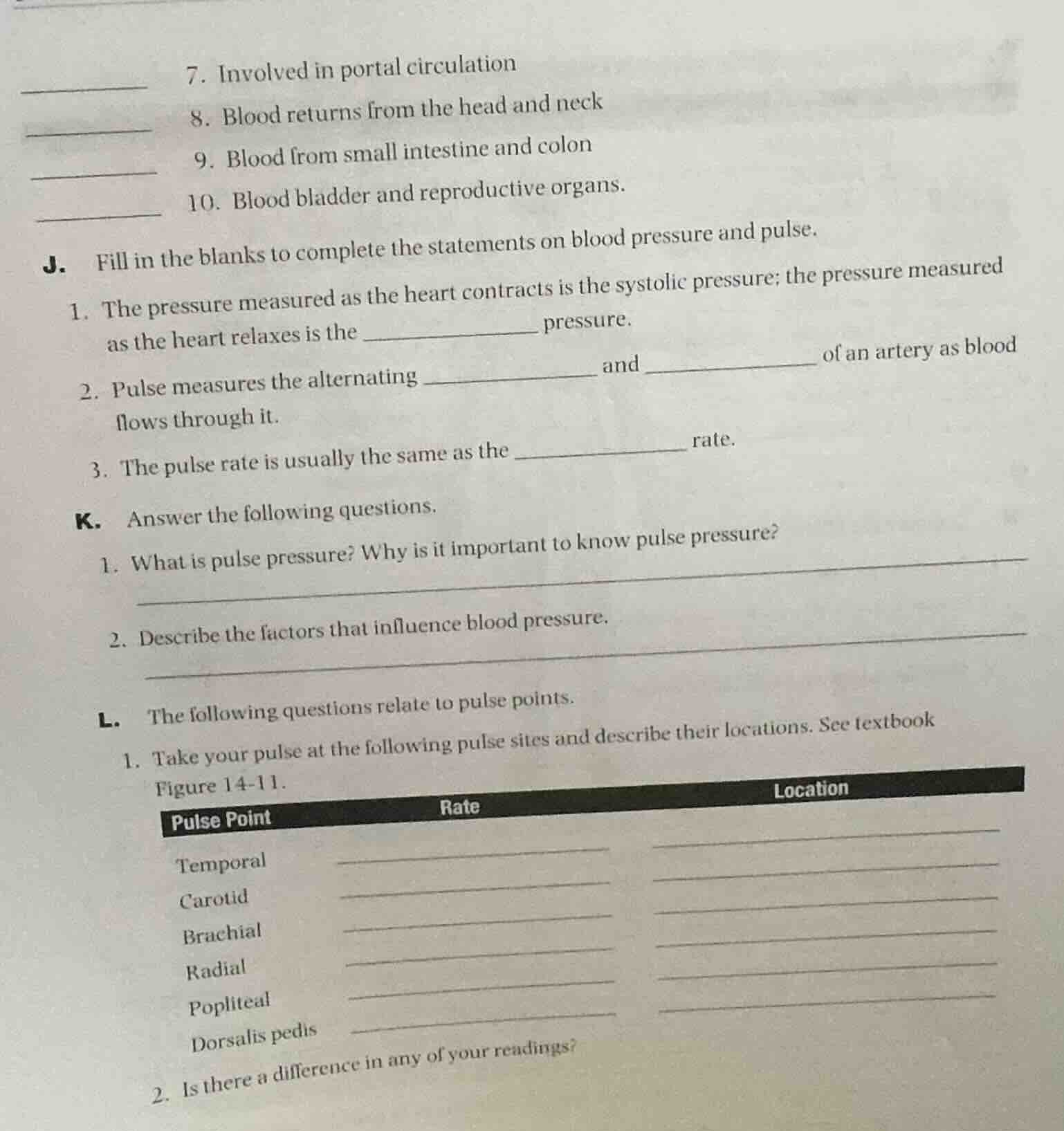
- involved in portal circulation
- blood returns from the head and neck
- blood from small intestine and colon
- blood bladder and reproductive organs.
j. fill in the blanks to complete the statements on blood pressure and pulse.
- the pressure measured as the heart contracts is the systolic pressure; the pressure measured as the heart relaxes is the __________ pressure.
- pulse measures the alternating ________ and ________ of an artery as blood flows through it.
- the pulse rate is usually the same as the __________ rate.
k. answer the following questions.
- what is pulse pressure? why is it important to know pulse pressure?
- describe the factors that influence blood pressure.
l. the following questions relate to pulse points.
- take your pulse at the following pulse sites and describe their locations. see textbook figure 14 - 11.
| pulse point | rate | location |
|---|---|---|
| carotid | ||
| brachial | ||
| radial | ||
| popliteal | ||
| dorsalis pedis |
- is there a difference in any of your readings?
Response
Section J (Fill in the Blanks)
Brief Explanations
- Blood pressure has two phases: systolic (heart contraction) and diastolic (heart relaxation).
- A pulse is the rhythmic expansion and recoil of an artery caused by blood flow from heart contractions.
- Each heart contraction generates a pulse, so pulse rate matches heart rate.
Brief Explanations
- Pulse pressure is the difference between systolic and diastolic blood pressure. It reflects heart function, artery stiffness, and blood flow efficiency, so it helps assess cardiovascular health.
- Blood pressure is influenced by cardiac output (heart rate and stroke volume), peripheral resistance (artery diameter, blood viscosity), blood volume, and vessel elasticity.
Brief Explanations
- Each pulse point corresponds to an artery close to the body's surface. Pulse rates at these sites should be identical in a healthy person.
- In a healthy individual, pulse rates across all sites should be the same. Differences may indicate a blockage or reduced blood flow in a vessel.

Snap & solve any problem in the app
Get step-by-step solutions on Sovi AI
Photo-based solutions with guided steps
Explore more problems and detailed explanations
- diastolic
- expansion; recoil
- heart
---