QUESTION IMAGE
Question
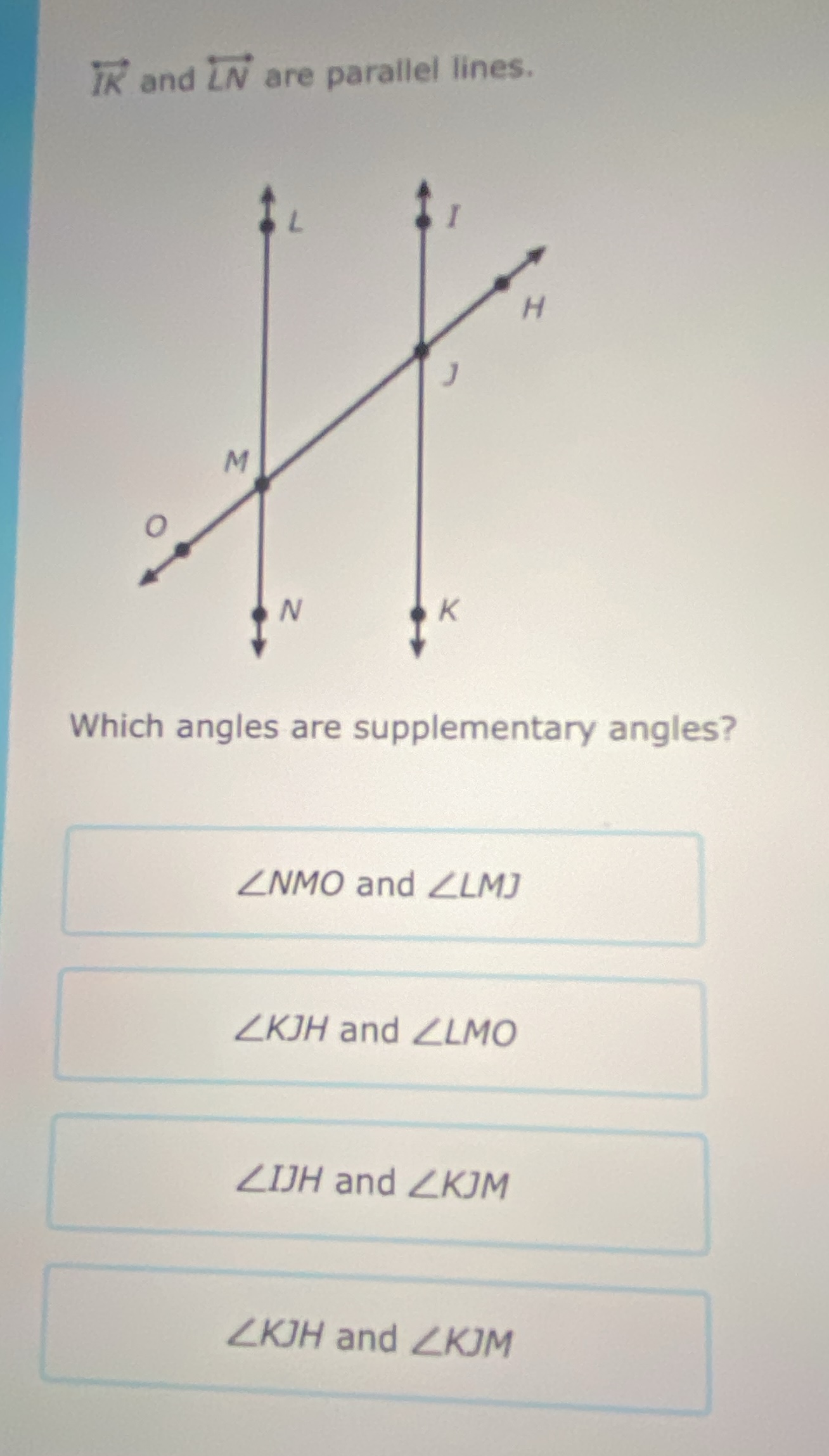
ir and ln are parallel lines.
which angles are supplementary angles?
∠nmo and ∠lmj
∠kjh and ∠lmo
∠ijh and ∠kjm
∠kjh and ∠kjm
- Recall the definition of supplementary angles: two angles whose sum is \(180^\circ\) (a straight angle).
- Analyze each option:
- Option 1: \(\angle NMO\) and \(\angle LMJ\) are vertical angles (equal), not supplementary (unless each is \(90^\circ\), not indicated here).
- Option 2: \(\angle KJH\) and \(\angle LMO\): Since \(IK \parallel LN\) and \(OH\) is a transversal, \(\angle LMO\) and \(\angle KJH\) – wait, no, let's check the lines. \(IK\) and \(LN\) are parallel, \(OH\) is a transversal. \(\angle KJH\) and \(\angle KJM\): Wait, no, let's check the last option. Wait, \(\angle KJH\) and \(\angle KJM\): Wait, \(\angle KJH\) and \(\angle KJM\) – wait, no, let's re - examine. Wait, \(\angle KJH\) and \(\angle KJM\): Wait, \(IK\) is a vertical line, \(OH\) is a transversal. \(\angle KJH\) and \(\angle KJM\): Wait, no, the last option is \(\angle KJH\) and \(\angle KJM\)? Wait, no, the fourth option is \(\angle KJH\) and \(\angle KJM\). Wait, actually, \(\angle KJH\) and \(\angle KJM\): Wait, no, let's think about the straight line. \(IK\) is a vertical line, and \(OH\) intersects it at \(J\). So \(\angle IJH\) and \(\angle KJH\) are supplementary, but in the options, let's check the fourth option: \(\angle KJH\) and \(\angle KJM\). Wait, no, maybe I made a mistake. Wait, let's check the angles:
Wait, \(\angle KJH\) and \(\angle KJM\): Wait, \(IK\) is a straight line (vertical), so the sum of \(\angle KJH\) and \(\angle KJM\) – no, wait, \(J\) is on \(IK\), so the line \(IK\) is straight, so the angle on a straight line is \(180^\circ\). Wait, \(\angle KJH\) and \(\angle KJM\): Wait, no, \(\angle KJH\) and \(\angle KJM\) – wait, maybe the correct option is \(\angle KJH\) and \(\angle KJM\)? Wait, no, let's check the options again.
Wait, the fourth option is \(\angle KJH\) and \(\angle KJM\). Let's see: \(IK\) is a vertical line, and \(OH\) passes through \(J\). So \(\angle KJH\) and \(\angle KJM\) – wait, no, \(\angle KJH\) and \(\angle IJH\) are supplementary, but \(\angle IJH\) and \(\angle KJM\) – no. Wait, maybe the correct option is \(\angle KJH\) and \(\angle KJM\)? Wait, no, let's re - evaluate.
Wait, supplementary angles sum to \(180^\circ\). Let's check each option:
- \(\angle NMO\) and \(\angle LMJ\): These are vertical angles (opposite angles formed by intersecting lines), so they are equal. Not supplementary (unless each is \(90^\circ\), not given).
- \(\angle KJH\) and \(\angle LMO\): \(\angle LMO\) and \(\angle KJH\) – since \(IK\parallel LN\), \(\angle LMO=\angle KJH\) (corresponding angles), so their sum is not \(180^\circ\) (unless each is \(90^\circ\)).
- \(\angle IJH\) and \(\angle KJM\): \(\angle IJH\) and \(\angle KJM\) – \(\angle IJH\) and \(\angle KJH\) are supplementary, but \(\angle KJM\) and \(\angle IJH\) – not necessarily.
- \(\angle KJH\) and \(\angle KJM\): Since \(IK\) is a straight line, the sum of \(\angle KJH\) and \(\angle KJM\) is \(180^\circ\) (they form a linear pair, angles on a straight line). So they are supplementary.

Snap & solve any problem in the app
Get step-by-step solutions on Sovi AI
Photo-based solutions with guided steps
Explore more problems and detailed explanations
\(\boldsymbol{\angle KJH}\) and \(\boldsymbol{\angle KJM}\) (the fourth option: \(\angle KJH\) and \(\angle KJM\))