QUESTION IMAGE
Question
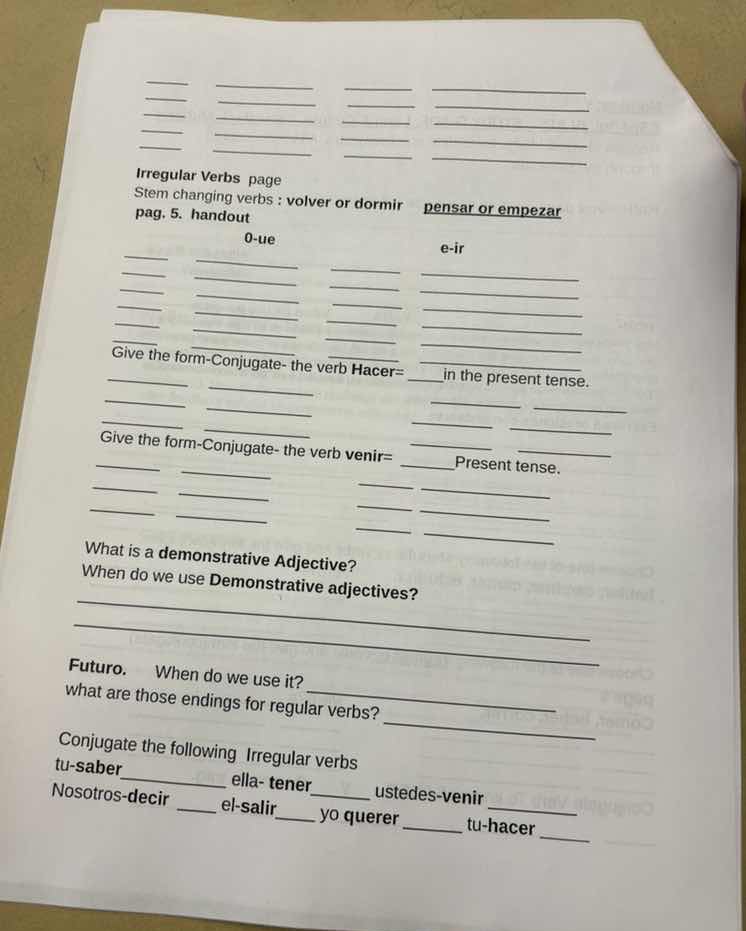
irregular verbs page
stem changing verbs : volver or dormir pensar or empezar
pag. 5. handout
o - ue e - ir
give the form - conjugate - the verb hacer = ____ in the present tense.
give the form - conjugate - the verb venir = ____ present tense.
what is a demonstrative adjective?
when do we use demonstrative adjectives?
futuro. when do we use it? ____
what are those endings for regular verbs? ____
conjugate the following irregular verbs
tu - saber __ ella - tener ustedes - venir __
nosotros - decir __ el - salir yo querer tu - hacer __
Stem-Changing Verbs (0-ue, e-ir)
- 0-ue (e.g., volver, dormir): These verbs change the stem vowel 'o' to 'ue' in all present tense forms except nosotros/as and vosotros/as.
- volver: vuelvo, vuelves, vuelve, volvemos, volvéis, vuelven
- dormir: duermo, duermes, duerme, dormimos, dormís, duermen
- e-ir (e.g., pensar, empezar): These verbs change the stem vowel 'e' to 'ie' in all present tense forms except nosotros/as and vosotros/as.
- pensar: pienso, piensas, piensa, pensamos, pensáis, piensan
- empezar: empiezo, empiezas, empieza, empezamos, empezáis, empiezan
Conjugations (Present Tense)
- Hacer: Irregular present tense verb with unique stem changes for most forms.
- Venir: Irregular present tense verb with a modified stem for most forms.
Demonstrative Adjectives
- Definition: Adjectives that point out specific nouns (near/far from speaker/listener).
- Usage: To indicate which specific person, place, thing, or idea is being referred to, based on proximity.
Futuro (Future Tense)
- Usage: To talk about actions/events that will happen later, predictions, or hypothetical situations.
- Regular verb endings: Added to the infinitive form of the verb, same for -ar, -er, -ir verbs.
Irregular Verb Conjugations (Present Tense)
Each verb has unique irregular present tense forms for the given subjects.

Snap & solve any problem in the app
Get step-by-step solutions on Sovi AI
Photo-based solutions with guided steps
Explore more problems and detailed explanations
Stem-Changing Verbs
0-ue (volver/dormir)
- vuelvo
- vuelves
- vuelve
- volvemos
- volvéis
- vuelven
(or for dormir: duermo, duermes, duerme, dormimos, dormís, duermen)
e-ir (pensar/empezar)
- pienso
- piensas
- piensa
- pensamos
- pensáis
- piensan
(or for empezar: empiezo, empiezas, empieza, empezamos, empezáis, empiezan)
Conjugate Hacer (Present Tense)
- yo hago
- tú haces
- él/ella/usted hace
- nosotros/as hacemos
- vosotros/as hacéis
- ellos/ellas/ustedes hacen
Conjugate Venir (Present Tense)
- yo vengo
- tú vienes
- él/ella/usted viene
- nosotros/as venimos
- vosotros/as venís
- ellos/ellas/ustedes vienen
Demonstrative Adjectives
- What is a demonstrative adjective?: A type of adjective used to point out or identify specific nouns, indicating their proximity to the speaker or listener.
- When do we use demonstrative adjectives?: We use them to specify which particular person, place, object, or idea we are referring to (e.g., to distinguish between "this book" and "that book").
Futuro
- When do we use it?: We use the future tense to describe actions, events, or states that will occur after the present moment, make predictions, or talk about hypothetical future situations.
- Regular verb endings: For all regular -ar, -er, -ir verbs, add the following endings to the full infinitive:
- yo: -é
- tú: -ás
- él/ella/usted: -á
- nosotros/as: -emos
- vosotros/as: -éis
- ellos/ellas/ustedes: -án
Irregular Verb Conjugations (Present Tense)
- tu-saber: sabes
- ella-tener: tiene
- ustedes-venir: vienen
- Nosotros-decir: decimos
- el-salir: sale
- yo querer: quiero
- tu-hacer: haces