QUESTION IMAGE
Question
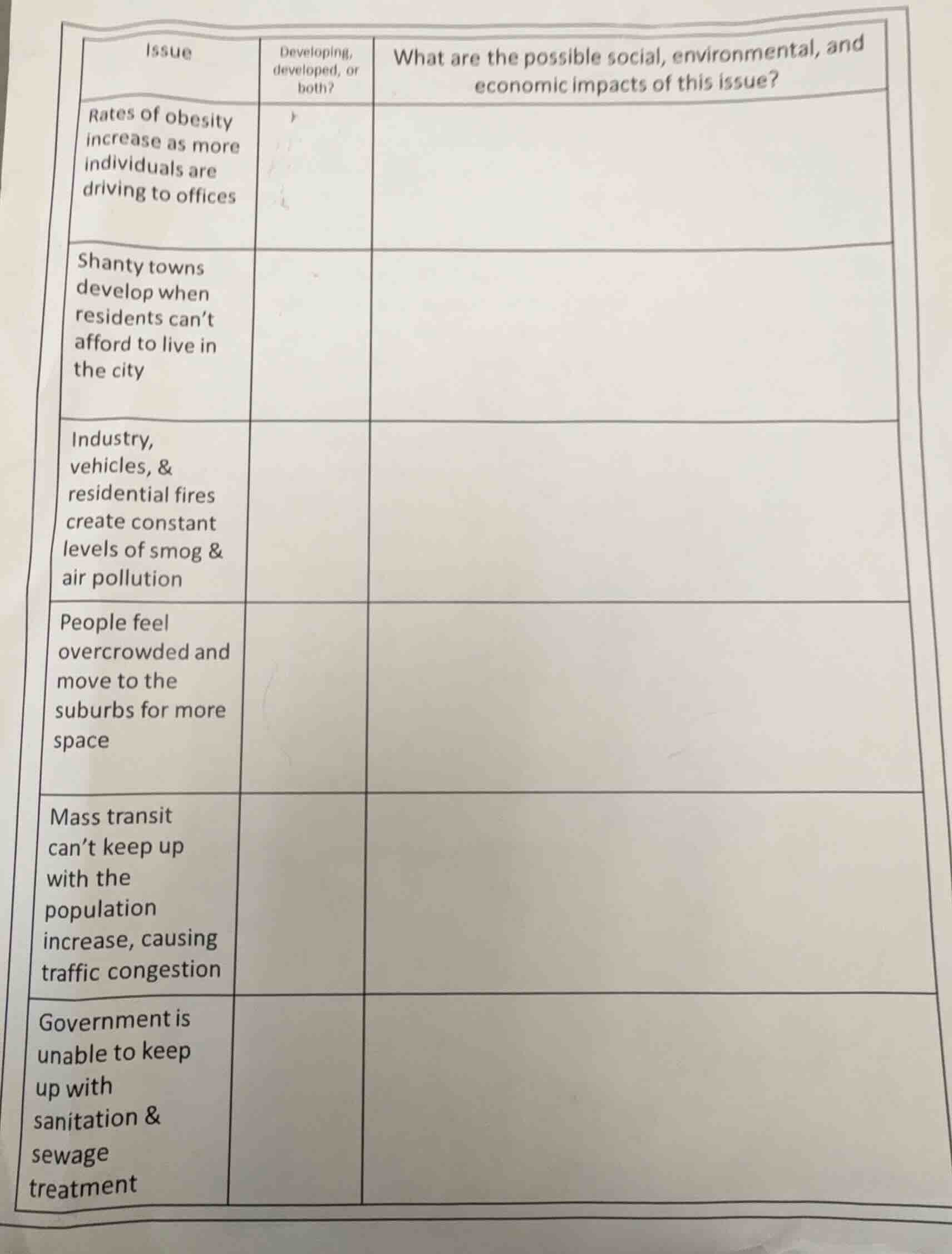
| issue | developing, developed, or both? | what are the possible social, environmental, and economic impacts of this issue? |
|---|---|---|
| shanty towns develop when residents can’t afford to live in the city | ||
| industry, vehicles, & residential fires create constant levels of smog & air pollution | ||
| people feel overcrowded and move to the suburbs for more space | ||
| mass transit can’t keep up with the population increase, causing traffic congestion | ||
| government is unable to keep up with sanitation & sewage treatment |
Brief Explanations
For each issue, the classification (developing, developed, both) and impacts are identified based on urban and public health patterns:
- Obesity from driving to offices: Common in developed nations with car-reliant commutes; impacts span health, healthcare costs, and productivity.
- Shanty towns from unaffordable city housing: Primarily a developing world issue tied to urbanization gaps; impacts include poor health, strained services, and informal economy growth.
- Smog/air pollution from industry/vehicles/fires: Affects both developed and developing regions, with different pollution sources; impacts include health crises, environmental damage, and economic losses.
- Suburban migration from overcrowding: Common in both contexts as cities grow; impacts include urban sprawl, increased emissions, and strained suburban infrastructure.
- Traffic congestion from underdeveloped mass transit: Affects both developed and developing areas with rapid population growth; impacts include lost productivity, emissions, and quality of life declines.
- Inadequate sanitation/sewage systems: Primarily a developing world issue with weak public infrastructure; impacts include disease outbreaks, environmental contamination, and healthcare burdens.

Snap & solve any problem in the app
Get step-by-step solutions on Sovi AI
Photo-based solutions with guided steps
Explore more problems and detailed explanations
| Issue | Developing, developed, or both? | What are the possible social, environmental, and economic impacts of this issue? |
|---|---|---|
| Shanty towns develop when residents can’t afford to live in the city | Developing | Social: High rates of infectious disease, limited access to education/healthcare, increased risk of crime. <br> Environmental: Unsafe waste disposal, contamination of local water sources, deforestation for informal housing. <br> Economic: Stagnant formal economic growth, reliance on informal low-wage work, strained public service budgets. |
| Industry, vehicles, & residential fires create constant levels of smog & air pollution | Both | Social: Higher rates of asthma, respiratory illnesses, and premature death; reduced quality of life. <br> Environmental: Acid rain, damage to plant/animal life, reduced air quality and visibility. <br> Economic: Increased healthcare costs, lost workdays, reduced tourism revenue. |
| People feel overcrowded and move to the suburbs for more space | Both | Social: Reduced access to urban public services, longer commute times, fragmented community ties. <br> Environmental: Urban sprawl, loss of green space, increased vehicle emissions and energy use. <br> Economic: Higher infrastructure costs for suburban roads/utilities, decline in urban business activity. |
| Mass transit can’t keep up with the population increase, causing traffic congestion | Both | Social: Increased stress, longer commute times, limited access to jobs/services for low-income groups. <br> Environmental: Higher greenhouse gas emissions, poor local air quality from idling vehicles. <br> Economic: Lost worker productivity, increased fuel costs, higher transportation infrastructure maintenance costs. |
| Government is unable to keep up with sanitation & sewage treatment | Developing | Social: High rates of waterborne diseases (cholera, typhoid), poor public health outcomes, reduced quality of life. <br> Environmental: Contamination of rivers/lakes, harm to aquatic ecosystems, soil pollution. <br> Economic: High healthcare costs, lost productivity from illness, reduced attractiveness for foreign investment. |