QUESTION IMAGE
Question
item #1
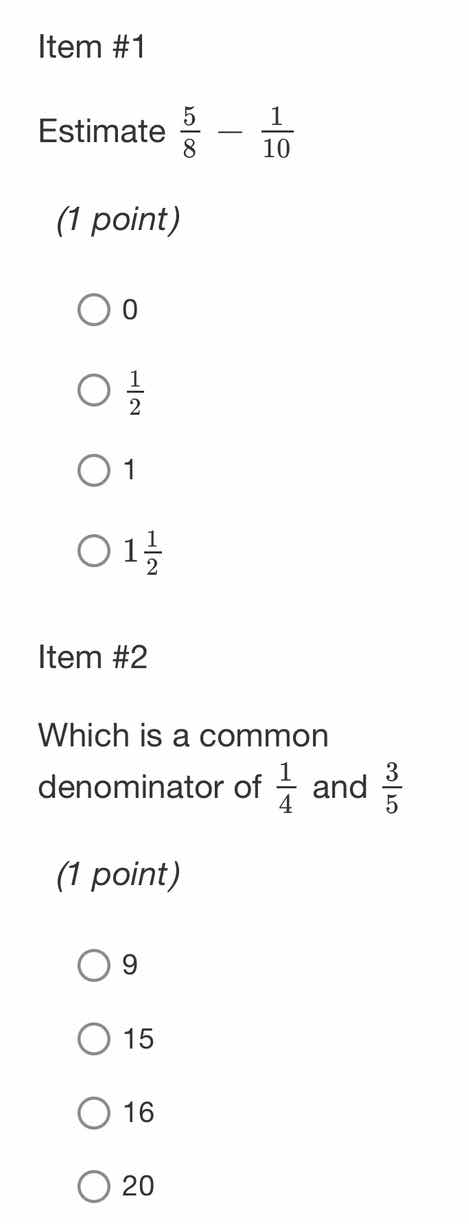
estimate \\(\frac{5}{8} - \frac{1}{10}\\)
(1 point)
\\(\bigcirc\\) 0
\\(\bigcirc\\) \\(\frac{1}{2}\\)
\\(\bigcirc\\) 1
\\(\bigcirc\\) \\(1\frac{1}{2}\\)
item #2
which is a common denominator of \\(\frac{1}{4}\\) and \\(\frac{3}{5}\\)
(1 point)
\\(\bigcirc\\) 9
\\(\bigcirc\\) 15
\\(\bigcirc\\) 16
\\(\bigcirc\\) 20
Item #1
Step1: Approximate $\frac{5}{8}$
$\frac{5}{8}$ is close to $\frac{1}{2}$ (since $\frac{4}{8}=\frac{1}{2}$ and 5 is close to 4) or we can also note that $\frac{5}{8} = 0.625$.
Step2: Approximate $\frac{1}{10}$
$\frac{1}{10}=0.1$.
Step3: Subtract the approximations
$0.625 - 0.1 = 0.525$, which is close to $\frac{1}{2}$.
Step1: Recall common denominator definition
A common denominator of two fractions is a common multiple of their denominators. The denominators here are 4 and 5.
Step2: Find LCM of 4 and 5
The prime factorization of 4 is $2\times2$ and of 5 is $5$. The LCM is $2\times2\times5 = 20$. Also, 20 is a multiple of both 4 (since $20\div4 = 5$) and 5 (since $20\div5 = 4$).

Snap & solve any problem in the app
Get step-by-step solutions on Sovi AI
Photo-based solutions with guided steps
Explore more problems and detailed explanations
$\frac{1}{2}$ (the option with $\frac{1}{2}$)