QUESTION IMAGE
Question
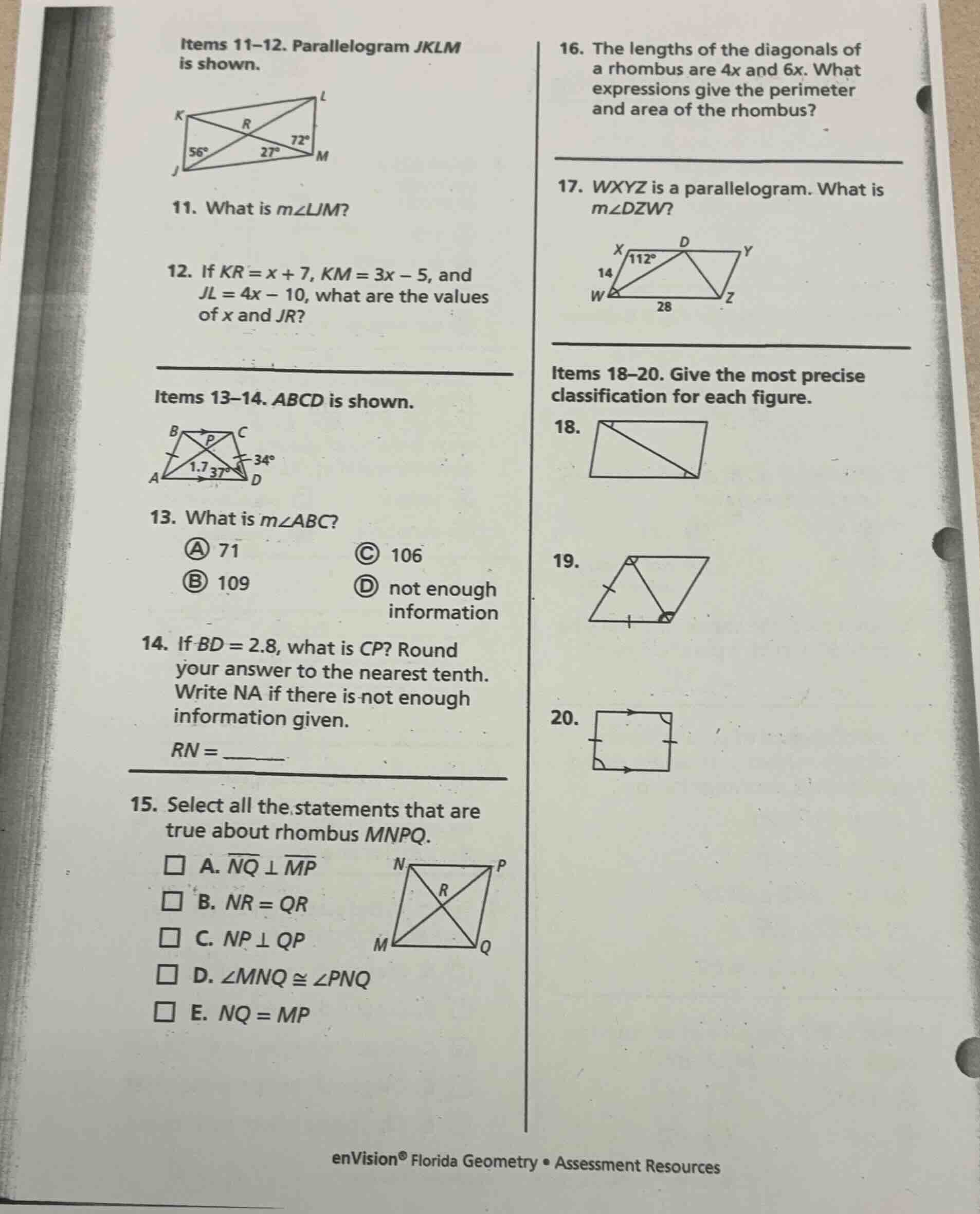
items 11–12. parallelogram jklm is shown.
- what is ( mangle ljm )?
- if ( kr = x + 7 ), ( km = 3x - 5 ), and ( jl = 4x - 10 ), what are the values of ( x ) and ( jr )?
items 13–14. abcd is shown.
- what is ( mangle abc )?
a 71 c 106
b 109 d not enough information
- if ( bd = 2.8 ), what is ( cp )? round your answer to the nearest tenth. write na if there is not enough information given.
( rn = _____ )
- select all the statements that are true about rhombus mnpq.
a. ( overline{nq} perp overline{mp} )
b. ( nr = qr )
c. ( np perp qp )
d. ( angle mnq cong angle pnq )
e. ( nq = mp )
- the lengths of the diagonals of a rhombus are ( 4x ) and ( 6x ). what expressions give the perimeter and area of the rhombus?
- wxyz is a parallelogram. what is ( mangle dzw )?
items 18–20. give the most precise classification for each figure.
18.
19.
20.
envision® florida geometry • assessment resources
Question 12 Solution:
Step1: Recall parallelogram diagonal property
In a parallelogram, diagonals bisect each other. So \( KR=\frac{1}{2}KM \) and \( JR = \frac{1}{2}JL \). Given \( KR=x + 7\) and \( KM=3x - 5\), we have \( x + 7=\frac{1}{2}(3x - 5) \).
Step2: Solve for \( x \)
Multiply both sides by 2: \( 2(x + 7)=3x - 5 \)
Expand left side: \( 2x+14 = 3x - 5 \)
Subtract \( 2x \) from both sides: \( 14=x - 5 \)
Add 5 to both sides: \( x = 19 \)
Step3: Find \( JR \)
First, find \( JL \) when \( x = 19 \): \( JL=4x - 10=4(19)-10=76 - 10 = 66 \)
Since \( JR=\frac{1}{2}JL \), \( JR=\frac{66}{2}=33 \)
Step1: Analyze the figure (ABCD)
From the diagram, we can see that triangle \( APD \) has angles \( 37^{\circ}\) and \( 34^{\circ}\). The sum of angles in a triangle is \( 180^{\circ}\), so the third angle \( \angle APD=180-(37 + 34)=109^{\circ}\). But in a parallelogram, adjacent angles are supplementary? Wait, no, let's look at the properties. Wait, actually, in the figure, \( ABCD \) has some markings. Wait, the angles at \( A \) and \( D \) in triangle \( APD \): Wait, maybe \( ABCD \) is a parallelogram? Wait, the markings show \( AB = CD \) (maybe? The diagram has marks). Wait, actually, in the triangle \( APD \), we have angles \( 37^{\circ}\) and \( 34^{\circ}\), so \( \angle PAD = 37^{\circ}\), \( \angle PDA=34^{\circ}\), so \( \angle BAD=37^{\circ}\), \( \angle ADC = 34^{\circ}+...\) Wait, no, maybe \( ABCD \) is a parallelogram, so \( \angle ABC + \angle BAD=180^{\circ}\)? Wait, no, let's recalculate. Wait, the angle at \( A \) in triangle \( APD \): \( \angle PAD = 37^{\circ}\), \( \angle PDA = 34^{\circ}\), so \( \angle APD=180 - 37 - 34 = 109^{\circ}\). But \( \angle BPC=\angle APD \) (vertical angles). Then, in quadrilateral \( ABCD \), if it's a parallelogram, \( AB\parallel CD \), \( AD\parallel BC \). Wait, maybe the angle \( \angle ABC \) is supplementary to the angle we found? Wait, no, the options are 71, 109, 106, or not enough. Wait, let's re - examine. The sum of \( 37^{\circ}\) and \( 34^{\circ}\) is \( 71^{\circ}\), and in a parallelogram, adjacent angles are supplementary? Wait, no, maybe \( \angle ABC=180-(37 + 34)=109^{\circ}\)? Wait, no, \( 37 + 34 = 71\), \( 180 - 71 = 109\)? Wait, no, maybe the triangle's angle is related to the parallelogram's angle. Wait, the correct answer is B (109). Let's check: In triangle \( APD \), angles are \( 37^{\circ}\) and \( 34^{\circ}\), so the angle adjacent to \( \angle ABC \) is \( 37 + 34 = 71^{\circ}\), so \( \angle ABC=180 - 71 = 109^{\circ}\)
Step1: Recall parallelogram diagonal property
In a parallelogram, diagonals bisect each other. So \( BP = PD=\frac{BD}{2}\). Given \( BD = 2.8\), so \( PD=\frac{2.8}{2}=1.4\). Also, from the diagram, \( AP = 1.7\) (marked). Wait, but what is \( CP \)? In a parallelogram, \( AP = CP \) (diagonals bisect each other). Wait, the diagram shows \( AP = 1.7\), so \( CP = 1.7\)? Wait, no, wait the problem says "If \( BD = 2.8\), what is \( CP \)? Round your answer to the nearest tenth. Write NA if there is not enough information given." Wait, maybe the figure is a parallelogram, so diagonals bisect each other, so \( AP = CP \). From the diagram, \( AP = 1.7\), so \( CP = 1.7\)

Snap & solve any problem in the app
Get step-by-step solutions on Sovi AI
Photo-based solutions with guided steps
Explore more problems and detailed explanations
\( x = 19 \), \( JR = 33 \)