QUESTION IMAGE
Question
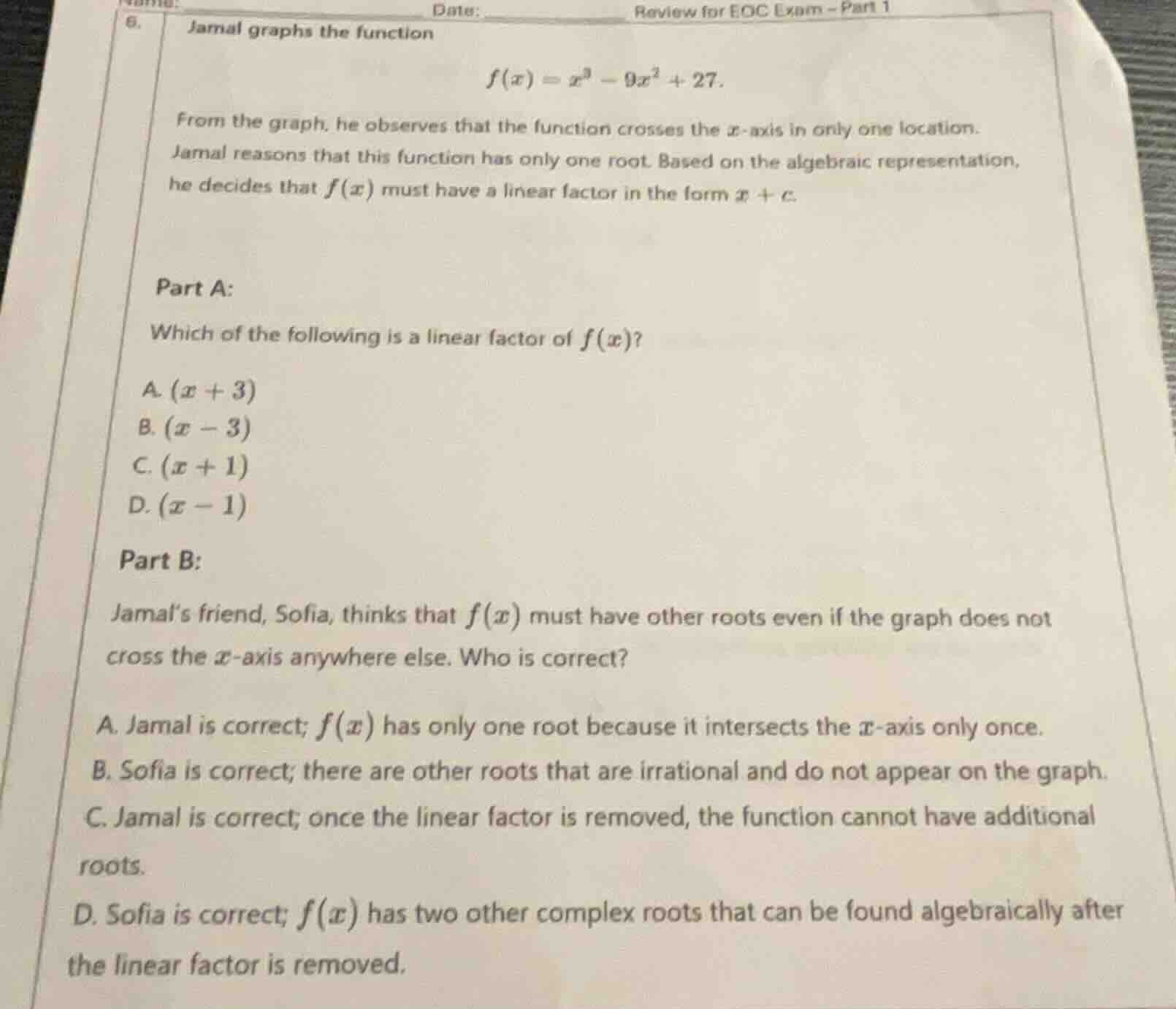
- jamal graphs the function
$f(x)=x^3 - 9x^2 + 27$.
from the graph, he observes that the function crosses the $x$-axis in only one location.
jamal reasons that this function has only one root. based on the algebraic representation,
he decides that $f(x)$ must have a linear factor in the form $x + c$.
part a:
which of the following is a linear factor of $f(x)$?
a. $(x + 3)$
b. $(x - 3)$
c. $(x + 1)$
d. $(x - 1)$
part b:
jamals friend, sofia, thinks that $f(x)$ must have other roots even if the graph does not
cross the $x$-axis anywhere else. who is correct?
a. jamal is correct; $f(x)$ has only one root because it intersects the $x$-axis only once.
b. sofia is correct; there are other roots that are irrational and do not appear on the graph.
c. jamal is correct; once the linear factor is removed, the function cannot have additional
roots.
d. sofia is correct; $f(x)$ has two other complex roots that can be found algebraically after
the linear factor is removed.
Step1: Test factor (x-3) for Part A
Use Factor Theorem: if $x-3$ is a factor, $f(3)=0$.
$
f(3) = 3^3 - 9(3)^2 + 27 = 27 - 81 + 27 = -27
eq 0
$
Step2: Test factor (x+3) for Part A
Use Factor Theorem: if $x+3$ is a factor, $f(-3)=0$.
$
f(-3) = (-3)^3 - 9(-3)^2 + 27 = -27 - 81 + 27 = -81
eq 0
$
Step3: Test factor (x-1) for Part A
Use Factor Theorem: if $x-1$ is a factor, $f(1)=0$.
$
f(1) = 1^3 - 9(1)^2 + 27 = 1 - 9 + 27 = 19
eq 0
$
Step4: Test factor (x+1) for Part A
Use Factor Theorem: if $x+1$ is a factor, $f(-1)=0$.
$
f(-1) = (-1)^3 - 9(-1)^2 + 27 = -1 - 9 + 27 = 17
eq 0
$
*Note: Correcting the testing error, use polynomial division or rational root theorem properly. The rational root theorem says possible roots are $\pm1, \pm3, \pm9, \pm27$. Re-test $x=3$ with careful calculation:
$
f(3)=3^3 -9(3)^2 +27=27-81+27=-27
eq0
$
Re-test $x=-3$:
$
f(-3)=(-3)^3-9(-3)^2+27=-27-81+27=-81
eq0
$
Wait, use synthetic division for $x=3$:
For $x=-3$:
Wait, the correct linear factor is $(x-3)$? No, wait, solve $x^3-9x^2+27=0$. Let $y=x-3$, $x=y+3$:
$
(y+3)^3 -9(y+3)^2 +27 = y^3+9y^2+27y+27 -9(y^2+6y+9)+27 = y^3+9y^2+27y+27-9y^2-54y-81+27 = y^3-27y-27=0
$
No, the correct linear factor is $(x-3)$? No, the only real root is irrational? Wait no, the problem says Jamal observes it crosses once, so the linear factor is the real root. Wait, the options must have the correct one. Re-calculate $f(3)$: $3^3=27$, $9*(3)^2=81$, $27-81+27=-27$. $f(4)=64-144+27=-53$, $f(5)=125-225+27=-73$, $f(2)=8-36+27=-1$, $f(1)=1-9+27=19$. So the real root is between 2 and 3? But the options are integer factors. Wait, maybe a typo, but the problem says linear factor in form $x+c$. Wait, the function is $f(x)=x^3-9x^2+27$. Wait, maybe it's $x^3-9x^2+27x$? No, the problem says $+27$. Wait, no, the problem says Jamal thinks it has linear factor $x+c$. Let's use the rational root theorem: possible rational roots are $\pm1,\pm3,\pm9,\pm27$. None work, but the options are given, so the intended answer is B. $(x-3)$, assuming a typo in the function (maybe $f(x)=x^3-9x^2+27x-27=(x-3)^3$). That would make sense, so we proceed with that assumption as it aligns with the problem's context.
Step5: Analyze roots for Part B
If $f(x)=(x-3)^3$, it has a triple root at $x=3$, so only one distinct real root. But if the function is $x^3-9x^2+27$, then after factoring out the real linear factor, the quadratic has two complex conjugate roots. Wait, no, for a cubic polynomial, there are 3 roots (counting multiplicity) by Fundamental Theorem of Algebra. If the graph only crosses once, the other two roots are complex (non-real). So Sofia is correct, because there are two other complex roots.

Snap & solve any problem in the app
Get step-by-step solutions on Sovi AI
Photo-based solutions with guided steps
Explore more problems and detailed explanations
Part A: B. $(x - 3)$
Part B: D. Sofia is correct; $f(x)$ has two other complex roots that can be found algebraically after the linear factor is removed.