QUESTION IMAGE
Question
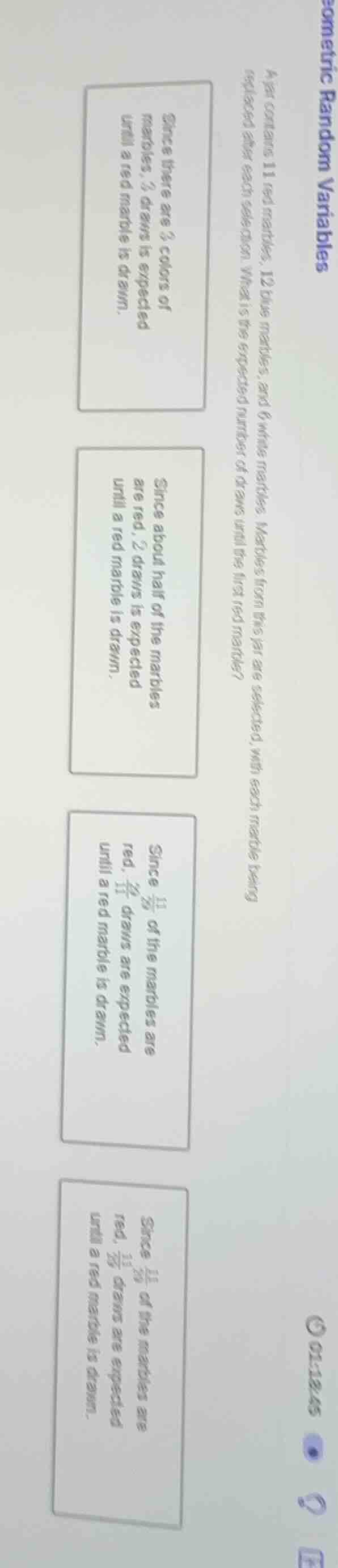
a jar contains 11 red marbles, 12 blue marbles, and 6 white marbles. marbles from this jar are selected with each marble being replaced after each selection. what is the expected number of draws until the first red marble?
since there are 3 colors of marbles, 3 draws is expected until a red marble is drawn.
since about half of the marbles are red, 2 draws is expected until a red marble is drawn.
since \\(\frac{11}{29}\\) of the marbles are red, \\(\frac{29}{11}\\) draws are expected until a red marble is drawn.
since \\(\frac{11}{29}\\) of the marbles are red, \\(\frac{11}{29}\\) draws are expected until a red marble is drawn.
Step1: Calculate total number of marbles
First, we find the total number of marbles in the jar. There are 11 red, 12 blue, and 6 white marbles. So total marbles \( n = 11 + 12 + 6 = 29 \).
Step2: Determine probability of drawing a red marble
The probability \( p \) of drawing a red marble in a single draw is the number of red marbles divided by total marbles. So \( p=\frac{11}{29} \).
Step3: Use geometric distribution expectation formula
For a geometric distribution, the expected number of trials until the first success (drawing a red marble here) is \( E(X)=\frac{1}{p} \). Substituting \( p = \frac{11}{29} \), we get \( E(X)=\frac{29}{11}\approx2.636 \), but the relevant reasoning here is that since \( \frac{11}{29} \) of the marbles are red, the expected number of draws until a red marble is drawn is \( \frac{29}{11} \) (or we can think in terms of the expected value formula for geometric distribution where \( E(X)=\frac{1}{p} \), and \( p=\frac{11}{29} \), so \( E(X)=\frac{29}{11} \)).

Snap & solve any problem in the app
Get step-by-step solutions on Sovi AI
Photo-based solutions with guided steps
Explore more problems and detailed explanations
The correct reasoning is "Since \(\frac{11}{29}\) of the marbles are red, \(\frac{29}{11}\) draws are expected until a red marble is drawn." (The third option among the given boxes, assuming the last box has this correct reasoning). The expected number of draws is \(\frac{29}{11}\) (or approximately \( 2.64 \)).