QUESTION IMAGE
Question
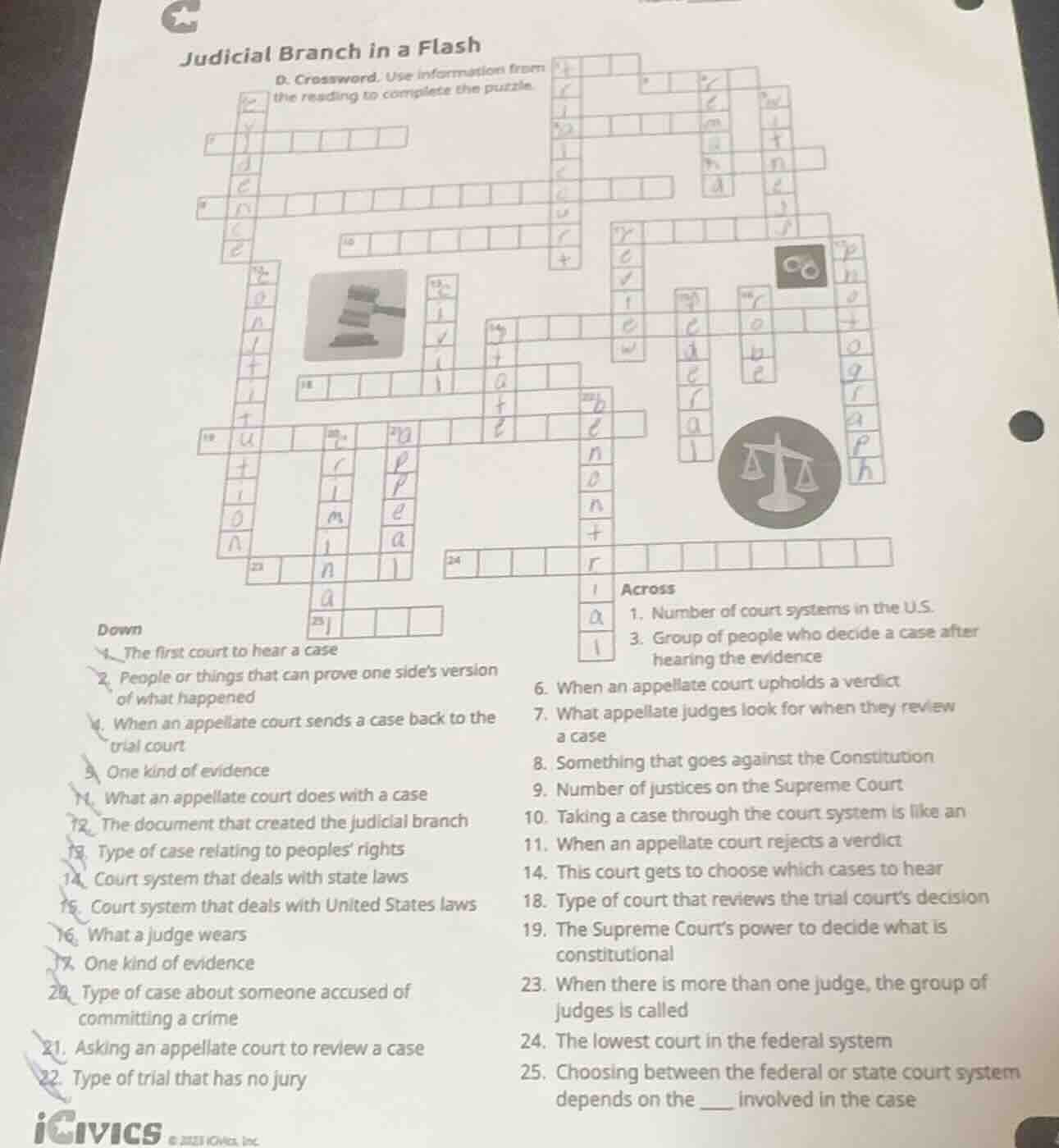
judicial branch in a flash
d. crossword. use information from
the reading to complete the puzzle.
down
- the first court to hear a case
- people or things that can prove one side’s version
of what happened
- when an appellate court sends a case back to the
trial court
- one kind of evidence
- what an appellate court does with a case
- the document that created the judicial branch
- type of case relating to peoples’ rights
- court system that deals with state laws
- court system that deals with united states laws
- what a judge wears
- one kind of evidence
- type of case about someone accused of
committing a crime
- asking an appellate court to review a case
- type of trial that has no jury
across
- number of court systems in the u.s.
- group of people who decide a case after
hearing the evidence
- when an appellate court upholds a verdict
- what appellate judges look for when they review
a case
- something that goes against the constitution
- number of justices on the supreme court
- taking a case through the court system is like an
- when an appellate court rejects a verdict
- this court gets to choose which cases to hear
- type of court that reviews the trial court’s decision
- the supreme court’s power to decide what is
constitutional
- when there is more than one judge, the group of
judges is called
- the lowest court in the federal system
- choosing between the federal or state court system
depends on the ___ involved in the case
Brief Explanations
Each answer is matched to the crossword clue based on U.S. judicial branch terminology:
- U.S. has 2 parallel court systems (state + federal).
- Evidence proves facts of a case.
- Jury decides a case after hearing evidence.
- Remand means sending a case back to trial court.
- Testimony is verbal evidence from a witness.
- Affirm means an appellate court upholds a verdict.
- Appellate judges review for legal errors.
- Unconstitutional means violating the Constitution.
- The U.S. Supreme Court has 9 justices.
- Navigating courts is like a legal process.
- Reverse means an appellate court rejects a verdict.
- The U.S. Constitution created the judicial branch.
- Civil cases involve people's rights/disputes.
- The Supreme Court chooses its own cases.
- State court system handles state laws.
- Federal court system handles U.S. federal laws.
- A judge wears a robe in court.
- Appellate courts review trial court decisions.
- Judicial review is the Supreme Court's power to check constitutionality.
- Criminal cases involve accused lawbreakers.
- Appeal is asking an appellate court to review a case.
- Bench trial has no jury, decided by a judge.
- A panel is a group of appellate judges.
- District Courts are the lowest federal courts.
- Choosing state/federal court depends on the case's subject matter.

Snap & solve any problem in the app
Get step-by-step solutions on Sovi AI
Photo-based solutions with guided steps
Explore more problems and detailed explanations
Down
- TRIAL
- EVIDENCE
- REMAND
- TESTIMONY
- REVIEWS
- CONSTITUTION
- CIVIL
- STATE
- FEDERAL
- ROBE
- CRIMINAL
- APPEAL
- BENCH
Across
- TWO
- JURY
- AFFIRM
- ERRORS
- UNCONSTITUTIONAL
- NINE
- PROCESS
- REVERSE
- SUPREME
- APPELLATE
- JUDICIAL REVIEW
- PANEL
- DISTRICT
- SUBJECT